

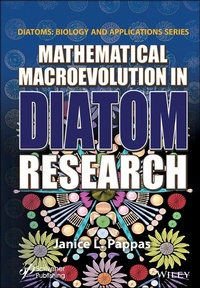
The Mathematical Biology of Diatoms
Description
The mathematical research in this volume may be applicable to studies of other unicells, biomechanics, biological processes, physio-chemical analyses, or nanoscience.
The work contained in this volume is an eclectic mix of analytical studies on diatoms. Mathematical treatment of the various biological disciplines covered in this book range from implicit, but succinct studies to more elaborate detailed computational studies. Topics include growth models, nanostructure, nanoengineering, cell growth, araphid diatoms, valve ontogeny, diatom metabolism, diatom motility, synchronization, diatom kinematics, photonics, biogenic sensors, photochemistry, diatom light response, colony growth, siliceous unicells, algal kinetics, diatom structure, diatom imaging, functional morphology, geometric structure, biomineralization, high-resolution imaging, non-destructive imaging, and 3D structure. This wide-ranging volume provides an introductory as well as an advanced treatment of recent interests in diatom research.
The mathematical research in this volume may be applicable to studies of other unicells, biomechanics, biological processes, physio-chemical analyses, or nanoscience.
More details
Other editions
Additional editions


Person
Richard Gordon's involvement with diatoms goes back to 1970 with his capillarity model for their gliding motility, published in the Proceedings of the National Academy of Sciences of the United States of America. He later worked on a diffusion-limited aggregation model for diatom morphogenesis, which led to the first paper ever published on diatom nanotechnology in 1988. He organized the first workshop on diatom nanotech in 2003. His other research is on computed tomography algorithms, HIV/AIDS prevention, and embryogenesis. See: https://en.wikipedia.org/wiki/Richard_Gordon_ (theoretical_biologist).
<b>Janice L. Pappas</b> has BA, BS and PhD degrees from the University of Michigan and a MA degree from Drake University. She is a mathematical biologist researching diatoms and invertebrates. She is a Great Lakes aquatic ecologist with studies on-board research vessels and in the lab, resulting in computational analyses of fish distributions in coastal wetlands and ecological informatics analysis of phytoplankton seasonal succession. Other studies include applications to diatom studies using Morse theory and morphospace dynamics, fuzzy measures in systematics, vector spaces in ecological analysis, information theory and Hamiltonian mechanics in morphogenesis, optimization, group and probability theory in macroevolutionary processes, and applied computer vision techniques in diatom imaging studies.
<b>Richard Gordon's</b> involvement with diatoms goes back to 1970 with his capillarity model for their gliding motility, published in the Proceedings of the National Academy of Sciences of the United States of America. He later worked on a diffusion-limited aggregation model for diatom morphogenesis, which led to the first paper ever published on diatom nanotechnology in 1988. He organized the first workshop on diatom nanotech in 2003. His other research is on computed tomography algorithms, HIV/AIDS prevention, and embryogenesis. See: https://en.wikipedia.org/wiki/Richard_Gordon_ (theoretical_biologist).