

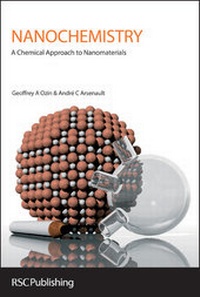
Nanochemistry
A Chemical Approach to Nanomaterials
Published on 6. October 2005
Book
Hardback
641 pages
978-0-85404-664-5 (ISBN)
Description
International interest in nanoscience research has flourished in recent years, as it becomes an integral part in the development of future technologies. The diverse, interdisciplinary nature of nanoscience means effective communication between disciplines is pivotal in the successful utilization of the science. Nanochemistry: A Chemical Approach to Nanomaterials is the first textbook for teaching nanochemistry and adopts an interdisciplinary and comprehensive approach to the subject. It presents a basic chemical strategy for making nanomaterials and describes some of the principles of materials self-assembly over 'all' scales. It demonstrates how nanometre and micrometre scale building blocks (with a wide range of shapes, compositions and surface functionalities) can be coerced through chemistry to organize spontaneously into unprecedented structures, which can serve as tailored functional materials. Suggestions of new ways to tackle research problems and speculations on how to think about assembling the future of nanotechnology are given. Primarily designed for teaching, this book will appeal to graduate and advanced undergraduate students. It is well illustrated with graphical representations of the structure and form of nanomaterials and contains problem sets as well as other pedagogical features such as further reading, case studies and a comprehensive bibliography.
Reviews / Votes
I have used your Nanochemistry book as my textbook for agraduate level ChE course introducing material self-assembly. Studentsliked the topic and the book a lot. I followed your book and the courseevaluation is excellent (4.8/5.0). I will teach the same class inSpring'08 semester and will use the same book as the textbook. Thanks forproviding such a great book for the society. - Peng Jiang * Chemical Engineering Department, August 2007 (Peng Jiang) * ...to this wonderful book written....insightful perspective on nanochemistry.Strongly recommend this book (only 39.95 for a hardcover copy!) to every student and researcher on materials chemistry, physics, materials science, engineering and biology. * Physical Sciences Educational Reviews, October 2006, Vol. 7, Issue 2 (Yang Gan) * A gem in the scientific literature...a beautifully written and richly illustrated book that is unlike any other.Ozin and Arsenault should be congratulated for their groundbreaking book. Reading it will reward students in chemistry and materials science as well as researchers from many different disciplines. * Science, 21 July 2006, Vol 313 (Michael W Pitcher) * Nanochemistry will be an invaluable reference book for undergraduate and graduate students looking for an easy way to educate themselves with the up-to-date advances made in chemical patterning, self-assembly, and nanomaterial synthesis....a superb textbook. * Advance Materials, 2006, 18, 1774-1776 (Benjamin Wiley and Younan Xia) * An invaluable reference book for undergraduate and graduate students. As a superb textbook for teaching of materials chemistry and nanotechnology. * Advanced Materials, 1/2006 (Benjamin Wiley) * This book is well worth buying. It is a kaleidoscopic compendium of the achievements of chemists working with materials scientists and physicists. * The Times Higher Educational Supplement, 24 February 2006 (Trevor Rayment) * Well-written and informative introductions to all aspects of the field that have a major chemistry component.This book can be highly recommended to develop and accompany courses for chemistry students * Nanotoday, May 2006, Volume 1, No. 2 (Mathias Brust) * Excellent features of the book make it a useful, practical tool for teachers of materials chemistry, to this reviewer's joy.As materials chemistry spreads through every domain of modern chemical research and into all sectors of the industry, chemistry practitioners would do well to find the time to read this seminal book. * The Chemical Educator, Vol.11, No. 1, 2006 (Mario Pagliaro) * The book succeeds in its goal of presenting concepts useful to create functional solid-state nanostructures that will likely be helpful for applications in several fields of modern science such as electronics, photonics, batteries, solar cells, fuel cells, and chemical storage and release. * Small, 2006, 2, No.5, 678-679 (Vincenzo Balzani) * "A text that covers all the basic concepts of nanoscale chemistry and materials science, and sets them in their historical context, has been long overdue. But here it is - not just a comprehensive guide to the field, but a recipe book for the future. Nanoengineers, start here!" * Philip Ball, winner of the 2005 Aventis Prize *More details
Language
English
Place of publication
Cambridge
United Kingdom
Target group
Professional and scholarly
Acadmics, graduate and advanced undergraduate students of chemistry, nanochemistry and materials science Chemistry/Food Science, general, Materials Science, Biomaterials, Nanotechnology, Nanochemistry, Nanotechnology, Nanomaterials
Product notice
Unsewn / adhesive bound
Illustrations
Not illustrated
Dimensions
Height: 234 mm
Width: 156 mm
Weight
1560 gr
ISBN-13
978-0-85404-664-5 (9780854046645)
Copyright in bibliographic data and cover images is held by Nielsen Book Services Limited or by the publishers or by their respective licensors: all rights reserved.
Schweitzer Classification
Other editions
New editions
Book
12/2008
2nd Edition
RSC Publishing
€59.00
Shipment within 15-20 days
Persons
Geoff Ozin, University of Toronto, Canada / A Arsenault, University of Toronto, Canada
Content
Preface - In the Beginning there was Nano; Nanochemistry Basics; Chemical Patterning and Lithography; Layer-By-Layer Self-Assembly; Nanocontact Printing and Writing; Nanorod, Nanotube, Nanowire Self-Assembly; Nanocluster Self-Assembly; Microspheres - Colours from the Beaker; Microporous and Mesoporous Materials; Self-Assembling Block Copolymers; Biomaterials and Bioinspiration; Self-Assembly of Large Building Blocks; Nano and Beyond; Nanochemistry and Nanolabs; Subject Index