

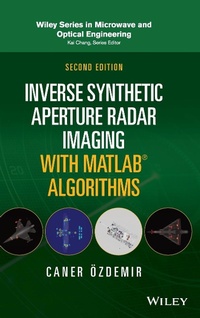
Inverse Synthetic Aperture Radar Imaging with MATLAB Algorithms
2nd Edition
Published on 30. June 2021
Book
Hardback
560 pages
978-1-119-52133-4 (ISBN)
Description
Build your knowledge of SAR/ISAR imaging with this comprehensive and insightful resource
The newly revised Second Edition of Inverse Synthetic Aperture Radar Imaging with MATLAB Algorithms covers in greater detail the fundamental and advanced topics necessary for a complete understanding of inverse synthetic aperture radar (ISAR) imaging and its concepts. Distinguished author and academician, Caner Özdemir, describes the practical aspects of ISAR imaging and presents illustrative examples of the radar signal processing algorithms used for ISAR imaging. The topics in each chapter are supplemented with MATLAB codes to assist readers in better understanding each of the principles discussed within the book.
This new edition incudes discussions of the most up-to-date topics to arise in the field of ISAR imaging and ISAR hardware design. The book provides a comprehensive analysis of advanced techniques like Fourier-based radar imaging algorithms, and motion compensation techniques along with radar fundamentals for readers new to the subject.
The author covers a wide variety of topics, including:
* Radar fundamentals, including concepts like radar cross section, maximum detectable range, frequency modulated continuous wave, and doppler frequency and pulsed radar
* The theoretical and practical aspects of signal processing algorithms used in ISAR imaging
* The numeric implementation of all necessary algorithms in MATLAB
* ISAR hardware, emerging topics on SAR/ISAR focusing algorithms such as bistatic ISAR imaging, polarimetric ISAR imaging, and near-field ISAR imaging,
* Applications of SAR/ISAR imaging techniques to other radar imaging problems such as thru-the-wall radar imaging and ground-penetrating radar imaging
Perfect for graduate students in the fields of electrical and electronics engineering, electromagnetism, imaging radar, and physics, Inverse Synthetic Aperture Radar Imaging With MATLAB Algorithms also belongs on the bookshelves of practicing researchers in the related areas looking for a useful resource to assist them in their day-to-day professional work.
More details
Other editions
Additional editions
E-Book
03/2021
2nd Edition
Wiley
€121.99
Available for download
E-Book
03/2021
2nd Edition
Wiley
€121.99
Available for download
Previous edition
Book
03/2012
Wiley
€132.50
Shipment within 10-20 days
Person
CANER ÖZDEMIR, PHD, teaches undergraduate and graduate courses on electromagnetics, antennas, radar, and signal processing at Mersin University in Turkey. He has published over 150 scientific journal articles and is the recipient of the URSI EMT-S Young Scientist Award in the 2004 International Symposium on Electromagnetic Theory, as well as the 2016 Best Paper Award in SPIE-Journal of Applied Remote Sensing.
Content
Preface to the Second Edition
Acknowledgments
Acronyms
1 Basics of Fourier Analysis
1.1 Forward and Inverse Fourier Transform
1.1.1 Brief History of Fourier Transform
1.1.2 Forward FT Operation
1.1.3 IFT
1.2 FT Rules and Pairs
1.2.1 Linearity
1.2.2 Time Shifting
1.2.3 Frequency Shifting
1.2.4 Scaling
1.2.5 Duality
1.2.6 Time Reversal
1.2.7 Conjugation
1.2.8 Multiplication
1.2.9 Convolution
1.2.10 Modulation
1.2.11 Derivation and Integration
1.2.12 Parseval's Relationship
1.3 Time-Frequency Representation of a Signal
1.3.1 Signal in the Time Domain
1.3.2 Signal in the Frequency Domain
1.3.3 Signal in the JFT Plane
1.4 Convolution and Multiplication Using FT
1.5 Filtering/Windowing
1.6 Data Sampling
1.7 DFT and FFT
1.7.1 DFT
1.7.2 FFT
1.7.3 Bandwidth and Resolutions
1.8 Aliasing
1.9 Importance of Fourier Transform in Radar Imaging
1.10 Effect of Aliasing in Radar Imaging
1.11 Matlab Codes
References
2 Radar Fundamentals
2.1 Electromagnetic (EM) Scattering
2.2 Scattering from PECs
2.3 Radar Cross Section (RCS)
2.3.1 Definition of RCS
2.3.2 RCS of Simple Shaped Objects
2.3.3 RCS of Complex Shaped Objects
2.4 Radar Range Equation
2.4.1 Bistatic Case
2.4.2 Monostatic Case
2.5 Range of Radar Detection
2.5.1 Signal-to-Noise Ratio (SNR)
2.6 Radar Waveforms
2.6.1 CW
2.6.2 FMCW
2.6.3 SFCW
2.6.4 Short Pulse
2.6.5 Chirp (LFM) Pulse
2.7 Pulsed Radar
2.7.1 PRF
2.7.2 Maximum Range and Range Ambiguity
2.7.3 Doppler Frequency
2.8 Matlab Codes
References
3 Synthetic Aperture Radar
3.1 SAR Modes
3.2 SAR System Design
3.3 Resolutions in SAR
3.4 SAR Image Formation
3.5 Range Compression
3.5.1 Matched Filter
3.5.2 Ambiguity Function
3.5.2.1 Relation to matched filter
3.5.2.2 Ideal ambiguity function
3.5.2.3 Rectangular-pulse ambiguity function
3.5.2.4 LFM-pulse ambiguity function
3.5.3 Pulse compression
3.5.3.1 Detailed processing of pulse compression
3.5.3.2 Bandwidth, Resolution, and Compression Issues for LFM signal
3.5.3.3 Pulse compression example
3.6 Azimuth Compression
3.6.1 Processing in Azimuth
3.6.2 Azimuth Resolution
3.6.3 Relation to ISAR
3.7 SAR Imaging
3.8 SAR Focusing Algorithms
3.8.1 RDA
3.8.1.1 Range compression in RDA
3.8.1.1.1 Matched filtering
3.8.1.1.2 Received raw SAR data
3.8.1.1.3 Range compression using matched filtering
3.8.1.2 Azimuth Fourier transform
3.8.1.3 Range Cell Migration Correction
3.8.1.4 Azimuth compression
3.8.1.5 Simulated SAR imaging example
3.8.1.6 Drawbacks of RDA
3.8.2 Chirp Scaling Algorithm
3.9.3 The omega-kA
3.9.4 Back Projection Algorithm
3.10 Example of a real SAR imagery
3.11 Problems in SAR Imaging
3.11.1 Range Migration and range walk
3.11.2 Motion Errors
3.11.3 Speckle Noise
3.12 Advanced Topics in SAR
3.12.1 SAR Interferometry
3.12.2 SAR Polarimetry
3.13 Matlab Codes
References
4 Inverse Synthetic Aperture Radar Imaging and Its Basic Concepts
4.1 SAR versus ISAR
4.2 The Relation of Scattered Field to the Image Function in ISAR
4.3 One-Dimensional (1D) Range Profile
4.4 1D Cross-Range Profile
4.5 Two-Dimensional (2D) ISAR Image Formation (Small Bandwidth, Small Angle)
4.5.1 Resolutions in ISAR
4.5.1.1 Range resolution
4.5.1.2 The Cross-range resolution
4.5.2 Range and Cross-Range Extends
4.5.3 Imaging Multi-Bounces in ISAR
4.5.4 Sample Design Procedure for ISAR
4.5.4.1 ISAR Design Example # 1: "Aircraft target"
4.5.4.2 ISAR Design Example # 2: "Military tank target"
4.6 2D ISAR Image Formation (Wide Bandwidth, Large Angles)
4.6.1 Direct Integration
4.6.2 Polar Reformatting
4.7 3D ISAR Image Formation
4.7.1 Range and Cross-Range Resolutions
4.7.2 A Design Example
4.8 Matlab Codes
References
5 Imaging Issues in Inverse Synthetic Aperture Radar
5.1 Fourier-Related Issues
5.1.1 DFT Revisited
5.1.2 Positive and Negative Frequencies in DFT
5.2 Image Aliasing
5.3 Polar Reformatting Revisited
5.3.1 Nearest Neighbor Interpolation
5.3.2 Bilinear Interpolation
5.4 Zero Padding
5.5 Point Spread Function (PSF)
5.6 Windowing
5.6.1 Common Windowing Functions
5.6.1.1 Rectangular Window
5.6.1.2 Triangular Window
5.6.1.3 Hanning Window
5.6.1.4 Hamming Window
5.6.1.5 Kaiser Window
5.6.1.6 Blackman Window
5.6.1.7 Chebyshev Window
5.6.2 ISAR Image Smoothing via Windowing
5.7 Matlab Codes
References
6 Range-Doppler Inverse Synthetic Aperture Radar Processing
6.1 Scenarios for ISAR
6.1.1 Imaging Aerial Targets via Ground-Based Radar
6.1.2 Imaging Ground/Sea Targets via Aerial Radar
6.2 ISAR Waveforms for Range-Doppler Processing
6.2.1 Chirp Pulse Train
6.2.2 Stepped Frequency Pulse Train
6.3 Doppler Shift's Relation to Cross Range
6.3.1 Doppler Frequency Shift Resolution
6.3.2 Resolving Doppler Shift and Cross Range
6.4 Forming the Range-Doppler Image
6.5 ISAR Receiver
6.5.1 ISAR Receiver for Chirp Pulse Radar
6.5.2 ISAR Receiver for SFCW Radar
6.6 Quadrature Detection
6.6.1 I-Channel Processing
6.6.2 Q-Channel Processing
6.7 Range Alignment
6.8 Defining the Range-Doppler ISAR Imaging Parameters
6.8.1 Image Frame Dimension (Image Extends)
6.8.2 Range-Cross-Range Resolution
6.8.3 Frequency Bandwidth and the Center Frequency
6.8.4 Doppler Frequency Bandwidth
6.8.5 PRF
6.8.6 Coherent Integration (Dwell) Time
6.8.7 Pulse Width
6.9 Example of Chirp Pulse-Based Range-Doppler ISAR Imaging
6.10 Example of SFCW-Based Range-Doppler ISAR Imaging
6.11 Matlab Codes
References
7 Scattering Center Representation of Inverse Synthetic Aperture Radar
7.1 Scattering/Radiation Center Model
7.2 Extraction of Scattering Centers
7.2.1 Image Domain Formulation
7.2.1.1 Extraction in the Image Domain: The "CLEAN" algorithm
7.2.1.2 Reconstruction in the Image Domain
7.2.2 Fourier Domain Formulation
7.2.2.1 Extraction in the Fourier Domain
7.2.2.2 Reconstruction in the Fourier Domain
7.3 Matlab Codes
References
8 Motion Compensation for Inverse Synthetic Aperture Radar
8.1 Doppler Effect Due to Target Motion
8.2 Standard MOCOMP Procedures
8.2.1 Translational MOCOMP
8.2.1.1 Range Tracking
8.2.1.2 Doppler Tracking
8.2.2 Rotational MOCOMP
8.3 Popular MOCOMP Techniques in ISAR
8.3.1 Cross-Correlation Method
8.3.1.1 Example for the Cross-Correlation Method
8.3.2 Minimum Entropy Method
8.3.2.1 Definition of Entropy in ISAR Images
8.3.2.2 Example for the Minimum Entropy Method
8.3.3 JFT-Based MOCOMP
8.3.3.1 Received Signal from a Moving Target
8.3.3.2 An Algorithm for JTF-Based Rotational MOCOMP
8.3.3.3 Example for JTF-Based Rotational MOCOMP
8.3.4 Algorithm for JTF-Based Translational and Rotational MOCOMP
8.3.4.1 A Numerical Example
8.4 Matlab Codes
References
9. Bistatic ISAR Imaging
9.1 Why Bi-ISAR Imaging?
9.2 Geometry for Bi-ISAR Imaging and the Algorithm
9.2.1 Bi-ISAR Imaging algorithm for a point scatterer
9.2.2 Bistatic ISAR Imaging algorithm for a target
9.3 Resolutions in Bistatic ISAR
9.3.1 Range resolution
9.3.2 Cross-range resolution
9.3.3 Range and cross-range extends
9.4 Design Procedure for Bi-ISAR Imaging
9.5 Bi-ISAR Imaging Examples
9.5.1 Bi-ISAR design example #1
9.5.1 Bi-ISAR design example #2
9.6 Mu-ISAR Imaging
9.6.1 Challenges in Mu-ISAR imaging
9.6.2 Mu-ISAR Imaging Example
9.7. Matlab Codes
References
10. Polarimetric ISAR Imaging
10.1 Polarization of an Electromagnetic (EM) Wave
10.1.1 Polarization Type
10.1.2 Polarization Sensitivity
10.1.3 Polarization in Radar Systems
10.2 Polarization Scattering Matrix
10.2.1 Relation to RCS
10.2.2 Polarization Characteristics of the Scattered Wave
10.2.3 Polarimetric decompositions of EM wave scattering
10.2.4 The Pauli decomposition
10.2.4.1 Description of Pauli decomposition
10.2.4.2 Interpretation of Pauli decomposition
10.2.4.3 Polarimetric Image Representation using Pauli decomposition
10.3 Why Polarimetric ISAR Imaging?
10.4 ISAR Imaging with Full Polarization
10.4.1 ISAR data in LP basis
10.4.2 ISAR data in CP basis
10.5. Polarimetric ISAR (Pol-ISAR) Images
10.5.1 Pol-ISAR image of a benchmark target
10.5.1.1 The "SLICY" target
10.5.1.2 Fully polarimetric EM simulation of SLICY
10.5.1.3 LP Pol-ISAR images of SLICY
10.5.1.4 CP Pol-ISAR images of SLICY
10.5.1.5 Pauli decomposition image of SLICY
10.5.2 Pol-ISAR image of a complex target
10.5.2.1 The "Military Tank" Target
10.5.2.2 Fully polarimetric EM simulation of "Tank" target
10.5.2.3 LP Pol-ISAR images of "Tank" target
10.5.3.4 CP Pol-ISAR images of "Tank" target
10.5.3.5 Pauli decomposition image of "Tank" target
10.6. Feature Extraction from Polarimetric Images
10.7. Matlab Codes
References
11. Near-field ISAR imaging
11.1 Definitions of Far and Near-Field Regions
11.1.1 The far-field region
11.1.1.1 The far-field definition based on target's cross-range extend
11.1.1.2 The far-field definition based on target's range extend
11.1.2 The Near-field region
11.2 Near-Field Signal Model for the Back-Scattered Field
11.3 Near-Field ISAR Imaging Algorithms
11.3.1 "Focusing operator" algorithm
11.3.2 Back-projection algorithm
11.3.2.1 Fourier Slice Theorem
11.3.2.2 BPA Formulation (3D case)
11.3.2.3 BPA Formulation (2D case)
11.4 Data Sampling Criteria and the Resolutions
11.5 Near-Field ISAR Imaging Examples
11.5.1 Point scatterers in the near-field: Comparison of far- and near-field imaging algorithms
11.5.2 Near-field ISAR imaging of a large object
11.5.3 Near-field ISAR imaging of a small object
11.6 Matlab Codes
References
12 Examples of Applications Based on SAR/ISAR
12.1. Imaging subsurface objects: GPR-SAR
12.1.1. The GPR problem
12.1.2 B-Scan GPR in Comparison to Strip-map SAR
12.1.3 Focused GPR images using SAR
12.1.3.1 GPR Focusing with omega-k algorithm (omega-kA)
12.1.3.2 GPR Focusing with BPA
12.1.3.3 Other popular GPR focusing techniques
12.2. Through-the-wall radar imaging (TWIR) using SAR
12.2.1 Challenges in TWIR
12.2.2 Techniques to improve cross-range resolution in TWIR
12.2.3 The use of SAR in TWIR
12.2.4 Example of SAR-based TWIR
12.3 Imaging Antenna-Platform Scattering: ASAR
12.3.1 The ASAR Imaging Algorithm
12.3.2 Numerical Example for ASAR imagery
12.4. Imaging platform coupling between antennas: ACSAR
12.4.1 The ACSAR imaging algorithm
12.4.2 Numerical Example for ACSAR
12.4.3. Applying ACSAR concept to the GPR problem
References
Appendix
Index