

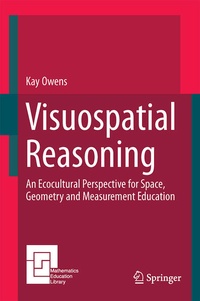
Visuospatial Reasoning
An Ecocultural Perspective for Space, Geometry and Measurement Education
Published on 21. November 2014
Book
Hardback
XXXI, 377 pages
978-3-319-02462-2 (ISBN)
Description
This book develops the theoretical perspective on visuospatial reasoning in ecocultural contexts, granting insights on how the language, gestures, and representations of different cultures reflect visuospatial reasoning in context. For a number of years, two themes in the field of mathematics education have run parallel with each other with only a passing acquaintance. These two areas are the psychological perspective on visuospatial reasoning and ecocultural perspectives on mathematics education. This volume examines both areas of research and explores the intersection of these powerful ideas. In addition, there has been a growing interest in sociocultural aspects of education and in particular that of Indigenous education in the field of mathematics education. There has not, however, been a sound analysis of how environmental and cultural contexts impact visuospatial reasoning, although it was noted as far back as the 1980s when Alan Bishop developed his duality of visual processing and interpreting visual information. This book provides this analysis and in so doing not only articulates new and worthwhile lines of research, but also uncovers and makes real a variety of useful professional approaches in teaching school mathematics. With a renewed interest in visuospatial reasoning in the mathematics education community, this volume is extremely timely and adds significantly to current literature on the topic.
More details
Series
Edition
2015 ed.
Language
English
Place of publication
Cham
Switzerland
Publishing group
Springer International Publishing
Target group
Professional and scholarly
Research
Illustrations
85 s/w Abbildungen, 29 farbige Abbildungen
XXXI, 377 p. 114 illus., 29 illus. in color.
Dimensions
Height: 241 mm
Width: 160 mm
Thickness: 28 mm
Weight
781 gr
ISBN-13
978-3-319-02462-2 (9783319024622)
DOI
10.1007/978-3-319-02463-9
Schweitzer Classification
Other editions
Additional editions
Kay Owens
Visuospatial Reasoning
An Ecocultural Perspective for Space, Geometry and Measurement Education
Book
09/2016
Springer
€106.99
Shipment within 10-15 days
Kay Owens
Visuospatial Reasoning
An Ecocultural Perspective for Space, Geometry and Measurement Education
E-Book
11/2014
1st Edition
Springer
€96.29
Available for download
Person
Patricia Paraide is an associate professor in Education Research at Divine Word University. She received her PhD at Deakin University in 2009. She has published a number of papers on education in Papua New Guinea, including mathematics education, and has presented at several conferences internationally. Her expertise and interests include language and linguistics, literacy across the lifespan, and education and indigenous knowledge.
Kay Owens began her teaching career as a mathematics and health education secondary teacher in Australia before moving to Papua New Guinea for 15 years with her partner Chris Owens. She taught mathematics at the Papua New Guinea University of Technology and taught, as Head of Department, health education and education at Balob Teachers College. On returning to Australia, she taught mathematics education at the now Western Sydney University for 15 years before moving to be with family in Dubbo to Charles Sturt University for 14 years. She was Vice-President (Publications) for the Mathematics Education Research Group of Australasia and held numerous positions in State and regional professional groups. She is a 35 year Member of Australian College of Educators following her work in PNG, and assists with mathematics and environmental associations. During her years in Australia she has continued to work with Papua New Guinea colleagues in joint research projects on ecocultural mathematics and mathematics education. She has numerous published papers and two of her books focus on Papua New GuineäVisuospatial Reasoning: An Ecocultural Perspective for Space, Geometry and Measurement Education and History of Number: Evidence from Papua New Guinea and Oceania.
Before joining Australian Catholic University, Emeritus Professor Philip Clarkson for nearly five years was Director of a Research Centre at the Papua New Guinea University of Technology. During this time, he carried out research into language and mathematics education and is well known internationally for this work; Charly Muke became one of his doctoral students. Prior to that Philip was at Monash University and tertiary colleges in Melbourne. He began his professional life as a teacher of chemistry, environmental science, mathematics and physical education in secondary schools. Philip Clarkson has led major consultancies and ARC research projects, was President, Secretary and Vice President (Publications) of the Mathematics Education Research Group of Australasia, foundation editor of Mathematics Education Research Journal, served on various editorial boards of both professional and research journals, and published widely. He continues to supervise research students, speak at various international conferences both in mathematics and science education, gives workshops for teachers and publishes regularly.
Charly Muke began his studies in mathematics and mathematics education at the University of Papua New Guinea. He was a mathematics teacher for many years before taking up a position at the University of Goroka and then a teaching position at St Theresa's College, Abergowrie, QLD, Australia. He received a Bachelor of Education (secondary mathematics teaching) and a research Masters qualification from Waikato University, New Zealand, for his work on his Mid-Wahgi counting system and he is co-author of a chapter in the book History of Number: Evidence from Papua New Guinea and Oceania. He completed his PhD aimed at identifying the role of local language in teaching through code-switching while it was used as a resource to teach mathematics in English in grade 3, the bridging class starting primary education in Papua New Guinea schools. He set up a library foundation in Jiwaka Province and continues to support the schools and education system in that Province bringing crates of books to the schools from his Australian contacts. He was also involved with Elementary Schools
Content
Introduction: Visuospatial reasoning in context.- Visuospatial reasoning in 20th century psychology-based studies.- Changing Perspective: sociocultural elaboration.- Place, culture, language, and visuospatial reasoning.- Visuospatial reasoning in cultural activities in Papua New Guinea.- Visuospatial reasoning in other cultures.- The impact of an ecocultural perspective of visuospatial reasoning on mathematics education.- The importance of an ecocultural perspective for Indigenous and transcultural education.- Visuospatial reasoning in contexts with digital technology.- An ecocultural perspective on visuospatial reasoning in geometry and measurement education.- Appendices.- Index.- References.