

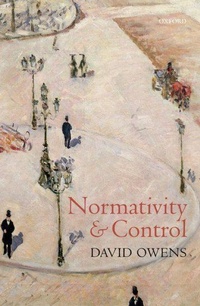
Normativity and Control
Published on 7. September 2017
Book
Hardback
272 pages
978-0-19-871323-4 (ISBN)
Description
Do we control what we believe? Are we responsible for what we believe? These two questions are connected: the kind of responsibility we have for our beliefs depends on the form of control that we have over them. For a number of years David Owens has investigated what form of control we must have over something in order to be held to the norms governing that thing, and has argued that belief, intention and action each require a different type of control. The forms of freedom appropriate to each of them vary, and so do the presuppositions of responsibility associated with each of them. Issues in the moral psychology of belief cast light on some of the traditional problems of epistemology and in particular on the problems of scepticism and testimony.
In this series of ten essays Owens explores various different forms of control we might have over belief and the different forms of responsibility they generate. He brings into the picture notable recent work in epistemology: on assurance theories of testimony, on 'pragmatic encroachment', on the aim of belief and on the value of knowledge. He also considers topics in related fields such as the philosophy of mind (e.g. the problem of self-knowledge and theories of the first person) and the philosophy of action (e.g. the guise of the good and the role of the will in free agency). Finally, Owens suggests a non-standard reading of the sceptical tradition in early modern philosophy as we find it in Descartes and Hume.
Seven of the essays collected here are previously published, one has been heavily revised, and two are previously unpublished. Owens provides a substantial introduction bringing together the themes of the essays.
In this series of ten essays Owens explores various different forms of control we might have over belief and the different forms of responsibility they generate. He brings into the picture notable recent work in epistemology: on assurance theories of testimony, on 'pragmatic encroachment', on the aim of belief and on the value of knowledge. He also considers topics in related fields such as the philosophy of mind (e.g. the problem of self-knowledge and theories of the first person) and the philosophy of action (e.g. the guise of the good and the role of the will in free agency). Finally, Owens suggests a non-standard reading of the sceptical tradition in early modern philosophy as we find it in Descartes and Hume.
Seven of the essays collected here are previously published, one has been heavily revised, and two are previously unpublished. Owens provides a substantial introduction bringing together the themes of the essays.
More details
Language
English
Place of publication
Oxford
United Kingdom
Target group
Professional and scholarly
Product notice
sewn/stitched
Cloth over boards
Dimensions
Height: 241 mm
Width: 155 mm
Thickness: 25 mm
Weight
499 gr
ISBN-13
978-0-19-871323-4 (9780198713234)
Copyright in bibliographic data and cover images is held by Nielsen Book Services Limited or by the publishers or by their respective licensors: all rights reserved.
Schweitzer Classification
Other editions
Additional editions
Person
David Owens is Professor of Philosophy at King's College London. He is the author of Shaping the Normative Landscape (Oxford 2012), Reason Without Freedom (Routledge 2000), and Causes and Coincidences (Cambridge 1992).
Content
NORMATIVITY: EPISTEMIC AND PRACTICAL; SCEPTICISM; PRACTICAL FREEDOM; TESTIMONY