

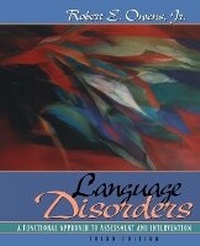
Language Disorders
A Functional Approach to Assessment and Intervention
3rd Edition
Published on 29. September 1998
Book
Hardback
596 pages
978-0-205-28703-1 (ISBN)
Description
Language Disorders is a comprehensive discussion of language disorders and clinical practice that takes students from model, through disorders, to assessment and intervention, with an emphasis on classroom application. It takes a functional, environmental, and conversational approach, by using the child's natural environment and conversational partners. Unlike other language disorders texts, which have a disorder-specific focus, this text takes a logical traverse from assessment through intervention.
This new edition is completely updated with current trends and developments in the field, and is full of practical ideas and useful suggestions for students and speech-language pathologists. The text provides concrete guidelines and procedures for the assessment and training of children as well as the training for speech-language pathologists. Building upon the success of the second edition, this third edition provides more information on classroom applications, a new chapter on culturally diverse children, and new sections on reading.
This new edition is completely updated with current trends and developments in the field, and is full of practical ideas and useful suggestions for students and speech-language pathologists. The text provides concrete guidelines and procedures for the assessment and training of children as well as the training for speech-language pathologists. Building upon the success of the second edition, this third edition provides more information on classroom applications, a new chapter on culturally diverse children, and new sections on reading.
More details
Edition
3rd edition
Language
English
Place of publication
United States
Publishing group
Pearson Education (US)
Target group
Professional and scholarly
Dimensions
Width: 242 mm
Thickness: 26 mm
Weight
1092 gr
ISBN-13
978-0-205-28703-1 (9780205287031)
Copyright in bibliographic data and cover images is held by Nielsen Book Services Limited or by the publishers or by their respective licensors: all rights reserved.
Schweitzer Classification
Other editions
New editions

Book
08/2003
4th Edition
Pearson
€90.67
Article exhausted; check for reprint
Previous edition

Book
12/1995
2nd Edition
Allyn & Bacon
€65.82
Article exhausted; check different version
Content
All chapters end with "Conclusion." I.INTRODUCTION.
1.A Functional Language Approach.
Role of Pragmatics in Intervention.
Role of Generalization in Intervention.
2.Language Impairments.
Diagnostic Categories.
II.COMMUNICATION ASSESSMENT.
3.Assessment of Children with Language Impairment.
Psychometric versus Descriptive Procedures.
Psychometric Assessment Protocols.
Descriptive Approaches.
An Integrated Functional Assessment Strategy.
Presymbolic and Minimally Symbolic Children.
4.Assessment of Children with Language Difference.
State of Service Delivery.
An Integrated Model for Assessment.
5.Language Sampling.
Planning and Collecting a Representative Sample.
Recording the Sample.
Transcribing the Sample.
Collecting Samples of Written Language.
6.Analysis across Utterances and Partners and by Communication Event.
Across Utterances and Partners.
Communication Event.
Conversational Partner.
7.Analyzing a Language Sample at the Utterance Level.
Language Use.
Content.
Form.
Presymbolic and Minimally Symbolic Children.
8.Narrative Analysis.
Development of Narratives.
Collecting Narratives.
Narrative Analysis.
CLD Children.
III.INTERVENTION.
9.A Functional Intervention Model.
Principles.
Generalization Variables.
10.Manipulating Context.
Nonlinguistic Contexts.
Linguistic Contexts.
11.Specific Intervention Techniques.
Pragmatics.
Semantics.
Syntax and Morphology.
Phonology.
CLD Children.
Use of Microcomputers.
Presymbolic and Minimally Symbolic Children.
12.Classroom Functional Intervention.
Background and Rationale: Recent Educational Trends.
Role of the Speech-Language Pathologist.
Elements of a Classroom Model.
Instituting a Classroom Model.
APPENDICES.
A: Language Test Content.
B: Phonological Development.
C: Considerations for CLD Children.
D: Form for Reporting the Language Skills of CLD Children.
E: Language Analysis Methods.
F: Selected English Morphological Prefixes and Suffixes.
G: Definitions of Illocutionary and Semantic Functions.
H: Indirect Elicitation Techniques.
I: Intervention Activities and Language Targets.
J: Analyzing Classroom Communication Breakdown.
K: Use of Children's Literature in Preschool Classrooms.
L: Thematic Unit on Listening.
Glossary.
References.
Author Index.
Subject Index.
1.A Functional Language Approach.
Role of Pragmatics in Intervention.
Role of Generalization in Intervention.
2.Language Impairments.
Diagnostic Categories.
II.COMMUNICATION ASSESSMENT.
3.Assessment of Children with Language Impairment.
Psychometric versus Descriptive Procedures.
Psychometric Assessment Protocols.
Descriptive Approaches.
An Integrated Functional Assessment Strategy.
Presymbolic and Minimally Symbolic Children.
4.Assessment of Children with Language Difference.
State of Service Delivery.
An Integrated Model for Assessment.
5.Language Sampling.
Planning and Collecting a Representative Sample.
Recording the Sample.
Transcribing the Sample.
Collecting Samples of Written Language.
6.Analysis across Utterances and Partners and by Communication Event.
Across Utterances and Partners.
Communication Event.
Conversational Partner.
7.Analyzing a Language Sample at the Utterance Level.
Language Use.
Content.
Form.
Presymbolic and Minimally Symbolic Children.
8.Narrative Analysis.
Development of Narratives.
Collecting Narratives.
Narrative Analysis.
CLD Children.
III.INTERVENTION.
9.A Functional Intervention Model.
Principles.
Generalization Variables.
10.Manipulating Context.
Nonlinguistic Contexts.
Linguistic Contexts.
11.Specific Intervention Techniques.
Pragmatics.
Semantics.
Syntax and Morphology.
Phonology.
CLD Children.
Use of Microcomputers.
Presymbolic and Minimally Symbolic Children.
12.Classroom Functional Intervention.
Background and Rationale: Recent Educational Trends.
Role of the Speech-Language Pathologist.
Elements of a Classroom Model.
Instituting a Classroom Model.
APPENDICES.
A: Language Test Content.
B: Phonological Development.
C: Considerations for CLD Children.
D: Form for Reporting the Language Skills of CLD Children.
E: Language Analysis Methods.
F: Selected English Morphological Prefixes and Suffixes.
G: Definitions of Illocutionary and Semantic Functions.
H: Indirect Elicitation Techniques.
I: Intervention Activities and Language Targets.
J: Analyzing Classroom Communication Breakdown.
K: Use of Children's Literature in Preschool Classrooms.
L: Thematic Unit on Listening.
Glossary.
References.
Author Index.
Subject Index.