

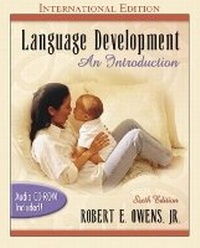
Language Development
An Introduction (with Audio CD): International Edition
6th Edition
Published on 5. August 2004
Book
Mixed media product
528 pages
978-0-205-44180-8 (ISBN)
Description
Clearly written, well organized, and comprehensive, Language Development is the most widely used text in its field.
In recognition of the tremendous language variations among children, the Sixth Edition of this highly readable book devotes significant space to individual developmental differences and cultural differences. Discussion of other cultures is included in the text wherever possible. In addition, the sections on culturally linguistically diverse children accurately reflect the realities of everyday life in the United States. Developed within a practical chronological framework, the Sixth Edition examines every aspect of syntax, morphology, semantics, phonology, and pragmatics. As in previous editions, Owens presents even the most complex, technical concepts at an appropriate level for beginning students.
In recognition of the tremendous language variations among children, the Sixth Edition of this highly readable book devotes significant space to individual developmental differences and cultural differences. Discussion of other cultures is included in the text wherever possible. In addition, the sections on culturally linguistically diverse children accurately reflect the realities of everyday life in the United States. Developed within a practical chronological framework, the Sixth Edition examines every aspect of syntax, morphology, semantics, phonology, and pragmatics. As in previous editions, Owens presents even the most complex, technical concepts at an appropriate level for beginning students.
More details
Edition
6th edition
Language
English
Place of publication
United States
Publishing group
Pearson Education (US)
Target group
Professional and scholarly
Dimensions
Height: 232 mm
Width: 188 mm
Thickness: 20 mm
Weight
800 gr
ISBN-13
978-0-205-44180-8 (9780205441808)
Copyright in bibliographic data and cover images is held by Nielsen Book Services Limited or by the publishers or by their respective licensors: all rights reserved.
Schweitzer Classification
Other editions
New editions

Book
04/2007
7th Edition
Pearson
€96.87
Article exhausted; check for reprint
Content
All chapters begin with "Chapter Objectives" and conclude with "Conclusion," "Discussions," and "Reflections."
Preface.
1. The Territory.
This Text and You.
Speech, Language, and Communication.
Properties of Language.
Components of Language.
2. Language-Development Models.
Behavioral Theory.
Psycholinguistic Theory: A Syntactic Model.
Psycholinguistic Theory: A Semantic/Cognitive Model.
Sociolinguistic Theory.
3. Child Development.
Developmental Patterns.
The Developing Child.
4. Neurolinguistics.
Central Nervous System.
Language Processing.
5. Cognitive and Perceptual Bases of Early Language.
Which Came First, Cognition or Language?
Neurological Development.
6. The Social and Communicative Bases of Early Language.
Development of Communication: A Chronology.
Maternal Communication Behaviors.
Interactions between Infant and Caregiver.
7. Language-Learning Processes in Young Children.
Comprehension, Production, and Cognitive Growth.
Child Learning Strategies.
Adult Conversational Teaching Techniques.
Importance of Play.
8. A First Language.
Single-Word Utterances.
Early Multiword Combinations.
Phonological Patterns.
9. Preschool Pragmatic and Semantic Development.
Pragmatic Development.
Semantic Development.
Interdependence of Form, Content, and Use: Pronouns.
10. Preschool Development of Language Form.
Stages of Syntactic and Morphologic Development.
Morphologic Development.
Sentence-Form Development.
Embedding and Conjoining.
Phonological Development.
11. School-Age and Adult Pragmatic and Semantic Development.
Pragmatic Development.
Semantic Development.
12. School-Age and Adult Language Form and Mode Development.
Syntactic and Morphologic Development.
Phonological Development.
Metalinguistic Abilities.
Reading and Writing: A New Mode.
13. Language Differences: Bidialectism and Bilingualism.
Dialects.
Bilingualism.
14. Language Research and Analysis.
Issues in the Study of Child Language.
Cross-Language Studies.
Examples of Child Language Data.
Appendix A: American English Speech Sounds.
Appendix B: Transcripts to Accompany Text Compact Disc.
Preface.
1. The Territory.
This Text and You.
Speech, Language, and Communication.
Properties of Language.
Components of Language.
2. Language-Development Models.
Behavioral Theory.
Psycholinguistic Theory: A Syntactic Model.
Psycholinguistic Theory: A Semantic/Cognitive Model.
Sociolinguistic Theory.
3. Child Development.
Developmental Patterns.
The Developing Child.
4. Neurolinguistics.
Central Nervous System.
Language Processing.
5. Cognitive and Perceptual Bases of Early Language.
Which Came First, Cognition or Language?
Neurological Development.
6. The Social and Communicative Bases of Early Language.
Development of Communication: A Chronology.
Maternal Communication Behaviors.
Interactions between Infant and Caregiver.
7. Language-Learning Processes in Young Children.
Comprehension, Production, and Cognitive Growth.
Child Learning Strategies.
Adult Conversational Teaching Techniques.
Importance of Play.
8. A First Language.
Single-Word Utterances.
Early Multiword Combinations.
Phonological Patterns.
9. Preschool Pragmatic and Semantic Development.
Pragmatic Development.
Semantic Development.
Interdependence of Form, Content, and Use: Pronouns.
10. Preschool Development of Language Form.
Stages of Syntactic and Morphologic Development.
Morphologic Development.
Sentence-Form Development.
Embedding and Conjoining.
Phonological Development.
11. School-Age and Adult Pragmatic and Semantic Development.
Pragmatic Development.
Semantic Development.
12. School-Age and Adult Language Form and Mode Development.
Syntactic and Morphologic Development.
Phonological Development.
Metalinguistic Abilities.
Reading and Writing: A New Mode.
13. Language Differences: Bidialectism and Bilingualism.
Dialects.
Bilingualism.
14. Language Research and Analysis.
Issues in the Study of Child Language.
Cross-Language Studies.
Examples of Child Language Data.
Appendix A: American English Speech Sounds.
Appendix B: Transcripts to Accompany Text Compact Disc.