

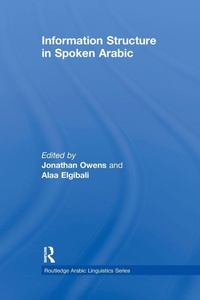
Information Structure in Spoken Arabic
1st Edition
Published on 15. February 2013
Book
Paperback/Softback
270 pages
978-0-415-84511-3 (ISBN)
Description
This book explores speakers' intentions, and the structural and pragmatic resources they employ, in spoken Arabic - which is different in many essential respects from literary Arabic. Based on new empirical findings from across the Arabic world this book elucidates the many ways in which context and the goals and intentions of the speaker inform and constrain linguistic structure in spoken Arabic.
This is the first book to provide an in-depth analysis of information structure in spoken Arabic, which is based on language as it is actually used, not on normatively-given grammar. Written by leading experts in Arabic linguistics, the studies evaluate the ways in which relevant parts of a message in spoken Arabic are encoded, highlighted or obscured. It covers a broad range of issues from across the Arabic-speaking world, including the discourse-sensitive properties of word order variation, the use of intonation for information focussing, the differential role of native Arabic and second languages to encode information in a codeswitching context, and the need for cultural contextualization to understand the role of "disinformation" structure.
The studies combine a strong empirical basis with methodological and theoretical issues drawn from a number of different perspectives including pragmatic theory, language contact, instrumental prosodic analysis and (de-)grammaticalization theory. The introductory chapter embeds the project within the deeper Arabic grammatical tradition, as elaborated by the eleventh century grammarian Abdul Qahir al-Jurjani. This book provides an invaluable comprehensive introduction to an important, yet understudied, component of spoken Arabic.
This is the first book to provide an in-depth analysis of information structure in spoken Arabic, which is based on language as it is actually used, not on normatively-given grammar. Written by leading experts in Arabic linguistics, the studies evaluate the ways in which relevant parts of a message in spoken Arabic are encoded, highlighted or obscured. It covers a broad range of issues from across the Arabic-speaking world, including the discourse-sensitive properties of word order variation, the use of intonation for information focussing, the differential role of native Arabic and second languages to encode information in a codeswitching context, and the need for cultural contextualization to understand the role of "disinformation" structure.
The studies combine a strong empirical basis with methodological and theoretical issues drawn from a number of different perspectives including pragmatic theory, language contact, instrumental prosodic analysis and (de-)grammaticalization theory. The introductory chapter embeds the project within the deeper Arabic grammatical tradition, as elaborated by the eleventh century grammarian Abdul Qahir al-Jurjani. This book provides an invaluable comprehensive introduction to an important, yet understudied, component of spoken Arabic.
Reviews / Votes
"By and large, the studies in this ground-breaking volume have opened a new vista on the significant subject of information structure, and will be of immense value to all students of Arabic and comparative linguistics who are interested in intercultural interaction of pragmatic ideas in modern linguistic scholarship." - Amidu Olalekan Sanni, Lagos; Zeitschrift fuer Arabische Linguistik (Journal of Arabic Linguistics), 57, 2013, pp. 91-94 (2013).More details
Series
Language
English
Place of publication
London
United Kingdom
Publishing group
Taylor & Francis Ltd
Target group
College/higher education
Professional and scholarly
Illustrations
17 s/w Abbildungen, 17 s/w Zeichnungen, 36 s/w Tabellen
36 Tables, black and white; 17 Line drawings, black and white; 17 Illustrations, black and white
Dimensions
Height: 234 mm
Width: 156 mm
Thickness: 16 mm
Weight
442 gr
ISBN-13
978-0-415-84511-3 (9780415845113)
Copyright in bibliographic data and cover images is held by Nielsen Book Services Limited or by the publishers or by their respective licensors: all rights reserved.
Schweitzer Classification
Other editions
Additional editions
Jonathan Owens | Alaa Elgibali
Information Structure in Spoken Arabic
E-Book
03/2013
Routledge
€64.49
Available for download
Jonathan Owens | Alaa Elgibali
Information Structure in Spoken Arabic
Book
07/2009
1st Edition
Routledge
€232.00
Shipment within 15-20 days
Persons
Jonathan Owens is Professor of Arabic Linguistics at Bayreuth University, Germany. He has published extensively on many aspects of Arabic linguistics; his most recent publications include Arabic as a Minority Language and A Linguistic History of Arabic. Alaa Elgibali is Professor of Arabic and Linguistics at the University of Maryland, USA. He is the author of several seminal publications, including Arabic as a First Language: A study in language acquisition and development, and is associate editor of the four-volume Encyclopedia of Arabic Language and Linguistics.
Content
1. Explaining Null and Overt Subjects in Spoken Arabic 2. Word Order and Textual Function in Gulf Arabic 3. Information Structure in the Najdi Dialects 4. Word Order in Egyptian Arabic: Form and Function 5. The Information Structure of Existential Sentences in Egyptian Arabic 6. The Pragmatics of Information Structure in Arabic: Colloquial Tautological Expressions as a Paradigm Example 7. From Complementizer to Discourse Marker: The Functions of 'inno in Lebanese Arabic 8. The (Absence of) Prosodic Reflexes of Given/New Information Status in Egyptian Arabic 9. Moroccan Arabic-French Codeswitching and Information Structure 10. Conversation Markers in Arabic-Hausa Codeswitching: Saliency and Language Hierarchies 11. Understatement, Euphemism, and Circumlocution in Egyptian Arabic: Cooperation in Conversational Dissembling