

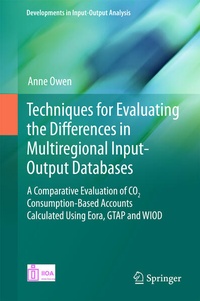
Techniques for Evaluating the Differences in Multiregional Input-Output Databases
A Comparative Evaluation of CO2 Consumption-Based Accounts Calculated Using Eora, GTAP and WIOD
Published on 17. February 2017
Book
Hardback
XXII, 217 pages
978-3-319-51555-7 (ISBN)
Description
This book introduces the Eora, Global Trade Analysis Project (GTAP) and World Input-Output (WIOD) databases and provides detailed metadata on the data sources, database structures and construction techniques used to build each system. It offers a detailed account of how multi-regional input-output (MRIO) databases are used to calculate consumption-based accounts - guiding the reader through each mathematical step and explaining the associated equations. It demonstrates that different MRIO databases calculate different national level consumption-based CO2 accounts. If these results are to be used as evidence in climate policy-making, analysts need to be confident about the accuracy of the databases and understand why the results differ.It carefully explains the mathematical equations behind each technique and provides a link to a repository where the reader can access specially prepared MATLAB functions associated with the techniques.To make meaningful comparisons between the three MRIO databases, each is mapped to a consistent classification system comprising 40 countries and 17 sectors. Further, readers can access the aggregated databases using the link provided. The effect of this aggregation is shown to be minimal, so readers can be confident that the aggregated versions of each database reflect the full-sized versions.The book concludes by making recommendations as to how future MRIO databases could be accurately and consistently constructed and how they should be used in policy-making in light of the findings.EndorsementAnne Owen did a splendid job in comparing the most important Global Multiregional Input Output databases (GMRIO) available. She probably is the ?rst to develop a good understanding what factors in GMRIO construction really contribute to uncertainties in carbon footprint analysis. A great achievement, packed in easy to understand language!Prof. Arnold TukkerScienti?c director CML Leiden, NLWith its thorough investigations and clear explanations of the differences in MRIO databases and outcomes, this book is compulsory reading for both skilled practitioners and scholars when starting any input-output analysis in a multiregional context.Dr. Harry C. WiltingSenior researcher, environment and economicsPBL Netherlands Environmental Assessment Agency, NL A novel exposition on understanding some of the biggest datasets underpinning current global sustainability assessments. Dr. Owen straddles technical incision with practitioner relevant insights and includes a range of methodological advances that will ensure the continued relevance of this work for many years to come. Prof. Richard WoodIndustrial Ecology ProgramNTNU, Norway
More details
Series
Edition
1st ed. 2017
Language
English
Place of publication
Cham
Switzerland
Publishing group
Springer International Publishing
Target group
Professional and scholarly
Illustrations
44 farbige Abbildungen
XXII, 217 p. 44 illus. in color.
Dimensions
Height: 241 mm
Width: 160 mm
Thickness: 18 mm
Weight
580 gr
ISBN-13
978-3-319-51555-7 (9783319515557)
DOI
10.1007/978-3-319-51556-4
Schweitzer Classification
Other editions
Additional editions
Anne Owen
Techniques for Evaluating the Differences in Multiregional Input-Output Databases
A Comparative Evaluation of CO2 Consumption-Based Accounts Calculated Using Eora, GTAP and WIOD
Book
05/2018
Springer
€128.39
Shipment within 10-15 days
Anne Owen
Techniques for Evaluating the Differences in Multiregional Input-Output Databases
A Comparative Evaluation of CO2 Consumption-Based Accounts Calculated Using Eora, GTAP and WIOD
E-Book
02/2017
Springer
€117.69
Available for download
Content
Chapter 1 Introduction.- Chapter 2 Literature review.- Chapter 3 Methodology and data.- Chapter 4 Using matrix difference statistics to compare MRIO databases.- Chapter 5 Using decomposition techniques to determine cause of difference in MRIO databases.- Chapter 6 Discussion.- Chapter 7 Conclusion.- Chapter 8 List of References.- Chapter 9 Appendix.