

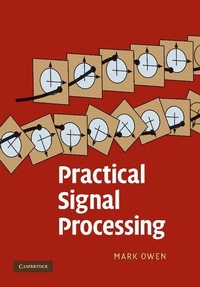
Practical Signal Processing
Published on 13. December 2012
Book
Paperback/Softback
348 pages
978-1-107-41182-1 (ISBN)
Description
The principles of signal processing are fundamental to the operation of many everyday devices. This book introduces the basic theory of digital signal processing, with emphasis on real-world applications. Sampling, quantization, the Fourier transform, filters, Bayesian methods and numerical considerations are covered, then developed to illustrate how they are used in audio, image, and video processing and compression, and in communications. The book concludes with methods for the efficient implementation of algorithms in hardware and software. Intuitive arguments rather than mathematical ones are used wherever possible, and links between various signal processing techniques are stressed. The advantages and disadvantages of different approaches are presented in the context of real-world examples, enabling the reader to choose the best solution to a given problem. With over 200 illustrations and over 130 exercises (including solutions), this book will appeal to practitioners working in signal processing, and undergraduate students of electrical and computer engineering.
More details
Language
English
Place of publication
Cambridge
United Kingdom
Target group
Professional and scholarly
College/higher education
Product notice
Paperback (trade)
Dimensions
Height: 244 mm
Width: 170 mm
Thickness: 19 mm
Weight
601 gr
ISBN-13
978-1-107-41182-1 (9781107411821)
Copyright in bibliographic data and cover images is held by Nielsen Book Services Limited or by the publishers or by their respective licensors: all rights reserved.
Schweitzer Classification
Other editions
Additional editions
Mark Owen
Practical Signal Processing
Book
05/2007
Cambridge University Press
€148.50
Shipment within 15-20 days
Content
Preface; Part I. Foundations: 1. Introduction; 2. Sampling; 3. Conversion between analogue and digital; 4. The frequency domain; 5. Filters; 6. Likelihood methods; 7. Numerical considerations; Part II. Applications: 8. Audio; 9. Still images; 10. Moving images; 11. Communications; 12. Implementations; Answers to chapter exercises.