

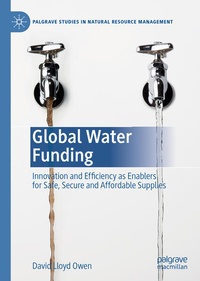
Global Water Funding
Innovation and efficiency as enablers for safe, secure and affordable supplies
Published on 30. July 2020
Book
Hardback
XXIX, 372 pages
978-3-030-49453-7 (ISBN)
Description
Is safe and sustainable water and sanitation for all an unaffordable pipedream? This book surveys the worldwide development of water and sewage services and the challenges in meeting Sustainable Development Goal 6 (SDG6) along with climate change, population growth and urbanisation. It explores the reasons why current SDG6 progress is failing, including weak policy implementation, staff shortages and inadequate funding, as well as the limited impact of aid funding. The author contends that despite a series of innovations, debt finance remains too small to address needs of developing economies. Therefore, instead of advocating new funding, this book proposes addressing the funding gap through technological innovation and more efficient management and procurement through a series of examples that have challenged traditional assumptions.
After four decades of good intentions, SDG6 is making a difference in monitoring shortfalls for the first time, allowing for more effective responses. This book outlines the role of innovation in hardware development, procurement and installation, and discusses how network management and operations can most effectively address funding gaps. The potential for savings is considerable, if effectively replicated. New approaches are driving forward affordable resilience, including nature-based solutions such as upstream habitat enhancement to retain water and improve downstream water quality; the circular economy, including water, nutrient, energy and heat recovery from wastewater; and demand management. This book will be of great value to scholars, policy makers and practitioners interested in the global finance of sustainable water and sanitation.
After four decades of good intentions, SDG6 is making a difference in monitoring shortfalls for the first time, allowing for more effective responses. This book outlines the role of innovation in hardware development, procurement and installation, and discusses how network management and operations can most effectively address funding gaps. The potential for savings is considerable, if effectively replicated. New approaches are driving forward affordable resilience, including nature-based solutions such as upstream habitat enhancement to retain water and improve downstream water quality; the circular economy, including water, nutrient, energy and heat recovery from wastewater; and demand management. This book will be of great value to scholars, policy makers and practitioners interested in the global finance of sustainable water and sanitation.
More details
Series
Edition
2020 ed.
Language
English
Place of publication
Cham
Switzerland
Publishing group
Springer International Publishing
Target group
Professional and scholarly
Illustrations
XXIX, 372 p.
Dimensions
Height: 216 mm
Width: 153 mm
Thickness: 27 mm
Weight
633 gr
ISBN-13
978-3-030-49453-7 (9783030494537)
DOI
10.1007/978-3-030-49454-4
Schweitzer Classification
Other editions
Additional editions
David Lloyd Owen
Global Water Funding
Innovation and efficiency as enablers for safe, secure and affordable supplies
Book
07/2021
Palgrave Macmillan
€106.99
Shipment within 7-9 days
David Lloyd Owen
Global Water Funding
Innovation and efficiency as enablers for safe, secure and affordable supplies
E-Book
07/2020
1st Edition
Palgrave Macmillan
€96.29
Available for download
Person
David Lloyd Owen runs Envisager, advising multilaterals, governments, companies and financiers about water regulation, economics and policy. He sits on the Advisory Board of the Pictet Water Fund and has previously authored
Smart Water Technologies and Techniques: Data Capture and Analysis for Sustainable Water Management
(2018).
Content
Chapter 1: The Case for Universal and Sustainable Access.- Chapter 2: Where we are.- Chapter 3: Where we need to be.- Chapter 4: The costs involved.- Chapter 5: Funding Flows Today.- Chapter 6: The gap between aspirations and realities.- Chapter 7: Addressing capital costs.- Chapter 8: Lowering operating costs.- Chapter 9: Demand Management and Resource Recovery.- Chapter 10: Innovation, Efficiency and Affordability.