

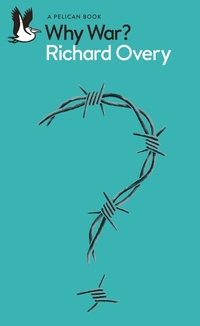
Why War?
Published on 19. June 2025
Book
Paperback/Softback
400 pages
978-0-241-56761-6 (ISBN)
Description
A richly absorbing book... Overy is unquestionably one of our finest living historians - The Daily Telegraph
Why has warfare always been part of the human story?
From biology to belief, what explains the persistence of violent conflict?
What light can this shed on humanity's past - and its future?
There can be few more important but also more contentious issues than attempting to understand the human propensity for conflict. Our history is inextricably tangled in wave after wave of inter-human fighting from as far back as we have records.
Repeatedly humans have foresworn war, have understood its appalling risks and have wished to create more pacific, productive societies. And yet almost inevitably circumstances emerge under which war once more seems inevitable or even desirable
How can we make sense of what Einstein called 'the dark places of human will and feeling'? Richard Overy draws on a lifetime's study of conflict to write this challenging account of how we can understand the causes of war. Looking at every facet of war from biology to belief, psychology to security, Overy allows readers to understand the many contradictory or self-reinforcing ways in which warfare can suddenly appear a legitimate option, and why it is likely to be part of our future as well as our past.
Why has warfare always been part of the human story?
From biology to belief, what explains the persistence of violent conflict?
What light can this shed on humanity's past - and its future?
There can be few more important but also more contentious issues than attempting to understand the human propensity for conflict. Our history is inextricably tangled in wave after wave of inter-human fighting from as far back as we have records.
Repeatedly humans have foresworn war, have understood its appalling risks and have wished to create more pacific, productive societies. And yet almost inevitably circumstances emerge under which war once more seems inevitable or even desirable
How can we make sense of what Einstein called 'the dark places of human will and feeling'? Richard Overy draws on a lifetime's study of conflict to write this challenging account of how we can understand the causes of war. Looking at every facet of war from biology to belief, psychology to security, Overy allows readers to understand the many contradictory or self-reinforcing ways in which warfare can suddenly appear a legitimate option, and why it is likely to be part of our future as well as our past.
Reviews / Votes
A richly absorbing book... Overy is unquestionably one of our finest living historians -- James Holland * The Daily Telegraph * PRAISE FOR BLOOD AND RUINS: 'Majestic and original ... Overy has written many fine books, but Blood and Ruins is his masterpiece. It puts all previous single-volume works of the conflict in the shade. -- Saul David * The Times * Monumental... [A] vast and detailed study that is surely the finest single-volume history of World War Two. * Wall Street Journal * This is a magnificent book that reflects the deep scholarship and humane judgment of a magisterial historian. * The Economist *More details
Series
Language
English
Place of publication
London
United Kingdom
Publishing group
Penguin Books Ltd
Dimensions
Height: 179 mm
Width: 109 mm
Thickness: 25 mm
Weight
232 gr
ISBN-13
978-0-241-56761-6 (9780241567616)
Copyright in bibliographic data and cover images is held by Nielsen Book Services Limited or by the publishers or by their respective licensors: all rights reserved.
Schweitzer Classification
Other editions
Additional editions
Person
Richard Overy is Honorary Research Professor of History at the University of Exeter and one of Britain's most distinguished historians. His major works include The Dictators, winner of the 2005 Wolfson Prize, The Morbid Age and The Bombing War, which was a finalist for the 2014 Cundhill Prize. He is a Fellow of the British Academy and a Member of the European Academy of Sciences and Arts.