

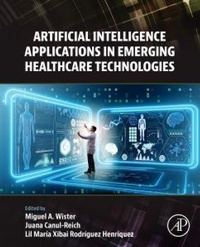
Artificial Intelligence Applications in Emerging Healthcare Technologies
Published on 7. May 2026
Book
Paperback/Softback
260 pages
978-0-443-33496-2 (ISBN)
Description
Artificial Intelligence Applications in Emerging Healthcare Technologies presents the latest advances and state-of-the-art methods and applications of computer science and emerging AI technologies in health and medicine. The book explores the impact of artificial intelligence (AI) in healthcare for medical decision-making and data analysis, tackling topics such as cloud computing, cybersecurity, the internet of things, natural language processing, virtual health, data science applied to healthcare, personalized medicine, imaging, diagnosis, drug discovery, and diseases, among others.
Chapters present adaptations or improvements on previous models and algorithms to process data from different sources. Other chapters investigate new formulations for the optimization of known procedures and algorithms. Finally, all chapters use experimental methods to study problems of interest in healthcare. This is a great resource for researchers and students who want to learn how machine learning algorithms and other data science techniques have been implemented to solve healthcare-related problems.
Chapters present adaptations or improvements on previous models and algorithms to process data from different sources. Other chapters investigate new formulations for the optimization of known procedures and algorithms. Finally, all chapters use experimental methods to study problems of interest in healthcare. This is a great resource for researchers and students who want to learn how machine learning algorithms and other data science techniques have been implemented to solve healthcare-related problems.
More details
Language
English
Place of publication
San Diego
United States
Publishing group
Elsevier Science Publishing Co Inc
Target group
Professional and scholarly
Dimensions
Height: 235 mm
Width: 191 mm
Weight
450 gr
ISBN-13
978-0-443-33496-2 (9780443334962)
Copyright in bibliographic data and cover images is held by Nielsen Book Services Limited or by the publishers or by their respective licensors: all rights reserved.
Schweitzer Classification
Other editions
Additional editions
Miguel Antonio Wister Ovando | Juana Canul-Reich | Lil María Rodríguez Henríquez
Artificial Intelligence Applications in Emerging Healthcare Technologies
E-Book
04/2026
Elsevier
€185.99
Available for download
Persons
Miguel A. Wister received his Ph.D. in Information Technology and Communications Engineering from the University of Murcia, Spain (2008). He earned an MSc in Informatics Technology at the Monterrey Institute of Technology and Higher Education (ITESM), Mexico, (1997), and a BSc degree in Informatics at the Juarez Autonomous University of Tabasco (UJAT), Mexico, (1993). He has tutored over 40 BSc and MSc students. Dr. Wister has also authored and co-authored about 20 scientific papers published in peer-reviewed conferences and journals. He is the editor and co-author of the book Intelligent Data Sensing and Processing for Health and Well-being Applications (Editorial Academic Press, ELSEVIER). He is also associate editor in two Journals: 1. Internet of Things Engineering Cyber Physical Human Systems; 2. International Journal of Grid and Utility Computing. His research interests are ubiquitous computing, focusing on ambient intelligence and the Internet of Things. viewed conferences and journals. Juana Canul-Reich holds a PhD in Computer Science and Engineering from the University of South Florida with a major in Data mining. She is currently a Professor-Researcher in the Academic Division of Sciences and Information Technologies at UJAT where she has tutored over 7 PhD thesis, 6 Msc thesis, and 15 BSc thesis. PhD Canul-Reich has also authored and co-authored over 30 scientific papers published in peer-reviewed conferences and journals. She is a level-2 member of the National Research System of CONAHCYT. She actively participates as a referee for both national and international scientific journals in the fields of machine learning or computational science. She has also been responsible for research projects funded by PRODEP and CONAHCYT. Her research interests focus mainly on Data Science and Artificial Intelligence applied to the health area. Lil Maria Rodriguez Henriquez. Her research interests are ubiquitous computing, focusing on distributed systems, Cryptography and Security. Received her Ph.D. degree from the Centro de Investigacion y Estudios Avanzados of the IPN, in 2015. She is currently a CONAHCYT Research Fellow with the National Institute of Astrophysics, Optics and Electronics (INAOE). Her recent work involves security on databases, partial order algorithms. She has tutored over 2 PhD thesis, 7 Msc thesis, and 4 BSc thesis at INAOE. PhD Rodriguez has also authored and co-authored about 15 scientific papers published in peer-reviewed conferences and journals.
Editor
Associate Professor, Academic Division of Information Technology and Systems (DAIS), Juarez Autonomous University of Tabasco (UJAT), Villahermosa, Tabasco, Mexico
Professor-Researcher in the Academic Division of Sciences and Information Technologies at UJAT, Mexico
Research Fellow with the National Institute of Astrophysics, Optics and Electronics (INAOE), Mexico
Content
1. Artificial Intelligence Applied in Emerging Healthcare Technologies
Juana Canul-Reich, Lil Maria Rodriguez Henriquez and Miguel A. Wister
2. Towards Detection of Depression and Anxiety in Adolescents through Social Media Texts
Irvin Hussein Lopez-Nava and Scarlett Magdaleno-Gatica
3. Enhancing Air Quality Analysis with Quantum Computing: Predicting the Risk of Sick Building Syndrome
Fabian Cuesta, Laura Rodriguez, Eldman de Oliveira Nunes, Paulo Nazareno Maia Sampaio and Ariel Posada
4. Incorporating a Chatbot in a Virtual Rehabilitation System: Methodology and Preliminary Evaluation
Delia Irazu Hernandez-Farias, Maria Fernanda Rojano Cacho and Enrique Sucar Succar
5. Automatic Speech Analysis for Detecting Cognitive Impairment
J. Ivan Lopez-Velazquez, Carlos A. Olachea-Hernandez, Francisco I. Gonzalez-Hernandez,
Alejandro A. Torres-Garcia, Manuel Montes-y-Gomez, and Luis Villasenor-Pineda
6. Personalized medicine, digital innovation, and artificial intelligence: An analysis according to the different stakeholders
Thomas Lefevre, Cyrille Delpierre and Eri Kasagi
7. Impact of Artificial Intelligence (AI) on Diagnostic Disease Detection
Harishchander Anandaram, Manimaran S and Anand Nayyar Sr.
8. Association of D-dimer and Fibrinogen with COVID-19 Severity: A Statistical and Clustering Approach
Henry J. Hernandez-Gomez, Freddy De la Cruz-Ruiz and Erasmo Zamarron-Licona
9. Application of Artificial Intelligence in the Research of Communicable and Non-Communicable Diseases
Freddy De la Cruz-Ruiz, Erasmo Zamarron-Licona, Sarai Aguilar-Barojas and Angel-Domingo Hernandez-de-la-O
10. AI-Assisted Identification of Depressive Symptoms with Large Language Models
Delia Irazu Hernandez-Farias, Hugo Jair Escalante Balderas, Luis Villasenor-Pineda, Karla Maria Valencia Segura, Diana Guadalupe Soancatl Rodriguez and Leydi Guadalupe Soancatl Rodriguez
11. Hand information extraction using artificial intelligence for Alzheimer's disease diagnosis
Eyitomilayo Yemisi Babatope, Mireya Sarai Garcia-Vazquez and Alejandro Alvaro Ramirez-Acosta
12. Assistive System for Visually Impaired Using YOLO and WebSockets
Diego Leonardo Ramirez Mancilla Sr., Diana Montserrat Albores Santiago, Diana Paulina Martinez Cancino, Abraham Hernandez Jimenez and Jose Octavio Vazquez Buenos Aires
Juana Canul-Reich, Lil Maria Rodriguez Henriquez and Miguel A. Wister
2. Towards Detection of Depression and Anxiety in Adolescents through Social Media Texts
Irvin Hussein Lopez-Nava and Scarlett Magdaleno-Gatica
3. Enhancing Air Quality Analysis with Quantum Computing: Predicting the Risk of Sick Building Syndrome
Fabian Cuesta, Laura Rodriguez, Eldman de Oliveira Nunes, Paulo Nazareno Maia Sampaio and Ariel Posada
4. Incorporating a Chatbot in a Virtual Rehabilitation System: Methodology and Preliminary Evaluation
Delia Irazu Hernandez-Farias, Maria Fernanda Rojano Cacho and Enrique Sucar Succar
5. Automatic Speech Analysis for Detecting Cognitive Impairment
J. Ivan Lopez-Velazquez, Carlos A. Olachea-Hernandez, Francisco I. Gonzalez-Hernandez,
Alejandro A. Torres-Garcia, Manuel Montes-y-Gomez, and Luis Villasenor-Pineda
6. Personalized medicine, digital innovation, and artificial intelligence: An analysis according to the different stakeholders
Thomas Lefevre, Cyrille Delpierre and Eri Kasagi
7. Impact of Artificial Intelligence (AI) on Diagnostic Disease Detection
Harishchander Anandaram, Manimaran S and Anand Nayyar Sr.
8. Association of D-dimer and Fibrinogen with COVID-19 Severity: A Statistical and Clustering Approach
Henry J. Hernandez-Gomez, Freddy De la Cruz-Ruiz and Erasmo Zamarron-Licona
9. Application of Artificial Intelligence in the Research of Communicable and Non-Communicable Diseases
Freddy De la Cruz-Ruiz, Erasmo Zamarron-Licona, Sarai Aguilar-Barojas and Angel-Domingo Hernandez-de-la-O
10. AI-Assisted Identification of Depressive Symptoms with Large Language Models
Delia Irazu Hernandez-Farias, Hugo Jair Escalante Balderas, Luis Villasenor-Pineda, Karla Maria Valencia Segura, Diana Guadalupe Soancatl Rodriguez and Leydi Guadalupe Soancatl Rodriguez
11. Hand information extraction using artificial intelligence for Alzheimer's disease diagnosis
Eyitomilayo Yemisi Babatope, Mireya Sarai Garcia-Vazquez and Alejandro Alvaro Ramirez-Acosta
12. Assistive System for Visually Impaired Using YOLO and WebSockets
Diego Leonardo Ramirez Mancilla Sr., Diana Montserrat Albores Santiago, Diana Paulina Martinez Cancino, Abraham Hernandez Jimenez and Jose Octavio Vazquez Buenos Aires