

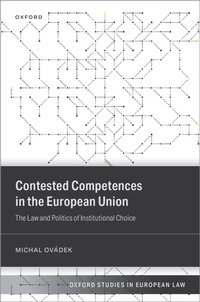
Contested Competences in the European Union
The Law and Politics of Institutional Choice
Will be published approx. on 28. January 2026
Book
Hardback
320 pages
978-0-19-889076-8 (ISBN)
Description
This is an open access title available under the terms of a CC BY-NC-ND 4.0 licence. It is free to read on the Oxford Academic platform and offered as a free PDF download from OUP and selected open access locations.
What role do procedural rules really play in shaping the behaviour of legislative actors? In theory, competences and procedures provide an accepted framework within which ministers, members of parliament, and senators draft and bargain over legislative proposals. Contested Competences in the European Union challenges this perception of legislative operation, revealing that the question of who gets to make decisions, and in accordance with which procedure, is often just as contested as the substantive content of legislation.
While institutional rules constrain actors' behaviour, they are not as fixed as their 'constitutional' nature might suggest. Instead, competences and procedures are regularly adapted through legislative practice in response to political pressures and contestation. Drawing on archival and statistical evidence, Contested Competences in the European Union presents a comprehensive theoretical, empirical, and historical account of the phenomenon of competence contestation across key policy areas. It reveals that the European Commission, Parliament, and Council frequently clash over legal competences, strategically bending procedures to suit their political goals. Despite impeding decision-making efficiency and diverting focus away from policy problems, this constant tug-of-war over rules has become an enduring part of how the EU works - and is unlikely to disappear any time soon.
What role do procedural rules really play in shaping the behaviour of legislative actors? In theory, competences and procedures provide an accepted framework within which ministers, members of parliament, and senators draft and bargain over legislative proposals. Contested Competences in the European Union challenges this perception of legislative operation, revealing that the question of who gets to make decisions, and in accordance with which procedure, is often just as contested as the substantive content of legislation.
While institutional rules constrain actors' behaviour, they are not as fixed as their 'constitutional' nature might suggest. Instead, competences and procedures are regularly adapted through legislative practice in response to political pressures and contestation. Drawing on archival and statistical evidence, Contested Competences in the European Union presents a comprehensive theoretical, empirical, and historical account of the phenomenon of competence contestation across key policy areas. It reveals that the European Commission, Parliament, and Council frequently clash over legal competences, strategically bending procedures to suit their political goals. Despite impeding decision-making efficiency and diverting focus away from policy problems, this constant tug-of-war over rules has become an enduring part of how the EU works - and is unlikely to disappear any time soon.
More details
Language
English
Place of publication
Oxford
United Kingdom
Target group
Professional and scholarly
Product notice
sewn/stitched
Cloth over boards
Dimensions
Height: 239 mm
Width: 162 mm
Thickness: 25 mm
Weight
630 gr
ISBN-13
978-0-19-889076-8 (9780198890768)
Copyright in bibliographic data and cover images is held by Nielsen Book Services Limited or by the publishers or by their respective licensors: all rights reserved.
Schweitzer Classification
Person
Michal Ovadek is an Assistant Professor in European Institutions, Politics and Policy in the UCL Department of Political Science. His research focuses on European integration, judicial politics and Central and Eastern Europe. A consistent theme in his work is the functioning of legal institutions, especially courts, and their impact on politics and society. Previously, Michal had worked as a researcher at universities in Sweden and Belgium and as a political adviser in the European Parliament.
Content
- 1: The Art of the Possible
- 2: Institutional Structure, Actors, and Preferences
- 3: Competences in Legislative Action
- 4: Internal Market
- 5: International Trade
- 6: Agriculture
- 7: Reservoir Power
- 8: Conditions and Consequences of Competence Disputes
- 9: Positions and Coalitions
- 10: Conclusion