

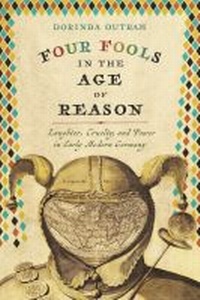
Four Fools in the Age of Reason
Laughter, Cruelty, and Power in Early Modern Germany
Will be published approx. on 30. April 2019
Book
Hardback
184 pages
978-0-8139-4201-8 (ISBN)
Description
Unveiling the nearly lost world of the court fools of eighteenth-century Germany, Dorinda Outram shows that laughter was an essential instrument of power. Whether jovial or cruel, mirth altered social and political relations.
Outram takes us first to the court of Frederick William I of Prussia, who emerges not only as an administrative reformer and notorious militarist but also as a ""master of fools,"" a ruler who used fools to prop up his uncertain power. The autobiography of the itinerant fool Peter Prosch affords a rare insider's view of the small courts in Catholic south Germany, Austria, and Bavaria. Full of sharp observations of prelates and princes, the autobiography also records episodes of the extraordinary cruelty for which the German princely courts were notorious. Joseph Froehlich, court fool in Dresden, presents more appealing facets of foolery. A sharp salesman and hero of the Meissen factories, he was deeply attached to the folk life of fooling. The book ends by tying the growth of Enlightenment skepticism to the demise of court foolery around 1800.
Outram's book is invaluable for giving us such a vivid depiction of the court fool and especially for revealing how this figure can shed new light on the wielding of power in Enlightenment Europe.
Outram takes us first to the court of Frederick William I of Prussia, who emerges not only as an administrative reformer and notorious militarist but also as a ""master of fools,"" a ruler who used fools to prop up his uncertain power. The autobiography of the itinerant fool Peter Prosch affords a rare insider's view of the small courts in Catholic south Germany, Austria, and Bavaria. Full of sharp observations of prelates and princes, the autobiography also records episodes of the extraordinary cruelty for which the German princely courts were notorious. Joseph Froehlich, court fool in Dresden, presents more appealing facets of foolery. A sharp salesman and hero of the Meissen factories, he was deeply attached to the folk life of fooling. The book ends by tying the growth of Enlightenment skepticism to the demise of court foolery around 1800.
Outram's book is invaluable for giving us such a vivid depiction of the court fool and especially for revealing how this figure can shed new light on the wielding of power in Enlightenment Europe.
More details
Series
Language
English
Place of publication
Charlottesville
United States
Target group
Professional and scholarly
Illustrations
8 black & white illustrations
Dimensions
Height: 229 mm
Width: 152 mm
Thickness: 17 mm
Weight
385 gr
ISBN-13
978-0-8139-4201-8 (9780813942018)
Copyright in bibliographic data and cover images is held by Nielsen Book Services Limited or by the publishers or by their respective licensors: all rights reserved.
Schweitzer Classification
Other editions
Additional editions

E-Book
04/2019
1st Edition
Naval Institute Press
from
€86.99
Available for download
Person
Dorinda Outram is Gladys I. and Franklin W. Clark Professor of History at the University of Rochester and the author of Panorama of the Enlightenment and other books.