

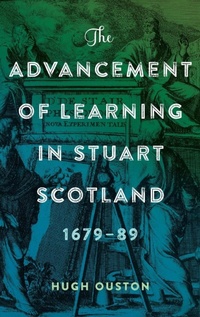
The Advancement of Learning in Stuart Scotland, 1679-89
Published on 6. August 2024
Book
Hardback
356 pages
978-1-83765-200-6 (ISBN)
Description
A study of Scottish thinkers and writers in their political and cultural context.
The "advancement of learning" was the term used by late seventeenth-century Scots for intellectual enquiry of all kinds. Encouraged by Stuart patronage, and echoing a Royalist ideology of continuity and order following the chaos of the Civil War, the "Virtuosi", Scottish writers and thinkers, sought to define Scotland's identity. They undertook structured, empirical enquiry into Scottish natural history and geography, human history and antiquities, law and society, while the legal and medical professions developed their status and purpose through institutions such as the Royal College of Physicians and the Advocates' Library. They both complemented and eclipsed the changing intellectual life of the Church and Universities.
This book considers the work of leading authors, such as Sir George Mackenzie, Sir Robert Sibbald and Lord Stair, alongside the many other voices engaged in learned research and debate, examining their shared or contrasting philosophy and methods. It shows how a distinctively Scottish take on the "Scientific Revolution" was enhanced by close contacts with the Royal Society and English thinkers, and a conscious membership of the European Republic of Letters.
The "advancement of learning" was the term used by late seventeenth-century Scots for intellectual enquiry of all kinds. Encouraged by Stuart patronage, and echoing a Royalist ideology of continuity and order following the chaos of the Civil War, the "Virtuosi", Scottish writers and thinkers, sought to define Scotland's identity. They undertook structured, empirical enquiry into Scottish natural history and geography, human history and antiquities, law and society, while the legal and medical professions developed their status and purpose through institutions such as the Royal College of Physicians and the Advocates' Library. They both complemented and eclipsed the changing intellectual life of the Church and Universities.
This book considers the work of leading authors, such as Sir George Mackenzie, Sir Robert Sibbald and Lord Stair, alongside the many other voices engaged in learned research and debate, examining their shared or contrasting philosophy and methods. It shows how a distinctively Scottish take on the "Scientific Revolution" was enhanced by close contacts with the Royal Society and English thinkers, and a conscious membership of the European Republic of Letters.
Reviews / Votes
Even more than [Ouston's landmark book chapter] "York in Edinburgh," The Advancement of Learning in Stuart Scotland, 1679-1689 makes plain the fertility of the subject and the complexity of the forces involved.Hugh Ouston is to be thanked for his detailed and stimulating exploration of the culture of the Restoration's final decade. * EIGHTEENTH-CENTURY SCOTLAND *More details
Series
Language
English
Place of publication
Woodbridge
United Kingdom
Publishing group
Boydell & Brewer Ltd
Target group
College/higher education
Product notice
Cloth over boards
Dimensions
Height: 240 mm
Width: 161 mm
Thickness: 24 mm
Weight
702 gr
ISBN-13
978-1-83765-200-6 (9781837652006)
Copyright in bibliographic data and cover images is held by Nielsen Book Services Limited or by the publishers or by their respective licensors: all rights reserved.
Schweitzer Classification
Other editions
Additional editions
E-Book
08/2024
1st Edition
Boydell & Brewer Ltd
€72.99
Available for download
E-Book
08/2024
1st Edition
De Gruyter
€72.99
Available for download
Person
Hugh Ouston has taught history in schools in Lothian, Edinburgh, Aberdeen and Perthshire. His interest in late seventeenth century Scotland began with postgraduate research in the 1970s and he completed a D. Phil. in 2020.
Content
Introduction: The historical context
1. 'Th'established hierarchy to secure': politics, ideology and the patronage of learning
2. 'He knew his grandfather's hand': the patronage of the medical profession
3. 'The Natural History ... of that kingdom': Sir Robert Sibbald and the description of Scotland
4. 'A firm and stable Rule, which will ply no obliquity': the legal profession and the Stuart state
5. 'A whole Man and his whole Age': Sir George Mackenzie and the advancement of learning
6. 'All dew incurradgement': patronage and learning in the Church and universities
7. 'The centre of virtue ... in this kingdome': the development of Edinburgh as a learned institution
8. 'What was most remarkable a doing by the learned': the Scottish Virtuoso tradition and the Republic of Letters
Conclusion: 'Intellectual alchemy?'
1. 'Th'established hierarchy to secure': politics, ideology and the patronage of learning
2. 'He knew his grandfather's hand': the patronage of the medical profession
3. 'The Natural History ... of that kingdom': Sir Robert Sibbald and the description of Scotland
4. 'A firm and stable Rule, which will ply no obliquity': the legal profession and the Stuart state
5. 'A whole Man and his whole Age': Sir George Mackenzie and the advancement of learning
6. 'All dew incurradgement': patronage and learning in the Church and universities
7. 'The centre of virtue ... in this kingdome': the development of Edinburgh as a learned institution
8. 'What was most remarkable a doing by the learned': the Scottish Virtuoso tradition and the Republic of Letters
Conclusion: 'Intellectual alchemy?'