

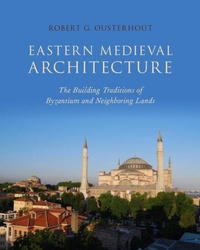
Eastern Medieval Architecture
The Building Traditions of Byzantium and Neighboring Lands
Published on 10. October 2019
Book
Hardback
816 pages
978-0-19-027273-9 (ISBN)
Description
Aside from Hagia Sophia, the monuments of the Byzantine East are poorly understood today. This is in sharp contrast to the well-known architectural marvels of Western Europes Middle Ages. In this landmark survey, distinguished art historian Robert Ousterhout introduces readers to the rich and diverse architectural traditions of the medieval Eastern Mediterranean.
The focus of the book is the Byzantine (or East Roman) Empire (324-1453 CE), with its capital in Constantinople, although the framework expands chronologically to include the foundations of Christian architecture in Late Antiquity and the legacy of Byzantine culture after the fall of Constantinople in 1453. Geographically broad as well, this study includes architectural developments in areas of Italy, the Caucasus, the Near East, the Balkans, and Russia, as well as related developments in early Islamic architecture. Alternating chapters that address chronological or regionally-based developments with thematic studies that focus on the larger cultural concerns, the book presents the architectural developments in a way that makes them accessible, interesting, and intellectually stimulating. In doing so, it also explains why medieval architecture in the East followed such a different trajectory from that of the West.
Lavishly illustrated with hundreds of color photographs, maps, and line drawings, Eastern Medieval Architecture will establish Byzantine traditions to be as significant and admirable as those more familiar examples in Western Europe, and serve as an invaluable resource for anyone interested in architectural history, Byzantium, and the Middle Ages.
The focus of the book is the Byzantine (or East Roman) Empire (324-1453 CE), with its capital in Constantinople, although the framework expands chronologically to include the foundations of Christian architecture in Late Antiquity and the legacy of Byzantine culture after the fall of Constantinople in 1453. Geographically broad as well, this study includes architectural developments in areas of Italy, the Caucasus, the Near East, the Balkans, and Russia, as well as related developments in early Islamic architecture. Alternating chapters that address chronological or regionally-based developments with thematic studies that focus on the larger cultural concerns, the book presents the architectural developments in a way that makes them accessible, interesting, and intellectually stimulating. In doing so, it also explains why medieval architecture in the East followed such a different trajectory from that of the West.
Lavishly illustrated with hundreds of color photographs, maps, and line drawings, Eastern Medieval Architecture will establish Byzantine traditions to be as significant and admirable as those more familiar examples in Western Europe, and serve as an invaluable resource for anyone interested in architectural history, Byzantium, and the Middle Ages.
Reviews / Votes
It is without doubt destined to be the standard reference book on Byzantine architecture for the future. * The Burlington Magazine * An engaging exploration of the monuments of the Christian East, as well as the interaction between architecture and the many cultures and intellectual, political, and economic currents that help shape it. Augmented by recommendations for further reading and an extensive bibliography, Eastern Medieval Architecture offers the reader a starting point for study of these structures, as well as a window into an impressive career.... Accessible and affordable, Robert Ousterhout's Eastern Medieval Architecture is a must-have for any teacher or student of architecture, Byzantium, or of the medieval. * Peregrinations * It is beautifully written, and filled with the most carefully chosen photographs of structures and details, rendered in glorious colour, and scores of drawings by the author's own hand. If every generation gets the history of Byzantine architecture that it deserves, then ours is very fortunate indeed! * Cornucopia * Eastern Medieval Architecture offers a fresh and inviting introduction to the vibrant architectural traditions of the Byzantine Empire and its neighbors. In this learned yet eminently readable volume, Ousterhout masterfully distills a vast amount of specialized research on more than a millennium of architectural production, both sacred and secular. His synthesis of canonical monuments and lesser-known buildings engagingly situates architecture within broader histories of empire, sacred space, craft production, and cultural interaction. * Ann Marie Yasin, University of Southern California * This is the most consequential study of its kind to appear in many years. It will change the way we study and teach Byzantine architecture. * Vasileios Marinis, Yale University * In this much-needed book, Robert Ousterhout provides an up-to-date introduction to the architecture of Byzantium and its neighbors. Diverse and generous in its scope and approach, while at the same time presenting a coherent narrative of a fascinating and complex subject, it will long remain the pre-eminent survey of the field for specialists and non-specialists alike. * Christina Maranci, Tufts University * A masterful, concise, and eminently readable synthesis of the architectural -- and thus also a key aspect of the cultural -- history of the medieval eastern Roman world and its neighbors. Drawing on his own ground-breaking research, on the original sources (written, material-cultural, and archaeological), and informed by an intimate knowledge of the vast modern literature in the field, Robert Ousterhout has produced an invaluable survey that will undoubtedly be the basic 'go-to' reference work for the subject for many years to come. * John Haldon, Princeton University *More details
Series
Language
English
Place of publication
New York
United States
Product notice
sewn/stitched
Cloth over boards
Illustrations
445 color illus., 368 b/w illus., 6 maps
Dimensions
Height: 274 mm
Width: 216 mm
Thickness: 47 mm
Weight
2477 gr
ISBN-13
978-0-19-027273-9 (9780190272739)
Copyright in bibliographic data and cover images is held by Nielsen Book Services Limited or by the publishers or by their respective licensors: all rights reserved.
Schweitzer Classification
Other editions
Additional editions
Robert G. Ousterhout
Eastern Medieval Architecture
The Building Traditions of Byzantium and Neighboring Lands
E-Book
08/2019
OUP eBook
€34.99
Available for download
Robert G. Ousterhout
Eastern Medieval Architecture
The Building Traditions of Byzantium and Neighboring Lands
E-Book
08/2019
OUP eBook
€34.99
Available for download
Person
Robert G. Ousterhout is Professor Emeritus in the History of Art at the University of Pennsylvania. His previous books include Visualizing Community: Art, Material Culture, and Settlement in Byzantine Cappadocia and Master Builders of Byzantium.
Content
- Author's Preface
- Introduction: Historical Architecture, East and West
- Part One: Late Antiquity (fourth to Seventh Centuries)
- Chapter One: Rome, the Domus Ecclesiae, and the Church Basilica
- Chapter Two: A Tale of Two Cities: Constantinople and Jerusalem in the Time of Constantine
- Chapter Three: Ritual Settings I: Liturgy, Initiation, Commemoration
- Chapter Four: Ritual Settings II: Pilgrimage, Relics, and Sacred Space
- Chapter Five: Makers, Methods, and Materials
- Chapter Six: Regional Developments, East and West
- Chapter Seven: Secular Architecture: Cities, Houses, and Fortifications
- Chapter Eight: Innovative Architecture
- Chapter Nine: The Basilica Transformed: Hagia Sophia in Constantinople
- Chapter Ten: Justinian's Building Program and Sixth-Century Developments
- Part Two: The Transitional Period (seventh to ninth centuries)
- Chapter Eleven: The Transitional Period within Byzantium
- Chapter Twelve: Transformation at the Edges of Empire
- Part Three: The Middle Byzantine Centuries (ninth to twelfth centuries)
- Chapter Thirteen: New Church Architecture and the Rise of Monasticism
- Chapter Fourteen: Secular Architecture and the Fate of the City
- Chapter Fifteen: Constantinople as an Architectural Center
- Chapter Sixteen: Master Builders and Their Craft
- Chapter Seventeen: Development of Regional Styles I: Middle Byzantine Greece and Macedonia
- Chapter Eighteen: Development of Regional Styles II: Middle Byzantine Anatolia
- Chapter Nineteen: Development of Regional Styles III: The Caucasus
- Chapter Twenty: Contested Lands: Architecture at the Time of the Crusades
- Chapter Twenty-One: The Exotic West: Southern Italy, Venice, and Sicily
- Chapter Twenty-Two: Exporting a Culture / Importing a Culture: Bulgaria, Kievan Rus' and Serbia
- Part Four: The Late Byzantine and Post-Byzantine Centuries (thirteenth to fifteenth centuries)
- Chapter Twenty-Three: The Difficult Thirteenth Century
- Chapter Twenty-Four: Palaiologan Constantinople and a New Architectural Idiom
- Chapter Twenty-Five: Old and New: Greek Cities and Landscapes
- Chapter Twenty-Six: Regional Diversity: Bulgaria, Serbia, and Romania
- Chapter Twenty-Seven: Rival Powers: The Ottomans and Russia
- Epilogue: An Enduring Legacy
- Glossary of Terms
- Abbreviations
- Bibliography
- Index