

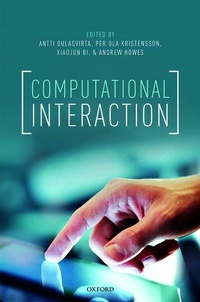
Computational Interaction
Published on 8. February 2018
Book
Paperback/Softback
432 pages
978-0-19-879961-0 (ISBN)
Description
This book presents computational interaction as an approach to explaining and enhancing the interaction between humans and information technology. Computational interaction applies abstraction, automation, and analysis to inform our understanding of the structure of interaction and also to inform the design of the software that drives new and exciting human-computer interfaces. The methods of computational interaction allow, for example, designers to identify user interfaces that are optimal against some objective criteria. They also allow software engineers to build interactive systems that adapt their behaviour to better suit individual capacities and preferences.
Embedded in an iterative design process, computational interaction has the potential to complement human strengths and provide methods for generating inspiring and elegant designs.
Computational interaction does not exclude the messy and complicated behaviour of humans, rather it embraces it by, for example, using models that are sensitive to uncertainty and that capture subtle variations between individual users. It also promotes the idea that there are many aspects of interaction that can be augmented by algorithms.
This book introduces computational interaction design to the reader by exploring a wide range of computational interaction techniques, strategies and methods. It explains how techniques such as optimisation, economic modelling, machine learning, control theory, formal methods, cognitive models and statistical language processing can be used to model interaction and design more expressive, efficient and versatile interaction.
Embedded in an iterative design process, computational interaction has the potential to complement human strengths and provide methods for generating inspiring and elegant designs.
Computational interaction does not exclude the messy and complicated behaviour of humans, rather it embraces it by, for example, using models that are sensitive to uncertainty and that capture subtle variations between individual users. It also promotes the idea that there are many aspects of interaction that can be augmented by algorithms.
This book introduces computational interaction design to the reader by exploring a wide range of computational interaction techniques, strategies and methods. It explains how techniques such as optimisation, economic modelling, machine learning, control theory, formal methods, cognitive models and statistical language processing can be used to model interaction and design more expressive, efficient and versatile interaction.
Reviews / Votes
This a detailed collection of well written papers which explores a wide range of Computational Interaction techniques and human/computer interaction settings. There is plenty of thought-provoking material that should be of interest to those involved in user interface design, implementation and assessment. * Patrick Hill, British Computational Society Reviews *More details
Language
English
Place of publication
Oxford
United Kingdom
Target group
Professional and scholarly
Product notice
Paperback (trade)
Unsewn / adhesive bound
Dimensions
Height: 231 mm
Width: 158 mm
Thickness: 22 mm
Weight
719 gr
ISBN-13
978-0-19-879961-0 (9780198799610)
Copyright in bibliographic data and cover images is held by Nielsen Book Services Limited or by the publishers or by their respective licensors: all rights reserved.
Schweitzer Classification
Other editions
Additional editions
Antti Oulasvirta | Per Ola Kristensson | Xiaojun Bi
Computational Interaction
Book
02/2018
Oxford University Press
€146.00
Shipment within 15-20 days
Antti Oulasvirta | Per Ola Kristensson | Xiaojun Bi
Computational Interaction
E-Book
01/2018
1st Edition
OUP eBook
€53.99
Available for download
Persons
Antti Oulasvirta is an Associate Professor at Aalto University where he leads the User Interfaces research group. He was previously a Senior Researcher at the Max Planck Institute for Informatics and the Cluster of Excellence on Multimodal Computing and Interaction at Saarland university. He received his doctorate in Cognitive Science from the University of Helsinki in 2006, after which he was a Fulbright Scholar at the School of Information in University of California-Berkeley in 2007-2008
Per Ola Kristensson is University Reader in Interactive Systems Engineering in the Department of Engineering at the University of Cambridge and a Fellow of Trinity College, Cambridge. He is interested in designing intelligent interactive systems that enable people to be more creative, expressive and satisfied in their daily lives. He is an Associate Editor of ACM Transactions on Computer-Human Interaction and ACM Transactions Intelligent Interactive Systems. In 2013, MIT Technology Review named him an Innovator Under 35 (TR35) and in 2014 he received the ACM User Interface Software and Technology Lasting Impact Award.
Xiaojun Bi is an Assistant Professor in the Department of Computer Science at Stony Brook University. He earned his Ph.D. from the Department of Computer Science at the University of Toronto, and received his Master's and Bachelor's degrees from Tsinghua University, China. He won the first place in the National Mathematical Olympiad (China) in his home province when he was a high school student, recruited by Tsinghua University with the national college entrance examination waived. Xiaojun Bi has authored over 25 publications in the premier HCI publication venues such as ACM CHI, UIST, and Human Computer Interaction, and over 20 US patents.
Andrew Howes is is a Professor of Human-Computer Interaction at the University of Birmingham School of Computer Science. His research interests are in computational models of human interaction. He is an associate editor of the International Journal of Human-Computer Studies and of Cognitive Science and he has served as committee member for the ACM SIGCHI Conference on Human Factors in Computing Systems. He was chair of the ACM CHI 2014 Spotlight on Interaction Science. Howes is currently visiting faculty at the Weinberg Institute for Cognitive Science at the University of Michigan and was a visiting scientist at NASA Ames Research Center
in 2015.
Per Ola Kristensson is University Reader in Interactive Systems Engineering in the Department of Engineering at the University of Cambridge and a Fellow of Trinity College, Cambridge. He is interested in designing intelligent interactive systems that enable people to be more creative, expressive and satisfied in their daily lives. He is an Associate Editor of ACM Transactions on Computer-Human Interaction and ACM Transactions Intelligent Interactive Systems. In 2013, MIT Technology Review named him an Innovator Under 35 (TR35) and in 2014 he received the ACM User Interface Software and Technology Lasting Impact Award.
Xiaojun Bi is an Assistant Professor in the Department of Computer Science at Stony Brook University. He earned his Ph.D. from the Department of Computer Science at the University of Toronto, and received his Master's and Bachelor's degrees from Tsinghua University, China. He won the first place in the National Mathematical Olympiad (China) in his home province when he was a high school student, recruited by Tsinghua University with the national college entrance examination waived. Xiaojun Bi has authored over 25 publications in the premier HCI publication venues such as ACM CHI, UIST, and Human Computer Interaction, and over 20 US patents.
Andrew Howes is is a Professor of Human-Computer Interaction at the University of Birmingham School of Computer Science. His research interests are in computational models of human interaction. He is an associate editor of the International Journal of Human-Computer Studies and of Cognitive Science and he has served as committee member for the ACM SIGCHI Conference on Human Factors in Computing Systems. He was chair of the ACM CHI 2014 Spotlight on Interaction Science. Howes is currently visiting faculty at the Weinberg Institute for Cognitive Science at the University of Michigan and was a visiting scientist at NASA Ames Research Center
in 2015.
Editor
Associate ProfessorAssociate Professor, Aalto University
University Reader in Interactive Systems EngineeringUniversity Reader in Interactive Systems Engineering, University of Cambridge
Assistant ProfessorAssistant Professor, Stony Brook University
Professor and Head of School at the School of Computer ScienceProfessor and Head of School at the School of Computer Science, University of Birmingham
Content
Input and interaction techniques
1: Roderick Murray-Smith: Control Theory, Dynamics and Continuous Interaction
2: Per Ola Kristensson: Statistical Language Processing for Text Entry
3: Otmar Hilliges: Input Recognition
Design
4: Antti Oulasvirta, Andreas Karrenbauer: Combinatorial Optimization for UI Design
5: Xiaojun Bi, Brian Smith, Tom Ouyang, Shumin Zhai: Soft Keyboard Performance Optimization
6: Yuki Koyama, Takeo Igarashi: Computational Design with Crowds
Systems
7: Alan Dix: Practical Formal Methods in HCI
8: Paul Cairns, Harold Thimbleby: From Premature Semantics to Mature Interaction Programming
9: Celia Martinie, Philippe Palanque, Camille Fayollas: Performance Evaluation of Interactive Systems with ICO Models
Human Behaviour
10: Andrew Howes, Xiuli Chen, Aditya Acharya, Richard L. Lewis: Interaction as an Emergent Property of a Partially Observable Markov Decision Process
11: Leif Azzopardi, Guido Zuccon: Economic Models of Interaction
12: Duncan P. Brumby, Christian P. Janssen, Tuomo Kujala, Dario D. Salvucci: Computational Models of User Multitasking
13: Wai-Tat Fu, Jessie Chin, Q. Vera Liao: The Central Role of Cognitive Computations in Human-Information Interaction
14: Nikola Banovic, Jennifer Mankoff, Anind K. Dey: Computational Model of Human Routine Behaviors
15: Wai-Tat Fu, Mingkun Gao, Hyo Jin Do: Computational Methods for Socio-Computer Interaction
1: Roderick Murray-Smith: Control Theory, Dynamics and Continuous Interaction
2: Per Ola Kristensson: Statistical Language Processing for Text Entry
3: Otmar Hilliges: Input Recognition
Design
4: Antti Oulasvirta, Andreas Karrenbauer: Combinatorial Optimization for UI Design
5: Xiaojun Bi, Brian Smith, Tom Ouyang, Shumin Zhai: Soft Keyboard Performance Optimization
6: Yuki Koyama, Takeo Igarashi: Computational Design with Crowds
Systems
7: Alan Dix: Practical Formal Methods in HCI
8: Paul Cairns, Harold Thimbleby: From Premature Semantics to Mature Interaction Programming
9: Celia Martinie, Philippe Palanque, Camille Fayollas: Performance Evaluation of Interactive Systems with ICO Models
Human Behaviour
10: Andrew Howes, Xiuli Chen, Aditya Acharya, Richard L. Lewis: Interaction as an Emergent Property of a Partially Observable Markov Decision Process
11: Leif Azzopardi, Guido Zuccon: Economic Models of Interaction
12: Duncan P. Brumby, Christian P. Janssen, Tuomo Kujala, Dario D. Salvucci: Computational Models of User Multitasking
13: Wai-Tat Fu, Jessie Chin, Q. Vera Liao: The Central Role of Cognitive Computations in Human-Information Interaction
14: Nikola Banovic, Jennifer Mankoff, Anind K. Dey: Computational Model of Human Routine Behaviors
15: Wai-Tat Fu, Mingkun Gao, Hyo Jin Do: Computational Methods for Socio-Computer Interaction