

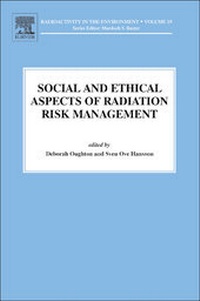
Social and Ethical Aspects of Radiation Risk Management: Volume 19
Published on 20. September 2013
Book
Hardback
408 pages
978-0-08-045015-5 (ISBN)
Description
Social and Ethical Aspects of Radiation Risk Management provides a comprehensive treatment of the major ethical and social issues resulting from the use of ionizing radiation. It covers topics such as nuclear fuel cycles, radioactive waste treatment, nuclear bomb testing, nuclear safety management, stakeholder engagement, cleanup after nuclear accidents, ecological risks from radiation, environmental justice, health and safety for radiation workers, radiation dose standards, the ethics of clinical radiology, and the principles of radiation protection and their ethical underpinnings. With authors ranging from philosophers to radiation protection officials and practitioners, the book spans from theoretical to practical implications of this important area of radiation risk assessment and management.
Reviews / Votes
"...quick and easy to read, as the chapters are quite short and do not contain equations, sophisticated graphs, or very technical language...This book definitely serves its stated purpose: it is indeed a response to the much-needed discussion between the public and government and scientists and stakeholders about radiation risk management." --Health Physics, July 2014More details
Series
Language
English
Place of publication
Oxford
United Kingdom
Publishing group
Elsevier Science & Technology
Target group
Professional and scholarly
Health physics specialists, radiation protection authorities, industry and regulators, risk assessors and managers, students in applied ethics<b>
</b>Illustrations
Illustrated
Dimensions
Height: 229 mm
Width: 152 mm
Weight
710 gr
ISBN-13
978-0-08-045015-5 (9780080450155)
Copyright in bibliographic data and cover images is held by Nielsen Book Services Limited or by the publishers or by their respective licensors: all rights reserved.
Schweitzer Classification
Other editions
Additional editions
Deborah Oughton | Sven Ove Hansson
Social and Ethical Aspects of Radiation Risk Management: Volume 19
Book
10/2018
Elsevier
€179.51
The article will not be published
D. Oughton | Sven Ove Hansson | M. Baxter
Social and Ethical Aspects of Radiation Risk Management
E-Book
05/2014
Elsevier
€180.00
Available for download
Persons
Deborah Oughton is professor in nuclear and environmental chemistry, and research director of the Centre of Environmental Radioactivity, at the Norwegian University of Life Sciences (UMB). Since the early 1990s, through the support of the Norwegian Ethics Programme, she has combined a career in science with study and research on the ethical implications of radiation risk. She currently holds an associated professorship in Research Ethics at the University of Oslo, is deputy head of the National Committee on Research Ethics in Science and Technology, and ethics coordinator at UMB. She has published widely in both science and ethics, and has been a strong advocate of putting ethics into practice in radiation risk management. Sven Ove Hansson, professor in philosophy, is a leading expert in the ethics of risk and one of the few moral philosophers who have written extensively on the ethics of radiation protection. In addition to being a moral philosopher, he is also a logician and a decision theorist. He is editor-in-chief of Theoria and editor of the book series Studia Logica Library: Outstanding Contributions. He is a member of the editorial boards of Synthese, Studia Logica, and the Journal of Philosophical Logic; member of the scientific editorial board of Philosophy & Technology; and area editor of the book series Logic, Argumentation & Reasoning. His books include The Structure of Values and Norms and Ethics at Peril. He is the author of well over 250 articles in refereed journals. He is member of the Royal Swedish Academy of Engineering Sciences (IVA) and President of the Society for Philosophy and Technology.
Content
Preface
1. Introduction
Part I. Ethical principles for radiation protection
2. Radiation risks and the ICRP
3. Moral thinking and radiation protection
4. A cross-cultural approach to radiation ethics
5. Ethical aspects of ecological risks from radiation
6. Why chemical risk assessment can learn from radiation protection
Part II. Putting protection to practice
7. Ethical issues in clinical radiology
8. Ethics in practice - protecting workers
9. ALARA: What is reasonably achievable?
Part III. Nuclear accidents and how to prevent them
10. Lessons learned from the Chernobyl accident in Norway
11. Lessons from the Fukushima Daiichi Disaster
12. Environmental injustice in radiation dose standards
13. Safety culture and safety quality
Part IV. Proliferation and the nuclear fuel cycle
14. The legacies of Soviet nuclear testing in Kazakhstan
15. Moral dilemmas of uranium and thorium fuel cycles
Part V. Public participation
16. Social identities and public uptake of science
17. Stakeholder Engagement in regaining living conditions after Chernobyl
18. Public Participation - potential and pitfalls
19. Can radwaste host communities be compensated without being bribed?
Index
1. Introduction
Part I. Ethical principles for radiation protection
2. Radiation risks and the ICRP
3. Moral thinking and radiation protection
4. A cross-cultural approach to radiation ethics
5. Ethical aspects of ecological risks from radiation
6. Why chemical risk assessment can learn from radiation protection
Part II. Putting protection to practice
7. Ethical issues in clinical radiology
8. Ethics in practice - protecting workers
9. ALARA: What is reasonably achievable?
Part III. Nuclear accidents and how to prevent them
10. Lessons learned from the Chernobyl accident in Norway
11. Lessons from the Fukushima Daiichi Disaster
12. Environmental injustice in radiation dose standards
13. Safety culture and safety quality
Part IV. Proliferation and the nuclear fuel cycle
14. The legacies of Soviet nuclear testing in Kazakhstan
15. Moral dilemmas of uranium and thorium fuel cycles
Part V. Public participation
16. Social identities and public uptake of science
17. Stakeholder Engagement in regaining living conditions after Chernobyl
18. Public Participation - potential and pitfalls
19. Can radwaste host communities be compensated without being bribed?
Index