

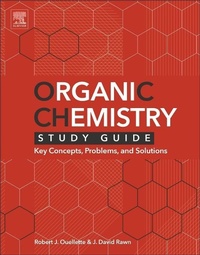
Organic Chemistry Study Guide
Key Concepts, Problems, and Solutions
Published on 23. October 2014
Book
Paperback/Softback
614 pages
978-0-12-801889-7 (ISBN)
Description
Organic Chemistry Study Guide: Key Concepts, Problems, and Solutions features hundreds of problems from the companion book, Organic Chemistry, and includes solutions for every problem. Key concept summaries reinforce critical material from the primary book and enhance mastery of this complex subject.
Organic chemistry is a constantly evolving field that has great relevance for all scientists, not just chemists. For chemical engineers, understanding the properties of organic molecules and how reactions occur is critically important to understanding the processes in an industrial plant. For biologists and health professionals, it is essential because nearly all of biochemistry springs from organic chemistry. Additionally, all scientists can benefit from improved critical thinking and problem-solving skills that are developed from the study of organic chemistry.
Organic chemistry, like any "skill", is best learned by doing. It is difficult to learn by rote memorization, and true understanding comes only from concentrated reading, and working as many problems as possible. In fact, problem sets are the best way to ensure that concepts are not only well understood, but can also be applied to real-world problems in the work place.
Organic chemistry is a constantly evolving field that has great relevance for all scientists, not just chemists. For chemical engineers, understanding the properties of organic molecules and how reactions occur is critically important to understanding the processes in an industrial plant. For biologists and health professionals, it is essential because nearly all of biochemistry springs from organic chemistry. Additionally, all scientists can benefit from improved critical thinking and problem-solving skills that are developed from the study of organic chemistry.
Organic chemistry, like any "skill", is best learned by doing. It is difficult to learn by rote memorization, and true understanding comes only from concentrated reading, and working as many problems as possible. In fact, problem sets are the best way to ensure that concepts are not only well understood, but can also be applied to real-world problems in the work place.
More details
Language
English
Place of publication
United States
Target group
College/higher education
Chemists, life scientists, food scientists, pharmacists, students in the physical and life sciences
Product notice
Paperback (trade)
Unsewn / adhesive bound
Dimensions
Height: 277 mm
Width: 217 mm
Thickness: 30 mm
Weight
1699 gr
ISBN-13
978-0-12-801889-7 (9780128018897)
Copyright in bibliographic data and cover images is held by Nielsen Book Services Limited or by the publishers or by their respective licensors: all rights reserved.
Schweitzer Classification
Other editions
Additional editions
Robert J. Ouellette | J. David Rawn
Organic Chemistry Study Guide
Key Concepts, Problems, and Solutions
E-Book
11/2014
Elsevier
€98.95
Available for download
Persons
Robert J. Ouellette, Professor Emeritus, Department of Chemistry, The Ohio State University. J. David Rawn, Department of Chemistry, Towson University
Content
Structure and Bonding in Organic CompoundsFunctional Groups and Their PropertiesEnergy Changes and Organic Reaction MechanismsAlkanes and Cycloalkanes Structures and ReactionsAlkenes Structures and PropertiesAlkenes Addition ReactionsAlkynesStereochemistryHaloalkanes and AlcoholsNucleophilic Substitution and Elimination ReactionsConjugated AlkenesArenes and AromatacityElectrophilic Aromatic SubstitutionMethods for Structure Determination: NMR and MSAlcohols: Reaction and SynthesisEthers and EpoxidesOrganometallic Chemistry of Transition Metal Compounds and Introduction to RetrosynthesisAldehydes and KetonesCarboxylic AcidsCarboxylic Acid DerivativesCarbonyl Condensation Reactions: Enols and EnolatesAmines and AmidesAryl Halides, Phenols and AnalinesPericyclic ReactionsCarbohydratesAmino Acids, Peptides and Proteins