

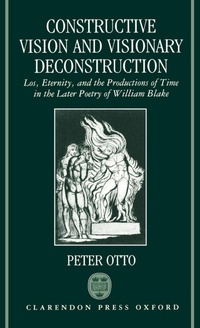
Constructive Vision and Visionary Deconstruction
Los, Eternity, and the Productions of Time in the Later Poetry of William Blake
Published on 14. February 1991
Book
Hardback
256 pages
978-0-19-811751-3 (ISBN)
Description
`Short copy entry, for Eng Lit 91'
This book focuses on the tension in Blake's poetry between a hermeneutics of suspicion and a hermeneutics of belief: it offers a new account of the way in which Blake's major prophecies work and of the stratagems they employ to consolidate error and so open their readers' eyes to `otherness'. Central to Peter Otto's reading is a re-definition of the role of Los and Jesus in Blake's work, emphasising Blake's prophetic intent. In the course of a radically new reading of Milton and Jerusalem, it is argued that in these poems the autonomous, world-forming imagination (that is staple to many accounts of Romanticism) is subject to visionary deconstruction. Rather than subordinating existence to perception, Blake's poems attempt to induce their readers to act. Constructive Vision is the first systematic and comprehensive analysis of Blake's work to draw on a radically new understanding of Blake's view of humanity.
This book focuses on the tension in Blake's poetry between a hermeneutics of suspicion and a hermeneutics of belief: it offers a new account of the way in which Blake's major prophecies work and of the stratagems they employ to consolidate error and so open their readers' eyes to `otherness'. Central to Peter Otto's reading is a re-definition of the role of Los and Jesus in Blake's work, emphasising Blake's prophetic intent. In the course of a radically new reading of Milton and Jerusalem, it is argued that in these poems the autonomous, world-forming imagination (that is staple to many accounts of Romanticism) is subject to visionary deconstruction. Rather than subordinating existence to perception, Blake's poems attempt to induce their readers to act. Constructive Vision is the first systematic and comprehensive analysis of Blake's work to draw on a radically new understanding of Blake's view of humanity.
Reviews / Votes
'certainly good for intense and intellectually demanding reading'Blake/An Illustrated Quarterly, Summer 1991 'Leading us, passage by passage, through Blake's two most difficult poems, he often has illuminating things to say ... many readers, particularly those still struggling to come to terms with Milton and Jerusalem, will find Otto highly useful as an interpreter who, eschewing eccentricity, speaks in Blake's own vein rather than in some alternative to it ... he excels in the use and explication of symbolic images.'
Brian Wilkie, University of Arkansas, Fayetteville, MLR,88.3, 1993 'In his engaging discussion of Milton he shows how critics have tended to base their readings on an ethic of self-fulfilment that the 'Bard's Song' is actually designed to deconstruct. His exploration of the 'three classes of men; defined in the poem ... is likely to have a lasting influence on approaches to the work. Otto's discussion of time ... brings a new sophistication to a subject that Blake criticism has tended to handle in a makeshift fashion.'
Andrew Lincoln, University of London, Literature and Theology, Vol. 7, No. 4, Dec '903 'an important book that should be read by all Blake critics'
Wordsworth Circle, Autumn 1993, Vol. XXIV, No. 4 'Otto's emphases permit him some most illuminating expositions of difficult texts, such as the Bard's song from Milton.'
Edward Larrissy. University of Keele. Notes and Queries. Sept '94
More details
Language
English
Place of publication
Oxford
United Kingdom
Publishing group
Oxford University Press
Target group
Professional and scholarly
Illustrations
3 Fotos bzw. Rasterbilder, 1 Zeichnung
3 halftones, 1 line drawing
Dimensions
Height: 222 mm
Width: 145 mm
Thickness: 19 mm
Weight
502 gr
ISBN-13
978-0-19-811751-3 (9780198117513)
Copyright in bibliographic data and cover images is held by Nielsen Book Services Limited or by the publishers or by their respective licensors: all rights reserved.
Schweitzer Classification