

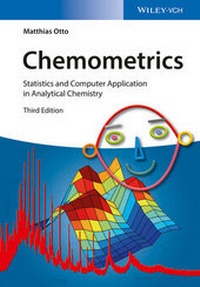
Chemometrics
Statistics and Computer Application in Analytical Chemistry
3rd Edition
Published on 16. November 2016
Book
Paperback/Softback
X, 383 pages
978-3-527-34097-2 (ISBN)
Description
The third edition of this long-selling introductory textbook and ready reference covers all pertinent topics, from basic statistics via modeling and databases right up to the latest regulatory issues.
The experienced and internationally recognized author, Matthias Otto, introduces the statistical-mathematical evaluation of chemical measurements, especially analytical ones, going on to provide a modern approach to signal processing, designing and optimizing experiments, pattern recognition and classification, as well as modeling simple and nonlinear relationships. Analytical databases are equally covered as are applications of multiway analysis, artificial intelligence, fuzzy theory, neural networks, and genetic algorithms. The new edition has 10% new content to cover such recent developments as orthogonal signal correction and new data exchange formats, tree based classification and regression, independent component analysis, ensemble methods and neuro-fuzzy systems. It still retains, however, the proven features from previous editions: worked examples, questions and problems, additional information and brief explanations in the margin.
The experienced and internationally recognized author, Matthias Otto, introduces the statistical-mathematical evaluation of chemical measurements, especially analytical ones, going on to provide a modern approach to signal processing, designing and optimizing experiments, pattern recognition and classification, as well as modeling simple and nonlinear relationships. Analytical databases are equally covered as are applications of multiway analysis, artificial intelligence, fuzzy theory, neural networks, and genetic algorithms. The new edition has 10% new content to cover such recent developments as orthogonal signal correction and new data exchange formats, tree based classification and regression, independent component analysis, ensemble methods and neuro-fuzzy systems. It still retains, however, the proven features from previous editions: worked examples, questions and problems, additional information and brief explanations in the margin.
Reviews / Votes
"Das Buch zeigt Verfahren zum Umgang mit Daten etc. Zusätzlich werden komplexere Themen wie PCA sehr gut dargestellt."Christian Lutz, TU Clausthal
More details
Edition
3. Auflage
Language
English
Place of publication
Berlin
Germany
Target group
Professional and scholarly
Illustrations
78
201 s/w Abbildungen, 78 s/w Tabellen
Dimensions
Height: 24.4 cm
Width: 17 cm
Thickness: 3.1 cm
Weight
872 gr
ISBN-13
978-3-527-34097-2 (9783527340972)
Schweitzer Classification
Other editions
New editions
Book
12/2023
4th Edition
Wiley-VCH
€109.00
Available immediately
Additional editions
E-Book
09/2016
3rd Edition
Wiley-VCH
€87.99
Available for download
E-Book
09/2016
3rd Edition
Wiley-VCH
€87.99
Available for download
Previous edition
Book
02/2007
2nd Edition
Wiley-VCH
€104.00
Article exhausted; check for reprint
Person
Since 2016, Matthias Otto is Professor emeritus of Analytical Chemistry at the TU Bergakademie Freiberg in Germany. He was born in Dresden (Germany) and did all entire studies at the University of Leipzig. In 1984 he moved to Freiberg (Germany) as a lecturer and was appointed full Professor there in 1987. He has taught almost all aspects of Analytical Chemistry, mainly within the curricula of chemistry, applied sciences and geoecology, and organizes courses in basic and advanced chemometrics. He is author and editor of successful textbooks in analytical chemistry.
Content
What is Chemometrics?
Basic Statistics
Signal Processing and Time-Series Analysis
Asymmetric Least Squares Smoothing Correction (AsLS)
Peak alignment methods
Optimization and Experimental Design
Supersaturated design
Pattern Recognition and Classification
Confusion matrix
Tree based clustering/classification
Modeling
Orthogonal signal correction
Independent Component Analysis (ICA)
Robust methods
Orthogonal Partial Least Squares (OPLS)
Multivariate Curve Resolution (MCR)
Re-sampling techniques (bootstrapping /jackknifing)
Bagging/Boosting
Analytical Databases
New data exchange formats: Netcdf, mzXML, etc.
Molecular structure generation/elucidation
Molecular descriptors and QSAR/QSPR examples
Knowledge Processing and Soft Computing
Ant colony algorithm
Dynamic neural networks?
Quality Assurance and Good Laboratory Practice
Update of directives
Appendix
Software update
Extend table III
Basic Statistics
Signal Processing and Time-Series Analysis
Asymmetric Least Squares Smoothing Correction (AsLS)
Peak alignment methods
Optimization and Experimental Design
Supersaturated design
Pattern Recognition and Classification
Confusion matrix
Tree based clustering/classification
Modeling
Orthogonal signal correction
Independent Component Analysis (ICA)
Robust methods
Orthogonal Partial Least Squares (OPLS)
Multivariate Curve Resolution (MCR)
Re-sampling techniques (bootstrapping /jackknifing)
Bagging/Boosting
Analytical Databases
New data exchange formats: Netcdf, mzXML, etc.
Molecular structure generation/elucidation
Molecular descriptors and QSAR/QSPR examples
Knowledge Processing and Soft Computing
Ant colony algorithm
Dynamic neural networks?
Quality Assurance and Good Laboratory Practice
Update of directives
Appendix
Software update
Extend table III