

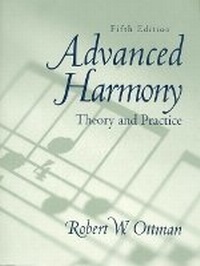
Advanced Harmony
Theory and Practice with CD Package
5th Edition
Published on 12. October 2000
Book
Mixed media product
504 pages
978-0-13-086237-2 (ISBN)
Description
For undergraduate courses in Music Theory in departments of Music.
A companion text to Ottman's Elementary Harmony: Theory and Practice, 5/e, Advanced Harmony continues the course of instruction in basic music theory. Combined, these two volumes present a systematic study of the principles of harmonic composition as developed by the composers of the 17th to the 19th centuries. It takes the reader to a more complex level of materials-19th century through 20th century. The text applies an incremental learning approach to the academic aspect of music and applies newly acquired knowledge to the writing of music.
A companion text to Ottman's Elementary Harmony: Theory and Practice, 5/e, Advanced Harmony continues the course of instruction in basic music theory. Combined, these two volumes present a systematic study of the principles of harmonic composition as developed by the composers of the 17th to the 19th centuries. It takes the reader to a more complex level of materials-19th century through 20th century. The text applies an incremental learning approach to the academic aspect of music and applies newly acquired knowledge to the writing of music.
More details
Edition
5th edition
Language
English
Place of publication
United States
Publishing group
Pearson Education (US)
Target group
Professional and scholarly
Dimensions
Height: 150 mm
Width: 250 mm
Thickness: 15 mm
Weight
1107 gr
ISBN-13
978-0-13-086237-2 (9780130862372)
Copyright in bibliographic data and cover images is held by Nielsen Book Services Limited or by the publishers or by their respective licensors: all rights reserved.
Schweitzer Classification
Other editions
Previous edition

Robert W. Ottman
Advanced Harmony:Theory and Practice
Book
12/1999
5th Edition
Pearson Education (US)
€37.13
Article exhausted; check for reprint
Content
1. Modulation.
2. Diminished Triads and Seventh Chords, Including Secondary Leading-Tone Functions.
3. Modulation with Diminished Seventh Chords.
4. Binary and Ternary Forms.
5. Application of Part-Writing Procedures to Instrumental Music.
6. Diatonic Seventh Chords.
7. Chromatic Chords: Modal Mixture; the Neapolitan Sixth; the Augmented Triad.
8. Augmented Sixth Chords.
9. Augmented Sixth Chords: Modulation and Other Uses.
10. Chords of the Ninth, the Eleventh, and the Thirteenth.
11. Chords and Progressions in Special Situations.
12. The Close of the Nineteenth Century-The Beginning of New Directions.
13. Debussy and Impressionism.
14. After Debussy: An Introduction to Twentieth-Century Music.
15. Twentieth-Century Music: Melody, Rhythm, and Harmony.
16. Serial Composition and Later Twentieth-Century Processes.
Appendix A. The Essentials of Part: Writing, Conventional Procedures.
Appendix B. Instrumentation: Ranges, Clefs, Transposition.
2. Diminished Triads and Seventh Chords, Including Secondary Leading-Tone Functions.
3. Modulation with Diminished Seventh Chords.
4. Binary and Ternary Forms.
5. Application of Part-Writing Procedures to Instrumental Music.
6. Diatonic Seventh Chords.
7. Chromatic Chords: Modal Mixture; the Neapolitan Sixth; the Augmented Triad.
8. Augmented Sixth Chords.
9. Augmented Sixth Chords: Modulation and Other Uses.
10. Chords of the Ninth, the Eleventh, and the Thirteenth.
11. Chords and Progressions in Special Situations.
12. The Close of the Nineteenth Century-The Beginning of New Directions.
13. Debussy and Impressionism.
14. After Debussy: An Introduction to Twentieth-Century Music.
15. Twentieth-Century Music: Melody, Rhythm, and Harmony.
16. Serial Composition and Later Twentieth-Century Processes.
Appendix A. The Essentials of Part: Writing, Conventional Procedures.
Appendix B. Instrumentation: Ranges, Clefs, Transposition.