

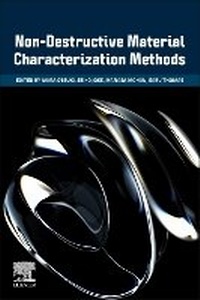
Non-Destructive Material Characterization Methods
Published on 4. September 2023
Book
Paperback/Softback
840 pages
978-0-323-91150-4 (ISBN)
Description
Non-Destructive Material Characterization Methods provides readers with a trove of theoretical and practical insight into how to implement different non-destructive testing methods for effective material characterization. The book starts with an introduction to the field before moving right into a discussion of a wide range of techniques that can be immediately implemented. Various imaging and microscopy techniques are first covered, with step-by-step insights on characterization using a polarized microscope, an atomic force microscope, computed tomography, ultrasonography, magnetic resonance imaging, infrared tomography, and more. Each chapter includes case studies, applications, and recent developments.
From there, elemental assay and mapping techniques are discussed, including Raman spectroscopy, UV spectroscopy, atomic absorption spectroscopy, neutron activation analysis, and various others. The book concludes with sections covering displacement measurement techniques, large-scale facility techniques, and methods involving multiscale analysis and advanced analysis.
From there, elemental assay and mapping techniques are discussed, including Raman spectroscopy, UV spectroscopy, atomic absorption spectroscopy, neutron activation analysis, and various others. The book concludes with sections covering displacement measurement techniques, large-scale facility techniques, and methods involving multiscale analysis and advanced analysis.
More details
Language
English
Place of publication
Philadelphia
United States
Target group
Professional and scholarly
Product notice
Paperback (trade)
Illustrations
Approx. 300 illustrations; Illustrations
Dimensions
Height: 229 mm
Width: 152 mm
Thickness: 42 mm
Weight
1106 gr
ISBN-13
978-0-323-91150-4 (9780323911504)
Copyright in bibliographic data and cover images is held by Nielsen Book Services Limited or by the publishers or by their respective licensors: all rights reserved.
Schweitzer Classification
Other editions
Additional editions
Akira Otsuki | Seiko Jose | Manasa Mohan
Non-Destructive Material Characterization Methods
E-Book
09/2023
Elsevier
€315.00
Available for download
Persons
Dr. Akira Otsuki is a Visiting Professor at Lulea University of Technology, and the Unit coordinator and leading professor of the unit "Mine Tailings? at Universidad Adolfo Ibanez. He is a member of several academic societies as well as an editor of academic journals including ChemEngineering and Recycling. He also serves as a guest editor of special issues, including "Colloidal/Fine Particle Aspects of Mine Tailings?. His research focuses on characterization and processing of complex materials, including waste materials, natural ores, and colloids. He has been developing and running national and international research projects on his research focuses.
Seiko Jose PhD is a scientist, working at ICAR-Central Sheep and Wool Research Institute, Avikanagar, Rajasthan, India. He has over 17 years' experience in textiles including time spent in industry and academia. His industrial experience is focused on wet processing of cotton, silk, and linen processing units. For the last 8 eight years of his research career, he has worked with a range of natural fibres such as, wool, jute, pineapple leaf fibre, coir, flax, and ramie. He has contributed to 30 research papers and 9 book chapters. His major research areas are extraction and characterization of natural fibre, textile dyeing and finishing, eco-friendly textile processing, natural fibre composites, and natural dyes. Dr. Manasa Mohan A. graduated in 2010 from University of Kerala, India, completing post-graduation with first rank from the Department of Chemistry, and also received a gold medal in chemistry from the University of Kerala. She completed her PhD in polymer-based drug delivery systems in 2018. She is now working as a Kothari postdoctoral fellow in Mahathma Gandhi University, Kottayam, Kerala. Prof. Sabu Thomas is a globally renowned scientist and one of the leading researchers in polymer science and nanotechnology. He currently serves as Professor of Polymer Science & Engineering and was the former Vice Chancellor of Mahatma Gandhi University, Kerala, India. Prof. Thomas is internationally recognized for his pioneering work on polymer blends, nanocomposites, green materials, and sustainable polymers.
Seiko Jose PhD is a scientist, working at ICAR-Central Sheep and Wool Research Institute, Avikanagar, Rajasthan, India. He has over 17 years' experience in textiles including time spent in industry and academia. His industrial experience is focused on wet processing of cotton, silk, and linen processing units. For the last 8 eight years of his research career, he has worked with a range of natural fibres such as, wool, jute, pineapple leaf fibre, coir, flax, and ramie. He has contributed to 30 research papers and 9 book chapters. His major research areas are extraction and characterization of natural fibre, textile dyeing and finishing, eco-friendly textile processing, natural fibre composites, and natural dyes. Dr. Manasa Mohan A. graduated in 2010 from University of Kerala, India, completing post-graduation with first rank from the Department of Chemistry, and also received a gold medal in chemistry from the University of Kerala. She completed her PhD in polymer-based drug delivery systems in 2018. She is now working as a Kothari postdoctoral fellow in Mahathma Gandhi University, Kottayam, Kerala. Prof. Sabu Thomas is a globally renowned scientist and one of the leading researchers in polymer science and nanotechnology. He currently serves as Professor of Polymer Science & Engineering and was the former Vice Chancellor of Mahatma Gandhi University, Kerala, India. Prof. Thomas is internationally recognized for his pioneering work on polymer blends, nanocomposites, green materials, and sustainable polymers.
Editor
Visiting Professor, Lulea University of Technology; Unit Coordinator and Leading Professor, Unit "Mine Tailings?, Universidad Adolfo Ibanez., Sweden
Scientist, Central Sheep and Wool Research Institute, Avikanagar, Rajasthan, India
Kothari postdoctoral fellow, School of Energy Materials, Mahathma Gandhi University, Kottayam, Kerala, India
Content
1. Introduction to Non-Destructive Material Characterizations
2. Optical Microscope (Interferometric and non- interferometric optical microscope techniques)
3. Polarized Microscope
4. Atomic Force Microscopy
5. Non-Destructive Imaging of Buried Interfaces Using Decelerated Electron-Beam in Scanning Electron Microscopy
6. Scanning Probe Microscope
7. Transmission Electron Microscope
8. Neutron Imaging
9. Infrared Thermography: Philosophy, Approaches, Analysis - Processing, and Guidelines
10. Non-Destructive Material Testing in Welding: Ultrasonic Scanning
11. Diffraction with X -Rays and Neutrons
12. Raman Spectroscopy - Part 1
13. Raman Spectroscopy - Part 2
14. UV-Vis Spectroscopy in Non-Destructive Testing
15. Hard X-ray Photoelectron Spectroscopy (HAXPES) and X-Ray Diffraction Techniques (XRD): Non-Destructive compositional, electronic, chemical and structural in-depth characterization in the tens-of-nanometer scale
16. X-ray Fluorescence Spectroscopy
17. Mass Spectrometry
18. Atomic Absorption Spectrophotometry
19. Dielectric Spectroscopy and Techniques
20. Element Analysis with Neutrons
21. X-ray Stress Analysis
22. Neutrons - Characteristics and Sources
23. NDT of Steel Components based upon their Magnetic Answer
24. Cloud-Based Non-Destructive Characterization
25. Complementary Results of Non-Destructive Elemental Assay and Liberation Analysis of Waste Printed Circuit Boards
26. Future Perspectives on Non-Destructive Material Characterization Methods towards Sustainability and Circular Economy
2. Optical Microscope (Interferometric and non- interferometric optical microscope techniques)
3. Polarized Microscope
4. Atomic Force Microscopy
5. Non-Destructive Imaging of Buried Interfaces Using Decelerated Electron-Beam in Scanning Electron Microscopy
6. Scanning Probe Microscope
7. Transmission Electron Microscope
8. Neutron Imaging
9. Infrared Thermography: Philosophy, Approaches, Analysis - Processing, and Guidelines
10. Non-Destructive Material Testing in Welding: Ultrasonic Scanning
11. Diffraction with X -Rays and Neutrons
12. Raman Spectroscopy - Part 1
13. Raman Spectroscopy - Part 2
14. UV-Vis Spectroscopy in Non-Destructive Testing
15. Hard X-ray Photoelectron Spectroscopy (HAXPES) and X-Ray Diffraction Techniques (XRD): Non-Destructive compositional, electronic, chemical and structural in-depth characterization in the tens-of-nanometer scale
16. X-ray Fluorescence Spectroscopy
17. Mass Spectrometry
18. Atomic Absorption Spectrophotometry
19. Dielectric Spectroscopy and Techniques
20. Element Analysis with Neutrons
21. X-ray Stress Analysis
22. Neutrons - Characteristics and Sources
23. NDT of Steel Components based upon their Magnetic Answer
24. Cloud-Based Non-Destructive Characterization
25. Complementary Results of Non-Destructive Elemental Assay and Liberation Analysis of Waste Printed Circuit Boards
26. Future Perspectives on Non-Destructive Material Characterization Methods towards Sustainability and Circular Economy