

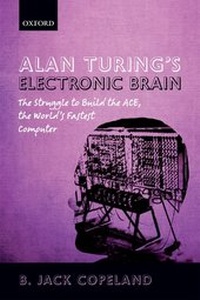
Alan Turing's Electronic Brain
The Struggle to Build the ACE, the World's Fastest Computer
1st Edition
Published on 24. May 2012
Book
Paperback/Softback
581 pages
978-0-19-960915-4 (ISBN)
Description
The mathematical genius Alan Turing, now well known for his crucial wartime role in breaking the ENIGMA code, was the first to conceive of the fundamental principle of the modern computer-the idea of controlling a computing machine's operations by means of a program of coded instructions, stored in the machine's 'memory'. In 1945 Turing drew up his revolutionary design for an electronic computing machine-his Automatic Computing Engine ('ACE'). A pilot model of the ACE ran its first program in 1950 and the production version, the 'DEUCE', went on to become a cornerstone of the fledgling British computer industry. The first 'personal' computer was based on Turing's ACE.
Alan Turing's Automatic Computing Engine describes Turing's struggle to build the modern computer. The first detailed history of Turing's contributions to computer science, this text is essential reading for anyone interested in the history of the computer and the history of mathematics. It contains first hand accounts by Turing and by the pioneers of computing who worked with him. As well as relating the story of the invention of the computer, the book clearly describes the hardware and software of the ACE-including the very first computer programs. The book is intended to be accessible to everyone with an interest in computing, and contains numerous diagrams and illustrations as well as original photographs.
The book contains chapters describing Turing's path-breaking research in the fields of Artificial Intelligence (AI) and Artificial Life (A-Life). The book has an extensive system of hyperlinks to The Turing Archive for the History of Computing, an on-line library of digital facsimiles of typewritten documents by Turing and the other scientists who pioneered the electronic computer.
Alan Turing's Automatic Computing Engine describes Turing's struggle to build the modern computer. The first detailed history of Turing's contributions to computer science, this text is essential reading for anyone interested in the history of the computer and the history of mathematics. It contains first hand accounts by Turing and by the pioneers of computing who worked with him. As well as relating the story of the invention of the computer, the book clearly describes the hardware and software of the ACE-including the very first computer programs. The book is intended to be accessible to everyone with an interest in computing, and contains numerous diagrams and illustrations as well as original photographs.
The book contains chapters describing Turing's path-breaking research in the fields of Artificial Intelligence (AI) and Artificial Life (A-Life). The book has an extensive system of hyperlinks to The Turing Archive for the History of Computing, an on-line library of digital facsimiles of typewritten documents by Turing and the other scientists who pioneered the electronic computer.
Reviews / Votes
Review from previous edition The amount of information collected by the editor is huge and it offers interesting reading for anybody with a deep interest in computer history. * EMS Newsletter * This book (and the related website of the Turing Archive) will be an invaluable reference for anyone seeking to understand the early history of British computers. * P. Aldrich Kidwell, Technology and Culture vol. 47, pp. 460-462 * An excellent documentary of Alan Turing's work ... The book provides rare insights ... The presentation is not technical but historical and inspirational ... Summing up: Recommended for general readers. * CHOICE * This is a provocative book. * A Booth, Mathematical Reviews *More details
Language
English
Place of publication
Oxford
United Kingdom
Target group
College/higher education
Professional and scholarly
Computer scientists, mathematicians, electrical and electronic engineers, philosophers, logicians, and historians of computing, mathematics, science and technology. The first detailed history of Turing's contributions to computer science, this text is essential reading for anyone interested in the history of the computer and the history of mathematics and will be recommended reading for courses on the history of computing and for some computer science courses. It will also be of interest to members of the IT industry.
Illustrations
155 black and white line illustrations, 30 black and white halftones
Dimensions
Height: 233 mm
Width: 156 mm
Thickness: 30 mm
Weight
864 gr
ISBN-13
978-0-19-960915-4 (9780199609154)
Copyright in bibliographic data and cover images is held by Nielsen Book Services Limited or by the publishers or by their respective licensors: all rights reserved.
Schweitzer Classification
Other editions
Additional editions
E-Book
05/2012
1st Edition
OUP Oxford
€34.69
Available for download
Others | B. Jack Copeland
Alan Turing's Electronic Brain
The Struggle to Build the ACE, the World's Fastest Computer
E-Book
05/2012
OUP eBook
€17.49
Available for download
Persons
Jack Copeland is Professor of Philosophy at the University of Canterbury, New Zealand, where he is Director of the Turing Archive for the History of Computing. His books include The Essential Turing, Colossus: The Secrets of Bletchley Park's Codebreaking Computers, Alan Turing's Automatic Computing Engine, Logic and Reality: Essays on the Legacy of Arthur Prior (all with Oxford University Press), and he has published more than 100 articles on the philosophy and history of computing, and mathematical and philosophical logic.
Content
PART I: THE NATIONAL PHYSICAL LABORATORY AND THE ACE PROJECT; PART II: TURING AND THE HISTORY OF COMPUTING; PART III: THE ACE COMPUTERS; PART IV: ELECTRONICS; PART V: TECHNICAL REPORTS AND LECTURES ON THE ACE AND THE PILOT ACE, 1945-1951