

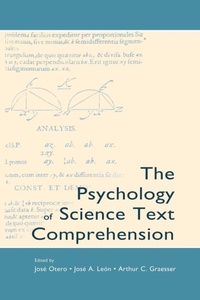
The Psychology of Science Text Comprehension
1st Edition
Published on 11. September 2014
Book
Paperback/Softback
472 pages
978-1-138-83340-1 (ISBN)
Description
This volume's goal is to provide readers with up-to-date information on the research and theory of scientific text comprehension. It is widely acknowledged that the comprehension of science and technological artifacts is very difficult for both children and adults. The material is conceptually complex, there is very little background knowledge for most individuals, and the materials are often poorly written. Therefore, it is no surprise that students are turned off from learning science and technology. Given these challenges, it is important to design scientific text in a fashion that fits the cognitive constraints of the learner. The enterprise of textbook design needs to be effectively integrated with research in discourse processing, educational technology, and cognitive science. This book takes a major step in promoting such an integration.
This volume:
*provides an important integration of research and theory with theoretical, methodological, and educational applications;
*includes a number of chapters that cover how science text information affects mental representations and strategies;
*introduces important suggestions about how text design and new technologies can be thought of as pedagogical features; and
*establishes academic text taxonomies and a consensus of the criteria to organize inferences and other mental mechanisms.
This volume:
*provides an important integration of research and theory with theoretical, methodological, and educational applications;
*includes a number of chapters that cover how science text information affects mental representations and strategies;
*introduces important suggestions about how text design and new technologies can be thought of as pedagogical features; and
*establishes academic text taxonomies and a consensus of the criteria to organize inferences and other mental mechanisms.
Reviews / Votes
"...this volume provides detailed descriptions of the multiple facets of science text design and comprehension. The analysis throughout are concise, and the tenor of the writing is non-technical. It draws on the cross-disciplinary interests of cognitive science, is relevant to a diverse audience, and can serve an important propaedeutic function for graduate students or others interested in entering the discourse on text comprehension....This volume makes a significant contribution to our understanding of the nature of coherence as an important cognitive construction that is created during reading."-Roman Taraban
Texas Tech University
More details
Language
English
Place of publication
London
United Kingdom
Publishing group
Taylor & Francis Ltd
Target group
Professional and scholarly
Professional
Dimensions
Height: 229 mm
Width: 152 mm
Thickness: 25 mm
Weight
678 gr
ISBN-13
978-1-138-83340-1 (9781138833401)
Copyright in bibliographic data and cover images is held by Nielsen Book Services Limited or by the publishers or by their respective licensors: all rights reserved.
Schweitzer Classification
Other editions
Additional editions
Jose Otero | Jos' A. Lecn | Arthur C. Graesser
The Psychology of Science Text Comprehension
E-Book
04/2014
1st Edition
Routledge
€78.99
Available for download
Jose Otero | Jos' A. Lecn | Arthur C. Graesser
The Psychology of Science Text Comprehension
E-Book
04/2014
Routledge
€78.99
Available for download
Jose Otero | Jos' A. Le¢n | Arthur C. Graesser
The Psychology of Science Text Comprehension
E-Book
04/2014
1st Edition
Routledge
€126.49
Available for download
Jose Otero | Jos' A. Lecn | Arthur C. Graesser
The Psychology of Science Text Comprehension
Book
03/2002
Routledge
€243.40
Shipment within 10-20 days
Persons
Jose Otero, Jos' A. Lecn, Arthur C. Graesser
Content
Contents: Preface. A.C. Graesser, J.A. Leon, J. Otero, Introduction to the Psychology of Science Text Comprehension. Part I: The Functions, Contents, and Design of Science Texts.S.R. Goldman, G.L. Bisanz, Toward a Functional Analysis of Scientific Genres: Implications for Understanding and Learning Processes. M.J. Chambliss, The Characteristic of Well-Designed Science Textbooks. I. Martins, Visual Imagery in School Science Texts. S. Ohlsson, Generating and Understanding Qualitative Explanations. Part II: Basic Cognitive Representations and Processes in Text Comprehension.P. van den Broek, S. Virtue, M.G. Everson, Y. Tzeng, Y-C. Sung, Comprehension and Memory of Science Texts: Inferential Processes and the Construction of a Mental Representation. J.A. Leon, G.E. Penalba, Understanding Causality and Temporal Sequence in Scientific Discourse. I. Tapiero, J. Otero, Situation Models as Retrieval Structures: Effects on the Global Coherence of Science Texts. P. Maury, O. Perez, J.A. Leon, Predictive Inferences in Scientific and Technological Contexts. M. Elshout-Mohr, M. van Daalen-Kapteijns, Situated Regulation of Scientific Text Processing. Part III: Comprehension Monitoring.J. Dunlosky, K.A. Rawson, D.J. Hacker, Metacomprehension of Science Text: Investigating the Levels-of-Disruption Hypothesis. J. Otero, Noticing and Fixing Difficulties While Understanding Science Texts. H. van Oostendorp, Updating Mental Representations During Reading Scientific Text. Part IV: Coordinating Multiple Information Sources and Media.R.E. Mayer, Using Illustrations to Promote Constructivist Learning From Science Text. M. Hegarty, N.H. Narayanan, P. Freitas, Understanding Machines From Multimedia and Hypermedia Presentations. W. Schnotz, M. Bannert, T. Seufert, Toward an Integrative View of Text and Picture Comprehension: Visualization Effects on the Construction of Mental Models. J-F. Rouet, E. Vidal-Abarca, "Mining for Meaning:" Cognitive Effects of Inserted Questions in Learning From Scientific Text.