

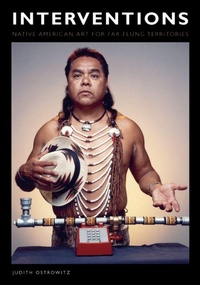
Interventions
Native American Art for Far-flung Territories
Will be published approx. on 2. March 2009
Book
Hardback
240 pages
978-0-295-98851-1 (ISBN)
Description
Interventions examines how members of Native American and Canadian First Nation groups situate their art in contemporary global environments, creating a new kind of nexus between the requirements of Native communities and the forms of public display that are of interest to worldwide audiences.
Judith Ostrowitz selects several critical cases to demonstrate this strategic tacking between macro- and micro-identities. The long-term implications of the totem pole restoration projects of the second half of the twentieth century; the opening of the National Museum of the American Indian; the dance event in Juneau known as Celebration; the impact of modernism and postmodernism on Indian art; and the use of electronic media to establish Indian territory on the Internet all demonstrate facets of the purposeful and context-driven strategies of self-representation designed by Native communities.
The NMAI may be the paramount example of the construction of public identity originating from Indian Country to date. Ostrowitz describes how, in the course of the museum's creation, the distinctions among many specific groups of origin were selectively blurred in service of larger goals. In contrast, the purpose of the gathering of Tlingit, Haida, and Tsimshian people at the biennial Celebration is to rejoice in distinct Native groups and in the vitality of their traditions. Postmodernism has afforded twentieth- and twenty-first century Native artists the opportunity to penetrate mainstream art worlds, where experimentation is encouraged and the former criteria for the production of "Native art" are selectively referenced.
Through close readings of Native cultural productions, Ostrowitz puts Native art practices into conversation with larger issues in cultural studies. Art audiences are becoming familiar with many works that address global communities but are generated in environments affected by specific ethnic, gendered, and cultural perspectives. As the work of non-Native artists in world-system venues is now also interpreted in the context of the biographical and cultural histories of their makers, all works of art may be better appreciated as expressions of local artistic position.
Judith Ostrowitz selects several critical cases to demonstrate this strategic tacking between macro- and micro-identities. The long-term implications of the totem pole restoration projects of the second half of the twentieth century; the opening of the National Museum of the American Indian; the dance event in Juneau known as Celebration; the impact of modernism and postmodernism on Indian art; and the use of electronic media to establish Indian territory on the Internet all demonstrate facets of the purposeful and context-driven strategies of self-representation designed by Native communities.
The NMAI may be the paramount example of the construction of public identity originating from Indian Country to date. Ostrowitz describes how, in the course of the museum's creation, the distinctions among many specific groups of origin were selectively blurred in service of larger goals. In contrast, the purpose of the gathering of Tlingit, Haida, and Tsimshian people at the biennial Celebration is to rejoice in distinct Native groups and in the vitality of their traditions. Postmodernism has afforded twentieth- and twenty-first century Native artists the opportunity to penetrate mainstream art worlds, where experimentation is encouraged and the former criteria for the production of "Native art" are selectively referenced.
Through close readings of Native cultural productions, Ostrowitz puts Native art practices into conversation with larger issues in cultural studies. Art audiences are becoming familiar with many works that address global communities but are generated in environments affected by specific ethnic, gendered, and cultural perspectives. As the work of non-Native artists in world-system venues is now also interpreted in the context of the biographical and cultural histories of their makers, all works of art may be better appreciated as expressions of local artistic position.
Reviews / Votes
". . . each chapter stands alone as a good underpinning for any researcher interested in exploring any of the areas she discusses specifically." -- Meghan Glass * Journal of Folklore Research * "Interventions merits our attention not only as a work on Native American art but also for its contribution to the broader question of how cultural actors assert themselves on a world stage without sacrificing their commitment to community values." -- Elizabeth Hutchinson * Museum Anthropology Review * "In this timely, important book, Ostrowitz presents the ways Native American artists stay true to specific cultural territories while at the same time moving beyond them to engage with the world community..A particular strength of this book is its versatility-one many consider it in its entirety, or use select chapters as insightful, current readings for courses in art history, museum studies, and visual anthropology. Recommended." * Choice * "Interventions is an admirable effort to reframe in theoretically sophisticated, relational, and global-rather than essentialist-terms the ongoing effort by native artists to claim and maintain sovereignty." * caa.reviews *More details
Language
English
Place of publication
Seattle
United States
Target group
Professional and scholarly
US School Grade: College Graduate Student
Product notice
sewn/stitched
Cloth over boards
With dust jacket
Dimensions
Height: 235 mm
Width: 158 mm
Thickness: 21 mm
Weight
467 gr
ISBN-13
978-0-295-98851-1 (9780295988511)
Copyright in bibliographic data and cover images is held by Nielsen Book Services Limited or by the publishers or by their respective licensors: all rights reserved.
Schweitzer Classification
Person
Judith Ostrowitz is the author of Privileging the Past: Reconstructing History in Northwest Coast Art. She is an adjunct associate professor who has taught at Columbia University, Yale, New York University, and the City College of New York.
Content
Illustrations
Acknowledgments
Introduction--Interventions: Native American Art for Far-Flung Territories
1 The World Is as Wide as the Imagination: Northwest Coast Art Projects Exceed Territory
2 Concourse and Periphery: Planning the National Museum of the American Indian
3 Dancing as Clan, Nation, and World-System at Celebration
4 The Good Reader of Contemporary Native American Art
5 Performing Race / Imagined Space: Native American Art in Electronic Media
Artistic Intervention and Strategic Practice: An Afterword
Notes
Works Cited
Index
Acknowledgments
Introduction--Interventions: Native American Art for Far-Flung Territories
1 The World Is as Wide as the Imagination: Northwest Coast Art Projects Exceed Territory
2 Concourse and Periphery: Planning the National Museum of the American Indian
3 Dancing as Clan, Nation, and World-System at Celebration
4 The Good Reader of Contemporary Native American Art
5 Performing Race / Imagined Space: Native American Art in Electronic Media
Artistic Intervention and Strategic Practice: An Afterword
Notes
Works Cited
Index