

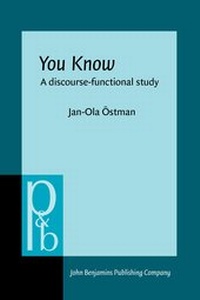
You Know
A discourse-functional approach
Published on 1. January 1981
Book
Paperback/Softback
91 pages
978-90-272-2516-0 (ISBN)
Description
The basic function the expression you know serves in conversational discourse is said to be that of a pragmatic particle used when the speaker wants the addressee to accept as mutual knowledge (or at least be cooperative with respect to) the propositional content of his utterance. The fact that you know is even used when the addressee is assumed not to know what the speaker is talking about, suggests that it functions at the deference level of politeness, as a striving towards attaining a camaraderie relationship between speaker and hearer. You know is found to be more often used by women than by men in spontaneous conversation, and the manner in which it is used is significantly different from male usage. Ontogenetically, the age of four seems to be crucial for initial steps to use and master pragmatic particles including you know. Data for the study were derived from tape-recorded conversations and interviews.
More details
Series
Language
English
Place of publication
Amsterdam
Netherlands
Target group
College/higher education
Professional and scholarly
Dimensions
Height: 240 mm
Width: 160 mm
Weight
200 gr
ISBN-13
978-90-272-2516-0 (9789027225160)
Copyright in bibliographic data and cover images is held by Nielsen Book Services Limited or by the publishers or by their respective licensors: all rights reserved.
Schweitzer Classification
Other editions
Additional editions
E-Book
01/1981
1st Edition
John Benjamins Publishing Company
€84.49
Available for download
Content
1. Preface; 2. 0. Aim; 3. 1. Introduction; 4. 1.1. Pragmatics; 5. 1.2. Face-Saving and Politeness; 6. 1.3. Implicit Anchorage; 7. 1.4. Cooperation and Grammar; 8. 1.5. Planning and Indirectness; 9. 1.6. Semantics and Pragmatics; 10. 2. The Present Study; 11. 2.1. Issues to be Covered; 12. 2.2. Methodology; 13. 2.3. Data; 14. 3. The Meaning and Functions of You know; 15. 3.1. Preamble; 16. 3.2. The General Meaning of You know; 17. 3.3. You know and Stylistic Strategies; 18. 3.4. Sub-Functions of You know: "as you know" & "don't you know"; 19. 3.5. You know as a Turn-Switching Marker; 20. 3.6. Pauses and You know; 21. 3.7. You know and Some Other Pragmatic Particles; 22. 3.8. On the Linguistic Representation of Pragmatic Expressions: The Level Analysis; 23. 3.9. The Particle Contour; 24. 3.10. Other Languages; 25. 4. The Acquisition of You know; 26. 4.1. Pragmatic Expressions and Child Language Acquisition; 27. 4.2. Egocentricity vs. Sociocentricity; 28. 4.3. The Segment Know in Early Child Language Acquisition; 29. 4.4. Speaker-Oriented Know; 30. 4.5. Listener-Oriented Know; 31. 4.6. The Acquisition of You know: Summary; 32. 4.7. On the Acquisition of Some Other Pragmatic Particles; 33. 4.8. Child Acquisition and Level Analysis; 34. 5. Socio-Psychological Aspects of You know: Male and Female Usage; 35. 5.1. General Remarks; 36. 5.2. Social Dialects and You know; 37. 5.3. Women's Language; 38. 5.4. Sex Differences in the Use of You know; 39. 6. Concluding Remark; 40. Notes; 41. References