

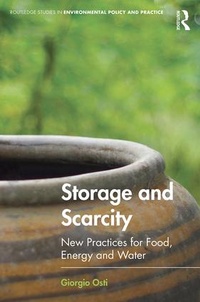
Storage and Scarcity
New practices for food, energy and water
1st Edition
Published on 27. June 2016
Book
Hardback
220 pages
978-1-4724-8301-0 (ISBN)
Description
In an era of abundance, at least part of humanity has stopped thinking about the future provision of basic vital resources such water, energy and food. Storage actions, with all their variants whether real or imagined, are sources of innovation in the provision and treatment of crucial resources. This book deals with cases of water, food, energy and biodiversity storage as a response to a new era of scarcity. Examining multilevel storage policies, consumers' practices and local organisations, author Giorgio Osti explores a variety of examples such as the need to stock agriculture produce, the industry and practices of food conservation, the role of artificial water basins in controlling floods and droughts and the development of batteries able to compensate for the intermittence of renewable energy sources. Storage and self-sufficiency can be achieved in many technical ways, at different territorial levels and according to different policies or philosophies. Being more a grasshopper or an ant - the two extreme positions - depends not only on the technologies available but also on different analyses of the environment and different attitudes to the future. This book offers an environmentalist perspective that uncovers hidden or absent activities of ultramodern societies that will be useful to students of environmental sociology as well as those researching and studying at the interface of environmental studies and geography.
More details
Series
Language
English
Place of publication
London
United Kingdom
Publishing group
Taylor & Francis Ltd
Target group
College/higher education
Illustrations
11 s/w Tabellen
11 Tables, black and white
Dimensions
Height: 234 mm
Width: 156 mm
Weight
570 gr
ISBN-13
978-1-4724-8301-0 (9781472483010)
Copyright in bibliographic data and cover images is held by Nielsen Book Services Limited or by the publishers or by their respective licensors: all rights reserved.
Schweitzer Classification
Other editions
Additional editions
Book
09/2020
1st Edition
Routledge
€51.98
Shipment within 15-20 days
E-Book
06/2016
Routledge
€59.49
Available for download
E-Book
06/2016
Routledge
€59.49
Available for download
Person
Giorgio Osti is a rural and environmental sociologist at the University of Trieste, Italy.
Content
1: Accumulation vs networking: The terms of the storage issue
1.1 Storage, an eclipsed issue
1.2 Between storage and security
1.3 Why storage is once again important
1.4 Social analysis of storage
2: The modularisation of food processing and consumption
2.1 Food conservation, a broad and ambivalent matter
2.2 Food security practices
2.3 Healthy food: storage as preservation
2.4 Organisations no food waste
2.5 Rituals of food storage
2.6 Rationing and rationalising Chapter 3 - Water storage: a multidimensional task
3.1 The long march toward water channelling
3.2 River banks, detention basins and floodable areas
3.3 The art of water saving and harvesting 3.4 The big task of small farm ponds
3.5 In between network and storage
4: Energy storage
4.1 The issue
4.2 The legal, technological and social frames
4.3 The Tartar Steppe of energy storage
4.4 Power storage systems embedded in national policies
4.5 Thermal energy. The Cinderella of storage
4.6 Conclusions
5: Long-term life storage
5.1 Forms of biodiversity storage: natural parks, botanical gardens, seed banks
5.2 Beyond land sparing and land sharing
5.3 The mutual exchanges of biodiversity and storage
5.4 Mosaics of biodiversity
6: Multi-storey: the fortune of the grasshoppers and the ants
1.1 Storage, an eclipsed issue
1.2 Between storage and security
1.3 Why storage is once again important
1.4 Social analysis of storage
2: The modularisation of food processing and consumption
2.1 Food conservation, a broad and ambivalent matter
2.2 Food security practices
2.3 Healthy food: storage as preservation
2.4 Organisations no food waste
2.5 Rituals of food storage
2.6 Rationing and rationalising Chapter 3 - Water storage: a multidimensional task
3.1 The long march toward water channelling
3.2 River banks, detention basins and floodable areas
3.3 The art of water saving and harvesting 3.4 The big task of small farm ponds
3.5 In between network and storage
4: Energy storage
4.1 The issue
4.2 The legal, technological and social frames
4.3 The Tartar Steppe of energy storage
4.4 Power storage systems embedded in national policies
4.5 Thermal energy. The Cinderella of storage
4.6 Conclusions
5: Long-term life storage
5.1 Forms of biodiversity storage: natural parks, botanical gardens, seed banks
5.2 Beyond land sparing and land sharing
5.3 The mutual exchanges of biodiversity and storage
5.4 Mosaics of biodiversity
6: Multi-storey: the fortune of the grasshoppers and the ants