

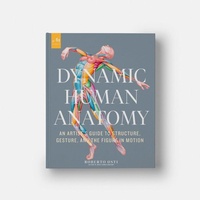
Dynamic Human Anatomy
An Artist's Guide to Structure, Gesture, and the Figure in Motion
Published on 6. April 2021
Book
Hardback
304 pages
978-1-58093-551-7 (ISBN)
Description
An essential visual guide for artists to the mastery and use of advanced human anatomy skills in the creation of figurative art
Dynamic Human Anatomy picks up where Basic Human Anatomy leaves off and offers artists and art students a deeper understanding of anatomy, including anatomy in motion, and how that essential skill is applied to the creation of fine figurative art.
Dynamic Human Anatomy picks up where Basic Human Anatomy leaves off and offers artists and art students a deeper understanding of anatomy, including anatomy in motion, and how that essential skill is applied to the creation of fine figurative art.
Reviews / Votes
'Leonardo da Vinci, Michelangelo and Raphael drew the human body with an understanding of its workings from the inside outside - as have thousands of artists since. Who better to teach this method than Roberto Osti, who trained as a medical illustrator before turning to fine art. . . . Dynamic Human Anatomy, a follow-up to his book Basic Human Anatomy, explains how this methodology can be used to reach beyond static depictions in order to 'convey a sense of life or express psychological character.'' - Artists MagazineMore details
Language
English
Place of publication
United States
Publishing group
Monacelli Press
Illustrations
400 Illustrations
Dimensions
Height: 224 mm
Width: 272 mm
Thickness: 29 mm
Weight
1558 gr
ISBN-13
978-1-58093-551-7 (9781580935517)
Copyright in bibliographic data and cover images is held by Nielsen Book Services Limited or by the publishers or by their respective licensors: all rights reserved.
Schweitzer Classification
Persons
Roberto Osti teaches figure drawing and human anatomy for artists at the New York Academy of Art, University of the Arts in Philadelphia, and the Pennsylvania Academy of the Fine Arts.
Formally trained as a medical illustrator before becoming a fine artist, Osti has contributed his work to many science and art publications. His paintings have been exhibited in galleries in Europe and the United States. He is the author of Basic Human Anatomy, an art instruction best seller and classic reference book.
Formally trained as a medical illustrator before becoming a fine artist, Osti has contributed his work to many science and art publications. His paintings have been exhibited in galleries in Europe and the United States. He is the author of Basic Human Anatomy, an art instruction best seller and classic reference book.
Content
Introduction
Chapter 1: Dynamic Anatomy-Historical Observations
The Many Lives of a Torso
Anatomy and Realism-Sculpture "Dissected"
Chapter 2: Aesthetic Geometries and Proportional Relationships
Stability, Utility, and Beauty
Aesthetic Geometries
The Battle of the Canons
Uses of Proportional Relationships
Proportional Relationships and Movement
Proportional Relationships and Aesthetic Geometries
Chapter 3: Landmarks and Muscular Volumes
Landmarks of the Torso
Landmarks of the Shoulder
Landmarks and Anatomy of the Arm
The Elbow Joint
Landmarks of the Hips
Landmarks of the Leg
The Knee
Landmarks of the Ankle and Foot
Chapter 4: The Uses of Landmarks and Proportional Relationships
Ways of Looking
Muscular-Skeletal Connections
Reconstructing the Skeleton
Chapter 5: Flows and Rhythms of the Figure
Flows, Rhythms, and Movement
Reading and Using the Flows
Flows of the Whole Body
Chapter 6: Movement
Origins of Movement
Dynamic Flows
Projecting Narrative
Movement and Stereometric Volumes
From Stereometric to Organic
Muscles in Action
Chapter 7: The Hands
Skeletal Structure of the Hand
Stereometric Rendering of the Hand
From Stereometric to Organic
Light on Form
Holding Objects
Chapter 8: The Face and Facial Expressions
Structure of the Head
Parts of the Face
Facial Features
Curvatures of the Face
Muscles of the Face and Facial Expressions
Chapter 9: Demonstrations and Techniques
Measuring Techniques
Structural Drawing
Tonal Drawing
Reduction Technique
Trois Crayons
Index
Chapter 1: Dynamic Anatomy-Historical Observations
The Many Lives of a Torso
Anatomy and Realism-Sculpture "Dissected"
Chapter 2: Aesthetic Geometries and Proportional Relationships
Stability, Utility, and Beauty
Aesthetic Geometries
The Battle of the Canons
Uses of Proportional Relationships
Proportional Relationships and Movement
Proportional Relationships and Aesthetic Geometries
Chapter 3: Landmarks and Muscular Volumes
Landmarks of the Torso
Landmarks of the Shoulder
Landmarks and Anatomy of the Arm
The Elbow Joint
Landmarks of the Hips
Landmarks of the Leg
The Knee
Landmarks of the Ankle and Foot
Chapter 4: The Uses of Landmarks and Proportional Relationships
Ways of Looking
Muscular-Skeletal Connections
Reconstructing the Skeleton
Chapter 5: Flows and Rhythms of the Figure
Flows, Rhythms, and Movement
Reading and Using the Flows
Flows of the Whole Body
Chapter 6: Movement
Origins of Movement
Dynamic Flows
Projecting Narrative
Movement and Stereometric Volumes
From Stereometric to Organic
Muscles in Action
Chapter 7: The Hands
Skeletal Structure of the Hand
Stereometric Rendering of the Hand
From Stereometric to Organic
Light on Form
Holding Objects
Chapter 8: The Face and Facial Expressions
Structure of the Head
Parts of the Face
Facial Features
Curvatures of the Face
Muscles of the Face and Facial Expressions
Chapter 9: Demonstrations and Techniques
Measuring Techniques
Structural Drawing
Tonal Drawing
Reduction Technique
Trois Crayons
Index