

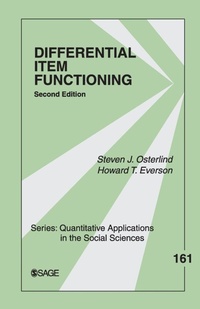
Differential Item Functioning
2nd Edition
Published on 8. December 2009
Book
Paperback/Softback
104 pages
978-1-4129-5494-5 (ISBN)
Description
This new edition presents an up-to-date description of differential item functioning. It describes varying procedures for addressing DIF in practical testing contexts. The authors present useful examples and studies of DIF that readers may employ as a guide in their own work. They also cover major statistical packages that can be employed in DIF analysis (e.g., SPSS, SAS, M+, Minitab, and Systat).This text is ideal for the measurement professional or advanced student who deals with educational or psychological assessment.
More details
Series
Edition
2nd Revised edition
Language
English
Place of publication
Thousand Oaks
United States
Target group
College/higher education
Edition type
Revised edition
Dimensions
Height: 216 mm
Width: 140 mm
Thickness: 6 mm
Weight
143 gr
ISBN-13
978-1-4129-5494-5 (9781412954945)
Copyright in bibliographic data and cover images is held by Nielsen Book Services Limited or by the publishers or by their respective licensors: all rights reserved.
Schweitzer Classification
Other editions
Previous edition
Steven J. Osterlind
Test Item Bias
Book
07/1983
1st Edition
SAGE Publications Inc
€39.80
Article exhausted; check for reprint
Persons
Dr. Steven J. Osterlind is Professor of Measurement and Statistics and Director of Educational Psychology program, University of Missouri-Columbia. Dr. Osterlind's expertise is in psychological assessment, including tests and measurement, statistics, psychometric methods and test development. He received his doctoral degree in 1976 in Educational Psychology (Measurement & Statistics) from the University of Southern California. In 1979, he was an American Scholar's Fellow at Yale University. At the University of Missouri he teaches graduate-level courses in multivariate statistics, analysis of variance, regression, general linear modeling, and psychometric methods. Additionally, he teaches seminar courses on specialized topics, including Item Response Theory and Computer Applications of Testing. He has worked on numerous national testing programs, including serving as statistician for NAEP (National Assessment of Educational Progress). In licensing and certification, he has worked with dozens of professional associations and organizations on their assessment programs. Dr. Osterlind has authored five books, the most recent of which is a major textbook titled Modern Measurement: Theory, Principles, and Application of Mental Appraisal; and, he has written more than 60 articles, book chapters, and other research reports in assessment. Additionally, he has authored more than 20 tests. He is principle author of College Basic Academic Subjects Examination (C-BASE), a test of collegiate achievement test currently adopted by more than 100 universities across the nation. Howard T. Everson is currently Professor of Psychology at Fordham University. In addition, he serves as a consulting research scientist to the American Institutes for Research and the American Councils for International Education. Professor Everson's research and scholarly interests focus on the intersection of cognition, instruction, and assessment. He has contributed to developments in educational psychology, psychometrics, and quantitative methods. Before joining the faculty at Fordham University, Dr. Everson was the Executive Director of the NAEP Education Statistics Services Institute at the American Institutes for Research, and is the former V.P. for Research at the College Board. Dr. Everson is a fellow of both the American Educational Research Association and the American Psychological Association.
Content
About the Authors
Series Editor's Introduction
1. Introduction
2. Description of DIF
3. Statistical Facets of DIF
4. Important Considerations
5. History of Test Bias and DIF
6. Quick-But-Incomplete Methods
7. Mantel-Haenszel Procedure
8. Nonparametic Methods
9. IRT-Based Methods
10. Logistic Regression
11. Specialized DIF Procedures
12. Future Directions
Conclusion
References
Author Index
Subject Index
Series Editor's Introduction
1. Introduction
2. Description of DIF
3. Statistical Facets of DIF
4. Important Considerations
5. History of Test Bias and DIF
6. Quick-But-Incomplete Methods
7. Mantel-Haenszel Procedure
8. Nonparametic Methods
9. IRT-Based Methods
10. Logistic Regression
11. Specialized DIF Procedures
12. Future Directions
Conclusion
References
Author Index
Subject Index