

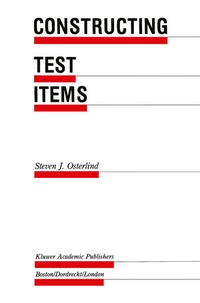
Constructing Test Items
Published on 26. September 2011
Book
Paperback/Softback
368 pages
978-94-010-6971-7 (ISBN)
Description
1 What Is Constructing Test Items?.- What This Book Is About.- Major Purposes Of This Book.- Why This Information Is Important.- Persons For Whom This Book Is Intended.- Overview Of The Remaining Chapters.- How To Approach the Chapters.- 2 Definition, Purpose, And Characteristics of Items.- Defining A Test Item.- Test Item Nomenclature.- Purpose For Test Items.- Criteria For Good Test Items.- Assumptions For Test Items.- Classification Of Items.- Conclusion.- 3 Determining the Content For Items: Validity.- Basic Concepts of Validity.- The Relationship Between Constructing Test Items and Validity.- Conditions For Items To Contribute To Validity.- Initial Considerations When Selecting Content For Items.- Achieving Clarity In A Test's Content.- Developing Test Content Specifications.- Melding Cognitive Processing Levels With Items Content.- Test Item Specifications.- Making An Item Consistent With Its Specification.- Conclusion.- 4 Starting To Write Items: Practical Considerations.- The Importance Of Good Writing In Test Items.- Sources For Information On Writing Style.- Using Taxonomies In Writing Items.- Distinctness Between Stem and Response Alternatives.- Importance Of An Interrogative Stem.- Determining The Correct Response For Test Items.- Determining The Optimal Number Of Response Alternatives.- Making Response Alternatives Plausible.- Use Of All Of The Above Or None Of The Above As Response Alternatives.- Using Specific Determiners In Test Items.- Constructing Complex Response Alternatives.- Time Examinees Need To Respond To Items.- Conclusion.- 5 Style, Editorial, and Publication Guidelines For Items in the Multiple-Choice Format.- Understanding The Multiple-Choice Item Format.- Advantages and Criticisms Of Items In The Multiple-Choice Format.- Editorial FormatFor Items.- Using Directions Correctly.- Specialized Style Rules For Multiple-Choice Items.- Type Characteristics and Page Layout.- Conclusion.- 6 Style, Editorial, and Publication Guidelines For Items in Other Common Formats.- Precision In Wording, Again.- Understanding Items In The True-False Format.- Understanding Items In The Matching Format.- Understanding Short-Answer AndSentence-Completion Items.- Understanding Cloze-Procedure.- Conclusion.- 7 Judging the Quality Of Test Items: Item Analysis.- Measurement Error.- Understanding Item Analysis.- Validating The Content Of Items.- Using Leading Questions In Item Analysis.- Item Statistics.- Item Parameters.- Item Bias.- Conclusion.- 8 Ethical, Legal Considerations, and Final Remarks for Item Writers.- Ethical Concerns For Item Writers.- Concluding Comments About Constructing Test Items.- References.- Author Index.
More details
Series
Edition
Softcover reprint of the original 1st ed. 1989
Language
English
Place of publication
Dordrecht
Netherlands
Target group
Professional and scholarly
Research
Illustrations
368 p.
Dimensions
Height: 235 mm
Width: 155 mm
Thickness: 20 mm
Weight
557 gr
ISBN-13
978-94-010-6971-7 (9789401069717)
DOI
10.1007/978-94-009-1071-3
Schweitzer Classification
Other editions
Additional editions
Steven J. Osterlind
Constructing Test Items
Book
06/1989
Kluwer Academic Publishers
€89.13
Article exhausted; check for reprint
Content
1 What Is Constructing Test Items?.- What This Book Is About.- Major Purposes Of This Book.- Why This Information Is Important.- Persons For Whom This Book Is Intended.- Overview Of The Remaining Chapters.- How To Approach the Chapters.- 2 Definition, Purpose, And Characteristics of Items.- Defining A Test Item.- Test Item Nomenclature.- Purpose For Test Items.- Criteria For Good Test Items.- Assumptions For Test Items.- Classification Of Items.- Conclusion.- 3 Determining the Content For Items: Validity.- Basic Concepts of Validity.- The Relationship Between Constructing Test Items and Validity.- Conditions For Items To Contribute To Validity.- Initial Considerations When Selecting Content For Items.- Achieving Clarity In A Test's Content.- Developing Test Content Specifications.- Melding Cognitive Processing Levels With Items Content.- Test Item Specifications.- Making An Item Consistent With Its Specification.- Conclusion.- 4 Starting To Write Items: Practical Considerations.- The Importance Of Good Writing In Test Items.- Sources For Information On Writing Style.- Using Taxonomies In Writing Items.- Distinctness Between Stem and Response Alternatives.- Importance Of An Interrogative Stem.- Determining The Correct Response For Test Items.- Determining The Optimal Number Of Response Alternatives.- Making Response Alternatives Plausible.- Use Of All Of The Above Or None Of The Above As Response Alternatives.- Using Specific Determiners In Test Items.- Constructing Complex Response Alternatives.- Time Examinees Need To Respond To Items.- Conclusion.- 5 Style, Editorial, and Publication Guidelines For Items in the Multiple-Choice Format.- Understanding The Multiple-Choice Item Format.- Advantages and Criticisms Of Items In The Multiple-Choice Format.- Editorial FormatFor Items.- Using Directions Correctly.- Specialized Style Rules For Multiple-Choice Items.- Type Characteristics and Page Layout.- Conclusion.- 6 Style, Editorial, and Publication Guidelines For Items in Other Common Formats.- Precision In Wording, Again.- Understanding Items In The True-False Format.- Understanding Items In The Matching Format.- Understanding Short-Answer AndSentence-Completion Items.- Understanding Cloze-Procedure.- Conclusion.- 7 Judging the Quality Of Test Items: Item Analysis.- Measurement Error.- Understanding Item Analysis.- Validating The Content Of Items.- Using Leading Questions In Item Analysis.- Item Statistics.- Item Parameters.- Item Bias.- Conclusion.- 8 Ethical, Legal Considerations, and Final Remarks for Item Writers.- Ethical Concerns For Item Writers.- Concluding Comments About Constructing Test Items.- References.- Author Index.