

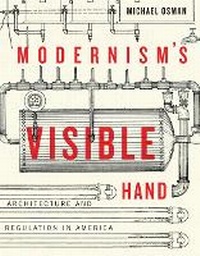
Modernism's Visible Hand
Architecture and Regulation in America
Published on 10. April 2018
Book
Paperback/Softback
280 pages
978-1-5179-0098-4 (ISBN)
Description
A groundbreaking history of the confluence of regulatory thinking and building design in the United States
What is the origin of "room temperature"? When did food become considered fresh or not fresh? Why do we think management makes things more efficient? The answers to these questions share a history with architecture and regulation at the turn of the twentieth century. This pioneering technological and architectural history of environmental control systems during the Gilded Age begins with the premise that regulation-of temperature, the economy, even the freshness of food-can be found in the guts of buildings. From cold storage and scientific laboratories to factories, these infrastructures first organized life in a way we now call "modern."
Drawing on a range of previously unexplored archival resources, Michael Osman examines the increasing role of environmental technologies in building design from the late nineteenth century. He shows how architects appropriated and subsumed the work of engineers as thermostats, air handlers, and refrigeration proliferated. He argues that this change was closely connected to broader cultural and economic trends in management and the regulation of risk. The transformation shaped the evolution of architectural modernism and the development of the building as a machine. Rather than assume the preexisting natural order of things, participants in regulation-including architects, scientists, entrepreneurs, engineers, managers, economists, government employees, and domestic reformers-became entangled in managing the errors, crises, and risks stemming from the nation's unprecedented growth.
Modernism's Visible Hand not only broadens our conception of how industrial capitalism shaped the built environment but is also vital to understanding the role of design in dealing with ecological crises today.
What is the origin of "room temperature"? When did food become considered fresh or not fresh? Why do we think management makes things more efficient? The answers to these questions share a history with architecture and regulation at the turn of the twentieth century. This pioneering technological and architectural history of environmental control systems during the Gilded Age begins with the premise that regulation-of temperature, the economy, even the freshness of food-can be found in the guts of buildings. From cold storage and scientific laboratories to factories, these infrastructures first organized life in a way we now call "modern."
Drawing on a range of previously unexplored archival resources, Michael Osman examines the increasing role of environmental technologies in building design from the late nineteenth century. He shows how architects appropriated and subsumed the work of engineers as thermostats, air handlers, and refrigeration proliferated. He argues that this change was closely connected to broader cultural and economic trends in management and the regulation of risk. The transformation shaped the evolution of architectural modernism and the development of the building as a machine. Rather than assume the preexisting natural order of things, participants in regulation-including architects, scientists, entrepreneurs, engineers, managers, economists, government employees, and domestic reformers-became entangled in managing the errors, crises, and risks stemming from the nation's unprecedented growth.
Modernism's Visible Hand not only broadens our conception of how industrial capitalism shaped the built environment but is also vital to understanding the role of design in dealing with ecological crises today.
Reviews / Votes
"Michael Osman weaves a complex web of interaction between architecture, science, and technology, as well as between architecture, business, and management. Modernism's Visible Hand is not only brilliant, it is also path-breaking."-Antoine Picon, author of Smart Cities: A Spatialised Intelligence"Michael Osman takes us on an extraordinary journey through turn-of-the-twentieth-century modern American life, travelling from temperature-controlled homes and cold-storage warehouses, to Pennsylvania's factories and Indiana's sand dunes. This engrossing, brilliant book is an altogether new look at American architecture, technology, and everyday life; it will be of immense value to readers interested in all these subjects."-Daniel M. Abramson, author of Obsolescence: An Architectural History
More details
Series
Language
English
Place of publication
Minnesota
United States
Target group
College/higher education
Professional and scholarly
Illustrations
70
Dimensions
Height: 229 mm
Width: 178 mm
Thickness: 38 mm
ISBN-13
978-1-5179-0098-4 (9781517900984)
Copyright in bibliographic data and cover images is held by Nielsen Book Services Limited or by the publishers or by their respective licensors: all rights reserved.
Schweitzer Classification
Person
Michael Osman is associate professor of architecture at the University of California, Los Angeles.
Content
Preface
Introduction
1. The Thermostatic Interior and Household Management
2. Cold Storage and the Speculative Market of Preserved Assets
3. Representing Regulation in Nature's Economy
4. Imaging Brainwork
5. Regulation through Paperwork in Architectural Practice
Conclusion
Acknowledgments
Notes
Index
Introduction
1. The Thermostatic Interior and Household Management
2. Cold Storage and the Speculative Market of Preserved Assets
3. Representing Regulation in Nature's Economy
4. Imaging Brainwork
5. Regulation through Paperwork in Architectural Practice
Conclusion
Acknowledgments
Notes
Index