

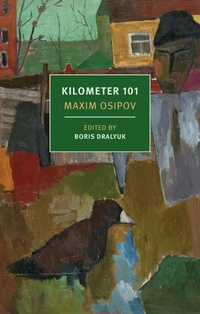
Kilometer 101
Published on 11. October 2022
Book
Paperback/Softback
296 pages
978-1-68137-686-8 (ISBN)
Description
A new collection of short fiction and nonfiction by a Russian master of bittersweet humor, dramatic irony, and poignant insights into contemporary life.
The town of Tarusa lies 101 kilometers outside Moscow, far enough to have served, under Soviet rule, as a place where former political prisoners and other “undesirables” could legally settle. Lying between the center of power and the provinces, between the modern urban capital and the countryside, Tarusa is the perfect place from which to observe a Russia that, in Maxim Osipov’s words, “changes a lot [in the course of a decade], but in two centuries—not at all.” The stories and essays in this volume—a follow-up to his debut in English, Rock, Paper, Scissors—tackle major questions of modern life in and beyond Russia with Osipov’s trademark blend of daring and subtlety. Deceit, political pressure, ethnic discrimination, the urge to emigrate, and the fear of abandoning one’s home, as well as myriad generational debts and conflicts, are as complexly woven through these pieces as they are through the lives of Osipov’s fellow Russians and through our own. What binds the prose in this volume is not only a set of concerns, however, but also Osipov’s penetrating insights and fearless realism. “Dreams fall away, one after another,” he writes in the opening essay, “some because they come true, but most because they prove pointless.” Yet, as he reminds us in the final essay, when viewed from ground level, “life tends not towards depletion, towards zero, but, on the contrary, towards repletion, fullness.”
The town of Tarusa lies 101 kilometers outside Moscow, far enough to have served, under Soviet rule, as a place where former political prisoners and other “undesirables” could legally settle. Lying between the center of power and the provinces, between the modern urban capital and the countryside, Tarusa is the perfect place from which to observe a Russia that, in Maxim Osipov’s words, “changes a lot [in the course of a decade], but in two centuries—not at all.” The stories and essays in this volume—a follow-up to his debut in English, Rock, Paper, Scissors—tackle major questions of modern life in and beyond Russia with Osipov’s trademark blend of daring and subtlety. Deceit, political pressure, ethnic discrimination, the urge to emigrate, and the fear of abandoning one’s home, as well as myriad generational debts and conflicts, are as complexly woven through these pieces as they are through the lives of Osipov’s fellow Russians and through our own. What binds the prose in this volume is not only a set of concerns, however, but also Osipov’s penetrating insights and fearless realism. “Dreams fall away, one after another,” he writes in the opening essay, “some because they come true, but most because they prove pointless.” Yet, as he reminds us in the final essay, when viewed from ground level, “life tends not towards depletion, towards zero, but, on the contrary, towards repletion, fullness.”
More details
Language
English
Place of publication
New York
United States
Publishing group
New York Review Books
Dimensions
Height: 201 mm
Width: 125 mm
Thickness: 20 mm
Weight
302 gr
ISBN-13
978-1-68137-686-8 (9781681376868)
Copyright in bibliographic data and cover images is held by Nielsen Book Services Limited or by the publishers or by their respective licensors: all rights reserved.
Schweitzer Classification
Other editions
Additional editions
Persons
Maxim Osipov, edited by Boris Dralyuk, translated from the Russian by Boris Dralyuk, Nicolas Pasternak Slater, and Alex Fleming