

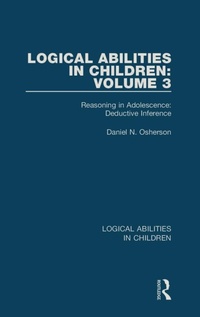
Logical Abilities in Children: Volume 3
Reasoning in Adolescence: Deductive Inference
1st Edition
Published on 14. August 2017
Book
Hardback
282 pages
978-1-138-08717-0 (ISBN)
Description
Originally published in 1975, this volume (3 of 4) presents an expanded model of certain deductive abilities in children and adults. A partial explanation of the growth of these abilities was suggested in Volume 2 of this series, and it is amplified here, both with regard to propositional logic and the logic of class inclusion. A new methodology is employed, the issue of the effect of content in deductive reasoning is covered, and developmental questions are reformulated. Although only data from experiments with adolescents are presented here, the volume sets the stage for potentially illustrating developmental comparisons, a topic pursued in Volume 4 of this novel and inventive series.
More details
Series
Language
English
Place of publication
London
United Kingdom
Publishing group
Taylor & Francis Ltd
Target group
College/higher education
Professional and scholarly
Dimensions
Height: 240 mm
Width: 161 mm
Thickness: 20 mm
Weight
599 gr
ISBN-13
978-1-138-08717-0 (9781138087170)
Copyright in bibliographic data and cover images is held by Nielsen Book Services Limited or by the publishers or by their respective licensors: all rights reserved.
Schweitzer Classification
Other editions
Additional editions
Daniel N. Osherson
Logical Abilities in Children: Volume 3
Reasoning in Adolescence: Deductive Inference
Book
08/2019
1st Edition
Routledge
€62.08
Shipment within 10-20 days
Daniel N. Osherson
Logical Abilities in Children: Volume 3
Reasoning in Adolescence: Deductive Inference
E-Book
08/2017
Routledge
€47.49
Available for download
Daniel N. Osherson
Logical Abilities in Children: Volume 3
Reasoning in Adolescence: Deductive Inference
E-Book
08/2017
Routledge
€47.49
Available for download
Person
Daniel N. Osherson
Content
Preface. Part 1: Introduction 1. Developmental Issues 2. The Research Question Sharpened 3. Three Kinds of Models for Logical Judgment 4. Deduction Models: General Considerations and an Exemplification 5. Empirical Conditions on Derivations 6. Methodological Issues 7. Method Part 2: Propositional Arguments 8. Experiment 1: Validation of Methodology, and the Question of Alternative Operations 9. Experiment 2: Within-Subject Consistency and Complex, Single-Operation Arguments 10. Experiment 3: New Operations 11. Experiment 4: Amalgamation of the Two Sets of Operations 12. Experiment 5: Further Test of the Theory Part 3: Familiar Content and Class Inclusion 13. The Question of a Qualitative Difference Reexamined 14. Experiment 6: Causal Arguments Testing the Theory of Table 8.1 15. Experiment 7: Causal Arguments Testing the Theory of Table 11.1 16. Experiment 8: More Causal Arguments Testing the Theory of Table 11.1 17. Experiment 9: Class-Inclusion Arguments Testing the Theory of Table 8.1 18. Experiment 10: Class-Inclusion Arguments Testing the Theory of Table 11.1 19. Experiment 11: More Class-Inclusion Arguments Testing the Theory of Table 8.1 Part 4: Further Issues 20. Other Properties of Argument Difficulty and Acceptance Rate 21. Some Remaining Theoretical Issues. Appendix: A Full Statement of the Theory. References. Author Index. Subject Index.