

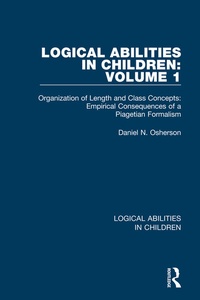
Logical Abilities in Children: Volume 1
Organization of Length and Class Concepts: Empirical Consequences of a Piagetian Formalism
1st Edition
Published on 13. August 2019
Book
Paperback/Softback
170 pages
978-1-138-08713-2 (ISBN)
Description
Originally published in 1974, a wide and interesting set of intellectual abilities in children are examined here. Volume 1 of 4 (Organization of Length and Class Concepts: Empirical Consequences of a Piagetian Formalism) converts an axiomatization of classes and asymmetrical relationships (proper to Piaget's discipline of Genetic Epistemology) into a model of the development of these notions in children. Here may be one of the only attempts to derive predictive consequences from the more philosophically oriented writings of the Genevan School.
More details
Series
Language
English
Place of publication
London
United Kingdom
Publishing group
Taylor & Francis Ltd
Target group
College/higher education
Professional and scholarly
Dimensions
Height: 234 mm
Width: 156 mm
Weight
453 gr
ISBN-13
978-1-138-08713-2 (9781138087132)
Copyright in bibliographic data and cover images is held by Nielsen Book Services Limited or by the publishers or by their respective licensors: all rights reserved.
Schweitzer Classification
Other editions
Additional editions
Daniel N. Osherson
Logical Abilities in Children: Volume 1
Organization of Length and Class Concepts: Empirical Consequences of a Piagetian Formalism
Book
08/2017
1st Edition
Routledge
€163.42
Shipment within 10-20 days
Daniel N. Osherson
Logical Abilities in Children: Volume 1
Organization of Length and Class Concepts: Empirical Consequences of a Piagetian Formalism
E-Book
08/2017
Routledge
€47.49
Available for download
Daniel N. Osherson
Logical Abilities in Children: Volume 1
Organization of Length and Class Concepts: Empirical Consequences of a Piagetian Formalism
E-Book
08/2017
Routledge
€47.49
Available for download
Person
Daniel N. Osherson
Content
Preface. 1. Introduction 2. Grize's Axiomatization of the Grouping 3. The Length Experiment 4. The Class-Inclusion Experiment 5. The Coordination Rules 6. Theoretical Use of the Axiomatization: General Considerations 7. The Model for Length Tasks 8. Extension of the Model for Length 9. An Attempt to Predict the Performance-Factors 10. The Model for Class-Inclusion 11. The Relation of the Theory to Genevan Psychology 12. Direction of Further Theoretical Efforts. References. Appendixes. Author Index. Subject Index.