

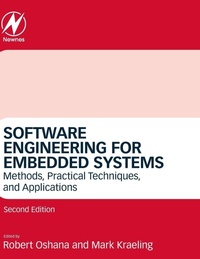
Software Engineering for Embedded Systems
Methods, Practical Techniques, and Applications
2nd Edition
Published on 21. June 2019
Book
Hardback
645 pages
978-0-12-809448-8 (ISBN)
Description
Software Engineering for Embedded Systems: Methods, Practical Techniques, and Applications, Second Edition provides the techniques and technologies in software engineering to optimally design and implement an embedded system. Written by experts with a solution focus, this encyclopedic reference gives an indispensable aid on how to tackle the day-to-day problems encountered when using software engineering methods to develop embedded systems. New sections cover peripheral programming, Internet of things, security and cryptography, networking and packet processing, and hands on labs. Users will learn about the principles of good architecture for an embedded system, design practices, details on principles, and much more.
More details
Edition
2nd edition
Language
English
Place of publication
Oxford
United Kingdom
Publishing group
Elsevier Science & Technology
Target group
College/higher education
professional embedded systems engineers, software engineers developing embedded systems, students taking a course in software engineering for a computer engineering degree.
Product notice
Laminated cover
Dimensions
Height: 246 mm
Width: 195 mm
Thickness: 38 mm
Weight
1426 gr
ISBN-13
978-0-12-809448-8 (9780128094488)
Copyright in bibliographic data and cover images is held by Nielsen Book Services Limited or by the publishers or by their respective licensors: all rights reserved.
Schweitzer Classification
Other editions
Additional editions
Robert Oshana | Mark Kraeling
Software Engineering for Embedded Systems
Methods, Practical Techniques, and Applications
E-Book
06/2019
2nd Edition
Newnes
€86.95
Available for download
Previous edition
Robert Oshana
Software Engineering for Embedded Systems
Methods, Practical Techniques, and Applications
Book
05/2013
Newnes
€85.41
Article exhausted; check for reprint
Persons
Rob Oshana is Vice President of Software Engineering R&D for the Microcontroller and Microprocessor business line at NXP, responsible for software enablement, IoT connectivity, software middleware and security, operating systems, machine learning, software services and advanced technologies. He serves on multiple industry advisory boards and is a recognized international speaker. He has published numerous books and articles on software engineering and embedded systems. He is also an adjunct professor at the University of Texas and Southern Methodist University and is a Senior Member of IEEE. Mark is an enterprise architect for the Train Performance and Transport Intelligence businesses at GE Transportation. He is responsible for integration of networking and applications with worldwide customers' locomotives and infrastructure. Mark is a regular speaker at embedded systems and industry conferences worldwide, focusing on virtualization, advanced wireless technologies, and asset performance management and their application to the transportation industry. Mark also actively participates in industry standards development including the Associate of American Railroads technical action groups. His leadership in the IoT space was recently highlighted by being elected to the program committee for the 2019 IoT Solutions World Congress.
Content
1. Overview of Embedded and Real-Time Systems
2. Embedded Systems Development Process
3. Specification and Modeling techniques
4. Architecture and design patterns
5. Real-Time building blocks
6. Hardware interface to embedded software
7. Programming and Implementation Guidelines
8. Software Reuse by Design in Embedded Systems
9. Embedded Implementation Tips and Tricks
10. Embedded Operating systems
11. Linux and OSS
12. Software Performance Engineering
13. Optimizing Embedded Software for Performance
14. Optimizing Embedded Software for Memory
15. Optimizing Embedded Software for Power
16. Embedded Systems and the Internet of Things
17. User interfaces for embedded systems
18. Integration and testing techniques and quality
19. Software Development Tools
20. Multicore Software Development
21. Safety-Critical Software Development for Embedded Systems
22. Intellectual Property Issues with Embedded Software
23. Managing embedded software development
24. Embedded Software Development for Storage and I/O
25. Embedded Software for Networking Applications
26. Multiple Case Studies
2. Embedded Systems Development Process
3. Specification and Modeling techniques
4. Architecture and design patterns
5. Real-Time building blocks
6. Hardware interface to embedded software
7. Programming and Implementation Guidelines
8. Software Reuse by Design in Embedded Systems
9. Embedded Implementation Tips and Tricks
10. Embedded Operating systems
11. Linux and OSS
12. Software Performance Engineering
13. Optimizing Embedded Software for Performance
14. Optimizing Embedded Software for Memory
15. Optimizing Embedded Software for Power
16. Embedded Systems and the Internet of Things
17. User interfaces for embedded systems
18. Integration and testing techniques and quality
19. Software Development Tools
20. Multicore Software Development
21. Safety-Critical Software Development for Embedded Systems
22. Intellectual Property Issues with Embedded Software
23. Managing embedded software development
24. Embedded Software Development for Storage and I/O
25. Embedded Software for Networking Applications
26. Multiple Case Studies