

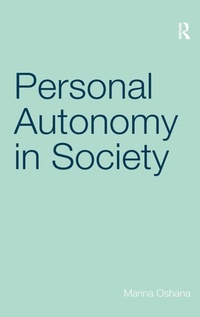
Personal Autonomy in Society
1st Edition
Published on 14. September 2006
Book
Hardback
204 pages
978-0-7546-5670-8 (ISBN)
Description
People are socially situated amid complex relations with other people and are bound by interpersonal frameworks having significant influence upon their lives. These facts have implications for their autonomy. Challenging many of the currently accepted conceptions of autonomy and of how autonomy is valued, Oshana develops a 'social-relational' account of autonomy, or self-governance, as a condition of persons that is largely constituted by a person's relations with other people and by the absence of certain social relations. She denies that command over one's motives and the freedom to realize one's will are sufficient to secure the kind of command over one's life that autonomy requires, and argues against psychological, procedural, and content neutral accounts of autonomy. Oshana embraces the idea that her account is 'perfectionist' in a sense, and argues that ultimately our commitment to autonomy is defeasible, but she maintains that a social-relational account best captures what we value about autonomy and best serves the various ends for which the concept of autonomy is employed.
Reviews / Votes
'Marina Oshana's development of a social-relational account of autonomy makes a major contribution to contemporary philosophical work on personal autonomy. Her insightful attention to the value of autonomy for socially and politically situated creatures, such as we are, yields important critiques of psychological and procedural theories of autonomy. Scholars and students alike will learn much from Oshana's subtle and clearly reasoned book.' Professor Paul Benson, Department of Philosophy and Associate Dean, University of Dayton, Ohio, USA 'Oshana criticizes purely "internalistic" and non-relational accounts of personal autonomy. She offers her own, "social-relational" account, according to which it is a necessary feature of personal autonomy that one stands in certain relations to others in a social context. The critiques are penetrating, and Oshana's theory is original and important. This excellent book will be of interest both to political philosophers and also those interested in debates about freedom, moral responsibility, and causal determinism. Highly recommended.' John Martin Fischer, Distinguished Professor of Philosophy , University of California, Riverside, USA 'This work is an excellent example of traditional analytical philosophy...very well written, thoroughly documented, insightful, and rife with elucidating examples...this is certainly an excellent college-level textbook that many philosophers will find engaging and useful in the classroom...Highly recommended.' Choice 'Oshana does an excellent job of developing a new and striking alternative account of autonomy, contrasting it with more traditional individualistic and less socially related accounts that she explains well... Anyone working on or studying autonomy and related issues will find the book of enormous value and will learn a great deal... Oshana succeeds admirably in accomplishing her worthy goal of contributing to the dialogue and engaging readers in all the rich and complex aMore details
Language
English
Place of publication
London
United Kingdom
Publishing group
Taylor & Francis Ltd
Target group
College/higher education
Dimensions
Height: 240 mm
Width: 161 mm
Thickness: 16 mm
Weight
479 gr
ISBN-13
978-0-7546-5670-8 (9780754656708)
Copyright in bibliographic data and cover images is held by Nielsen Book Services Limited or by the publishers or by their respective licensors: all rights reserved.
Schweitzer Classification
Other editions
Additional editions
Marina Oshana
Personal Autonomy in Society
Book
11/2016
1st Edition
Routledge
€100.50
Shipment within 10-20 days
Person
Marina Oshana is Professor in the Department of Philosophy at the University of Florida, USA.
Content
Contents: Preface; The concept of autonomy; The inner citadel - autonomy as psychological authenticity; Social-relational autonomy; The conditions for personal autonomy; Objections from liberalism; The value of autonomy; What kind of freedom does autonomy require?; Loose ends and parting thoughts; Bibliography; Index.