

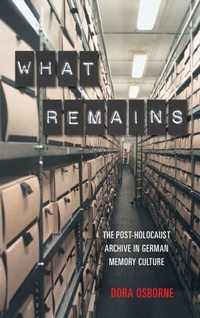
What Remains
The Post-Holocaust Archive in German Memory Culture
Will be published approx. on 27. February 2020
Book
Hardback
238 pages
978-1-64014-052-3 (ISBN)
Description
A study of the archival turn in contemporary German memory culture, drawing on recent memorials, documentaries, and prose narratives that engage with the material legacy of National Socialism and the Holocaust.
With the passing of those who witnessed National Socialism and the Holocaust, the archive matters as never before. However, the material that remains for the work of remembering and commemorating this period of history is determined by both the bureaucratic excesses of the Nazi regime and the attempt to eradicate its victims without trace. This book argues that memory culture in the Berlin Republic is marked by an archival turn that reflects this shift from embodied to externalized, material memory and responds to the particular status of the archive "after Auschwitz." What remains in this late phase of memory culture is the post-Holocaust archive, which at once ensures and hauntsthe future of Holocaust memory.
Drawing on the thinking of Freud, Derrida, and Georges Didi-Huberman, this book traces the political, ethical, and aesthetic implications of the archival turn in contemporary German memory culture across different media and genres. In its discussion of recent memorials, documentary film and theater, as well as prose narratives, all of which engage with the material legacy of the Nazi past, it argues that the performanceof "archive work" is not only crucial to contemporary memory work but also fundamentally challenges it.
Dora Osborne is Senior Lecturer in German at the University of St Andrews.
With the passing of those who witnessed National Socialism and the Holocaust, the archive matters as never before. However, the material that remains for the work of remembering and commemorating this period of history is determined by both the bureaucratic excesses of the Nazi regime and the attempt to eradicate its victims without trace. This book argues that memory culture in the Berlin Republic is marked by an archival turn that reflects this shift from embodied to externalized, material memory and responds to the particular status of the archive "after Auschwitz." What remains in this late phase of memory culture is the post-Holocaust archive, which at once ensures and hauntsthe future of Holocaust memory.
Drawing on the thinking of Freud, Derrida, and Georges Didi-Huberman, this book traces the political, ethical, and aesthetic implications of the archival turn in contemporary German memory culture across different media and genres. In its discussion of recent memorials, documentary film and theater, as well as prose narratives, all of which engage with the material legacy of the Nazi past, it argues that the performanceof "archive work" is not only crucial to contemporary memory work but also fundamentally challenges it.
Dora Osborne is Senior Lecturer in German at the University of St Andrews.
Reviews / Votes
Drawing on the theoretical insights of Jacques Derrida, Georges Didi-Huberman, and Michael Sheringham, Osborne's thorough and meticulous analysis conceptualizes the post-Holocaust archive not merely as a historical resource but as a memorial archive that in itself "has become part of the discourse of memory" and, as such, continues to generate "a haunted legacy that does not provide simple answers" about Germany's tainted past. . . . What Remains? offers a persuasive analysis of how the material residues of the post-Holocaust archive are deployed, envisioned, enacted, and embodied in contemporary German memorial art, documentary film, theater, and prose narrative. GERMAN STUDIES REVIEW -- Charlotte Schallie * GERMAN STUDIES REVIEW *More details
Series
Language
English
Place of publication
Columbia, MD
United States
Publishing group
Boydell & Brewer Ltd
Target group
Professional and scholarly
Product notice
Cloth over boards
Illustrations
5 s/w Abbildungen
5 b/w illus.
Dimensions
Height: 227 mm
Width: 159 mm
Thickness: 22 mm
Weight
527 gr
ISBN-13
978-1-64014-052-3 (9781640140523)
Copyright in bibliographic data and cover images is held by Nielsen Book Services Limited or by the publishers or by their respective licensors: all rights reserved.
Schweitzer Classification
Other editions
Additional editions
E-Book
02/2020
1st Edition
De Gruyter
€48.99
Available for download
Person
DORA OSBORNE is Senior Lecturer in German at the University of St Andrews.
Content
Introduction: Memory Culture's Archival Turn
The Post-Holocaust Archive
Memorial Projects: Memory Work as Archive Work
Documentary Film and Theater: The Unfinished Business of Archive Work
Prose Narrative: Archive Work and Its Discontents
Conclusion
Bibliography
The Post-Holocaust Archive
Memorial Projects: Memory Work as Archive Work
Documentary Film and Theater: The Unfinished Business of Archive Work
Prose Narrative: Archive Work and Its Discontents
Conclusion
Bibliography