

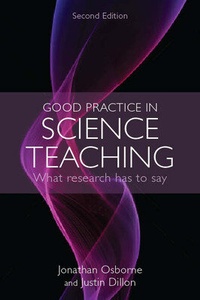
Good Practice in Science Teaching
2nd Edition
Published on 1. May 2010
Book
Other book format
978-0-335-23859-0 (ISBN)
Unfortunately, price unknown
Available (delivery time upon request)
Not available
Description
"The book has wide appeal in that the issues investigated - for example, the nature of science, practical work, the role of language, of technology and formative and summative assessment - are relevant and pertinent to science teachers' work in all school systems."
Professor David F Treagust, Curtin University of Technology, Australia
This new edition of Good Practice in Science Teaching offers a comprehensive overview of the major areas of research and scholarship in science education.
Each chapter summarizes the research work and evidence in the field, and discusses its significance, reliability and implications for the practice of science teaching.
Thoroughly revised throughout, the new edition includes:
- Three new chapters covering: the learning of science in informal contexts; teacher professional development; and technology-mediated learning
- Updates to every chapter, reflecting the changes and developments in science education
- Further reading sections at the end of each chapter
Each chapter has been written by science education researchers with national or international reputations. Each topic is approached in a straight-forward manner and is written in a concise and readable style.
This invaluable guide is ideal for science teachers of children of all ages, and others who work in teaching and related fields. It is an essential text for teachers in training and those studying for higher degrees.
Contributors: Philip Adey, Paul Black, Maria Evagorou, John Gilbert, Melissa Glackin, Christine Harrison, Jill Hohenstein, Heather King, Alex Manning, Robin Millar, Natasha Serret, Shirley Simon, Julian Swain, Mary Webb.
Professor David F Treagust, Curtin University of Technology, Australia
This new edition of Good Practice in Science Teaching offers a comprehensive overview of the major areas of research and scholarship in science education.
Each chapter summarizes the research work and evidence in the field, and discusses its significance, reliability and implications for the practice of science teaching.
Thoroughly revised throughout, the new edition includes:
- Three new chapters covering: the learning of science in informal contexts; teacher professional development; and technology-mediated learning
- Updates to every chapter, reflecting the changes and developments in science education
- Further reading sections at the end of each chapter
Each chapter has been written by science education researchers with national or international reputations. Each topic is approached in a straight-forward manner and is written in a concise and readable style.
This invaluable guide is ideal for science teachers of children of all ages, and others who work in teaching and related fields. It is an essential text for teachers in training and those studying for higher degrees.
Contributors: Philip Adey, Paul Black, Maria Evagorou, John Gilbert, Melissa Glackin, Christine Harrison, Jill Hohenstein, Heather King, Alex Manning, Robin Millar, Natasha Serret, Shirley Simon, Julian Swain, Mary Webb.
More details
Persons
Jonathan Osborne is the Shriram Family Professor of Science Education at Stanford University, USA. He started his career teaching physics in London schools before joining King's College London, UK in 1985 where he worked until 2008 before moving to Stanford.
Justin Dillon is Professor of Science and Environmental Education and Head of the Science and Technology Education Group at King's College London, UK. He started his career teaching science in London schools before joining King's College London, UK in 1989. He is President of the European Science Education Research Association and an editor of the International Journal of Science Education. He is Editor of Becoming a Teacher 3e (Open University Press, 2007).
Justin Dillon is Professor of Science and Environmental Education and Head of the Science and Technology Education Group at King's College London, UK. He started his career teaching science in London schools before joining King's College London, UK in 1989. He is President of the European Science Education Research Association and an editor of the International Journal of Science Education. He is Editor of Becoming a Teacher 3e (Open University Press, 2007).
Content
Introduction: Research matters?
Science teachers, science teaching: Issues and challenges
How science works: What is the nature of scientific reasoning and what do we know about students' understanding?
Science for citizenship
Thinking about learning: Learning in science
Science teaching and cognitive acceleration
Practical work
The role of language in the learning and teaching of science
Technology mediated learning
Formative assessment in science
Summative assessment: Gold or glitter?
Students' attitudes to science
Supporting science learning in out-of-school contexts
Supporting the development of effective science teachers
Index
Science teachers, science teaching: Issues and challenges
How science works: What is the nature of scientific reasoning and what do we know about students' understanding?
Science for citizenship
Thinking about learning: Learning in science
Science teaching and cognitive acceleration
Practical work
The role of language in the learning and teaching of science
Technology mediated learning
Formative assessment in science
Summative assessment: Gold or glitter?
Students' attitudes to science
Supporting science learning in out-of-school contexts
Supporting the development of effective science teachers
Index