

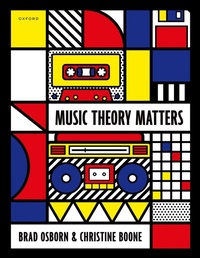
Music Theory Matters
Will be published approx. on 30. June 2026
Book
Paperback/Softback
558 pages
978-0-19-761206-4 (ISBN)
Description
Authors Brad Osborn and Christine Boone's Music Theory Matters uses popular music as the basis for introducing students to music theory. Osborn and Boone engage students with popular music from page one, then introduce them to more classical terms as the book progresses. Chapters alternate between classical and popular-focused topics, giving instructors some degree of flexibility in crafting a curriculum from a mix of classical and popular repertoire. The book helps students with skills that are part of the traditional theory curriculum, including writing and analysis in common practice style, but also with skills that are part of new theory curricula, including analyzing popular music and songwriting.
Reviews / Votes
More progressive, current, relevant, broad, and diverse than any other theory text I've seen. * Nathan Fleshner, University of Tennessee * A truly innovative textbook, Music Theory Matters offers an impressive array of musical examples, representing works by persons of color, women, living composers, and other historically excluded individuals. It engages popular music in sophisticated yet accessible ways, alongside European classical and romantic music, making it ideal for curricula that wish to better engage works in a variety of styles. * Victoria Malawey, Macalester College *More details
Language
English
Place of publication
New York
United States
Dimensions
Height: 254 mm
Width: 203 mm
Weight
3 gr
ISBN-13
978-0-19-761206-4 (9780197612064)
Copyright in bibliographic data and cover images is held by Nielsen Book Services Limited or by the publishers or by their respective licensors: all rights reserved.
Schweitzer Classification
Persons
Brad Osborn is Professor of Music Theory and affiliated faculty in American Studies at the University of Kansas. He is the author of Everything in its Right Place: Analyzing Radiohead (OUP, 2017), Interpreting Music Video: Popular Music in the Post-MTV Era (2021), and the co-author of American Popular Music (OUP, 2021).
Christine Boone is a visiting Associate Professor of Music at St. Olaf College. Her research interests are centered around popular music. She has presented papers on the Beatles in both the United States and the United Kingdom. Her current research focuses on mashups, and her work has been published in both books and articles. Throughout her career as a music theorist, Christine, a lyric soprano, has remained active as a professional soloist in major works. In addition, she has put her musical knowledge to work on NPR's classical music game show, "Piano Puzzler."
Christine Boone is a visiting Associate Professor of Music at St. Olaf College. Her research interests are centered around popular music. She has presented papers on the Beatles in both the United States and the United Kingdom. Her current research focuses on mashups, and her work has been published in both books and articles. Throughout her career as a music theorist, Christine, a lyric soprano, has remained active as a professional soloist in major works. In addition, she has put her musical knowledge to work on NPR's classical music game show, "Piano Puzzler."
Content
- Preface
- About the Authors
- Chapter 1: Visualizing Pitch
- 1.1 The Musical Alphabet
- 1.2 Visualizing Pitch on the Guitar and Keyboard
- 1.3 Visualizing Pitch in Digital Audio Workstations (DAWs)
- 1.4 Integer Notation
- 1.5 Staff Notation
- Chapter 2: Simple Metric Grids
- 2.1 Feeling the Beat
- 2.2 Eighth-Note Grids
- 2.3 Sixteenth-Note Grids
- 2.4 Triple Meter
- 2.5 Time Feels
- Chapter 3: Chords and Scales in Major Keys
- 3.1 Major and Pentatonic Scales
- 3.2 Intervals of the Major Scale
- 3.3 Key Signatures and the Circle of Fifths
- 3.4 Triads in Major Keys
- 3.5 Inverted Triads
- Chapter 4: Compound Metric Grids
- 4.1 Compound Meter Signatures
- 4.2 Hemiola
- 4.3 Triplets
- 4.4 Swing and Shuffle Feels
- 4.5 Compound Time Feels
- Chapter 5: Chords and Scales in Minor Keys
- 5.1 Three Forms of the Minor Scale
- 5.2 Diatonic Modes
- 5.3 Minor Key Signatures
- 5.4 Triads in Minor Keys
- 5.5 Minor Pentatonic Scales
- Chapter 6: Lyrical and Textual Analysis
- 6.1 Music vs. Lyrics
- 6.2 Form and Lyrics
- 6.3 Setting Text
- 6.4 Text Painting
- 6.5 Lyrics as Protest
- Chapter 7: Chords with Seventh, Ninth, and Other Extensions
- 7.1 Seventh Chords
- 7.2 Ninth Chords and add-9
- 7.3 Eleventh Chords and sus4
- 7.4 Thirteenth Chords and Sixths
- Chapter 8: Introduction to Harmony and Counterpoint
- 8.1 Consonance and Dissonance
- 8.2 Voice-Leading
- 8.3 Non-chord Tones
- 8.4 Six-Four Chords
- Chapter 9: Classical Harmonic Function
- 9.1 Cadence, Phrase, and Hypermeter
- 9.2 Tonic, Predominant, Dominant Functions and Prolongation
- 9.3 Melodic and Harmonic Sequences
- 9.4 Intro to Sentences and Periods
- Chapter 10: Diatonic Chord Loops
- 10.1 Contains V, begins on I
- 10.2 Contains V, begins off I
- 10.3 Missing V, begins on I
- 10.4 Missing V, begins off I
- 10.5 Absent-I
- Chapter 11: Classical Textures
- 11.1 Chorale Texture and Four-Part Voice Leading
- 11.2 Other Four-Part Textures
- 11.3 Polyphonic Textures
- 11.4 Harmonizing a Melody
- Chapter 12: Pop Timbres and Effects
- 12.1 Timbre Theory
- 12.2 The Four Textural Layers
- 12.3 Pop Instruments (and Some Effects)
- 12.4 Common Effects
- Chapter 13: Classical Orchestration and Scoring
- 13.1 Transposing Instruments
- 13.2 Reading an Orchestral/Band Score
- 13.3 Scoring for Voices
- 13.4 Incorporating Electronics into Classical Music
- Chapter 14: Applied Chords
- 14.1 Applied Dominants
- 14.2 Applied Diminished Chords
- 14.3 Voice Leading with Applied Chords
- 14.4 Other Ways to Resolve Applied Chords
- 14.5 Neapolitan and Augmented Sixth Chords
- Chapter 15: Borrowed Chords
- 15.1 Writing and Voice Leading with Borrowed Chords
- 15.2 Borrowed Chords in Classical Music
- 15.3 Borrowed Chords in Popular Music
- Chapter 16: Modulation
- 16.1 Pivot Chord Modulation to Closely Related Keys
- 16.2 Pivot Chord Modulation to Distantly Related Keys
- 16.3 Common Tone Modulation
- 16.4 Direct Modulation
- 16.5 Interpreting Modulations
- Chapter 17: Strophic, Verse/Chorus, and Other Pop Forms
- 17.1 Verse/Chorus Forms
- 17.2 Strophic Forms
- 17.3 Some Smaller Sections
- 17.4 Other Song Forms
- Chapter 18: Concise Classical Forms
- 18.1 Binary Forms
- 18.2 Ternary Forms
- 18.3 Rondo Forms
- Chapter 19: Changing and Asymmetrical Meters
- 19.1 Syncopation
- 19.2 Asymmetrical Meter
- 19.3 Changing Meter
- 19.4 Tempo Modulations
- Chapter 20: Metric Displacement and Dissonance
- 20.1 Metric Displacement
- 20.2 Hypermetric Displacement and Metric Fake-Outs
- 20.3 Grouping Dissonance
- Chapter 21: Chromatic Chord Loops
- 21.1 Dual Leading Tone Loops (DLTL)
- 21.2 Triple Tonic Loops (TTL)
- 21.3 Modal Pop Loops
- 21.4 Other Non-Diatonic Pop Loops
- Chapter 22: Longer Classical Forms
- 22.1 Sonata Form
- 22.2 Special Types of Sonata Form
- 22.3 Sonata-Rondo Form
- 22.4 Concerto Form
- Chapter 23: Advanced Chromatic Harmony
- 23.1 Altered Dominants and Common-Tone Diminished Seventh Chords
- 23.2 Enharmonic Modulations
- 23.3 Mediant Relationships
- 23.4 Neo-Riemannian Theory
- Chapter 24: Atonal and Serial Music
- 24.1 Non-Tertian Sonorities
- 24.2 Synthetic Scales
- 24.3 Atonal Pitch Class Sets
- 24.4 Serial Composition
- Chapter 25: Minimalism and Postminimalism
- 25.1 Early Minimalism
- 25.2 Postminimalism
- 25.3 The Minimalist Spirit in Today's Music
- 25.4 Conclusion: The State of Classical Music Today
- Glossary
- Credits
- Index
- About the Authors
- Chapter 1: Visualizing Pitch
- 1.1 The Musical Alphabet
- 1.2 Visualizing Pitch on the Guitar and Keyboard
- 1.3 Visualizing Pitch in Digital Audio Workstations (DAWs)
- 1.4 Integer Notation
- 1.5 Staff Notation
- Chapter 2: Simple Metric Grids
- 2.1 Feeling the Beat
- 2.2 Eighth-Note Grids
- 2.3 Sixteenth-Note Grids
- 2.4 Triple Meter
- 2.5 Time Feels
- Chapter 3: Chords and Scales in Major Keys
- 3.1 Major and Pentatonic Scales
- 3.2 Intervals of the Major Scale
- 3.3 Key Signatures and the Circle of Fifths
- 3.4 Triads in Major Keys
- 3.5 Inverted Triads
- Chapter 4: Compound Metric Grids
- 4.1 Compound Meter Signatures
- 4.2 Hemiola
- 4.3 Triplets
- 4.4 Swing and Shuffle Feels
- 4.5 Compound Time Feels
- Chapter 5: Chords and Scales in Minor Keys
- 5.1 Three Forms of the Minor Scale
- 5.2 Diatonic Modes
- 5.3 Minor Key Signatures
- 5.4 Triads in Minor Keys
- 5.5 Minor Pentatonic Scales
- Chapter 6: Lyrical and Textual Analysis
- 6.1 Music vs. Lyrics
- 6.2 Form and Lyrics
- 6.3 Setting Text
- 6.4 Text Painting
- 6.5 Lyrics as Protest
- Chapter 7: Chords with Seventh, Ninth, and Other Extensions
- 7.1 Seventh Chords
- 7.2 Ninth Chords and add-9
- 7.3 Eleventh Chords and sus4
- 7.4 Thirteenth Chords and Sixths
- Chapter 8: Introduction to Harmony and Counterpoint
- 8.1 Consonance and Dissonance
- 8.2 Voice-Leading
- 8.3 Non-chord Tones
- 8.4 Six-Four Chords
- Chapter 9: Classical Harmonic Function
- 9.1 Cadence, Phrase, and Hypermeter
- 9.2 Tonic, Predominant, Dominant Functions and Prolongation
- 9.3 Melodic and Harmonic Sequences
- 9.4 Intro to Sentences and Periods
- Chapter 10: Diatonic Chord Loops
- 10.1 Contains V, begins on I
- 10.2 Contains V, begins off I
- 10.3 Missing V, begins on I
- 10.4 Missing V, begins off I
- 10.5 Absent-I
- Chapter 11: Classical Textures
- 11.1 Chorale Texture and Four-Part Voice Leading
- 11.2 Other Four-Part Textures
- 11.3 Polyphonic Textures
- 11.4 Harmonizing a Melody
- Chapter 12: Pop Timbres and Effects
- 12.1 Timbre Theory
- 12.2 The Four Textural Layers
- 12.3 Pop Instruments (and Some Effects)
- 12.4 Common Effects
- Chapter 13: Classical Orchestration and Scoring
- 13.1 Transposing Instruments
- 13.2 Reading an Orchestral/Band Score
- 13.3 Scoring for Voices
- 13.4 Incorporating Electronics into Classical Music
- Chapter 14: Applied Chords
- 14.1 Applied Dominants
- 14.2 Applied Diminished Chords
- 14.3 Voice Leading with Applied Chords
- 14.4 Other Ways to Resolve Applied Chords
- 14.5 Neapolitan and Augmented Sixth Chords
- Chapter 15: Borrowed Chords
- 15.1 Writing and Voice Leading with Borrowed Chords
- 15.2 Borrowed Chords in Classical Music
- 15.3 Borrowed Chords in Popular Music
- Chapter 16: Modulation
- 16.1 Pivot Chord Modulation to Closely Related Keys
- 16.2 Pivot Chord Modulation to Distantly Related Keys
- 16.3 Common Tone Modulation
- 16.4 Direct Modulation
- 16.5 Interpreting Modulations
- Chapter 17: Strophic, Verse/Chorus, and Other Pop Forms
- 17.1 Verse/Chorus Forms
- 17.2 Strophic Forms
- 17.3 Some Smaller Sections
- 17.4 Other Song Forms
- Chapter 18: Concise Classical Forms
- 18.1 Binary Forms
- 18.2 Ternary Forms
- 18.3 Rondo Forms
- Chapter 19: Changing and Asymmetrical Meters
- 19.1 Syncopation
- 19.2 Asymmetrical Meter
- 19.3 Changing Meter
- 19.4 Tempo Modulations
- Chapter 20: Metric Displacement and Dissonance
- 20.1 Metric Displacement
- 20.2 Hypermetric Displacement and Metric Fake-Outs
- 20.3 Grouping Dissonance
- Chapter 21: Chromatic Chord Loops
- 21.1 Dual Leading Tone Loops (DLTL)
- 21.2 Triple Tonic Loops (TTL)
- 21.3 Modal Pop Loops
- 21.4 Other Non-Diatonic Pop Loops
- Chapter 22: Longer Classical Forms
- 22.1 Sonata Form
- 22.2 Special Types of Sonata Form
- 22.3 Sonata-Rondo Form
- 22.4 Concerto Form
- Chapter 23: Advanced Chromatic Harmony
- 23.1 Altered Dominants and Common-Tone Diminished Seventh Chords
- 23.2 Enharmonic Modulations
- 23.3 Mediant Relationships
- 23.4 Neo-Riemannian Theory
- Chapter 24: Atonal and Serial Music
- 24.1 Non-Tertian Sonorities
- 24.2 Synthetic Scales
- 24.3 Atonal Pitch Class Sets
- 24.4 Serial Composition
- Chapter 25: Minimalism and Postminimalism
- 25.1 Early Minimalism
- 25.2 Postminimalism
- 25.3 The Minimalist Spirit in Today's Music
- 25.4 Conclusion: The State of Classical Music Today
- Glossary
- Credits
- Index