

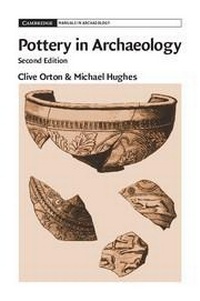
Pottery in Archaeology
2nd Edition
Published on 13. May 2013
Book
Hardback
356 pages
978-1-107-00874-8 (ISBN)
Description
This revised edition provides an up-to-date account of the many different kinds of information that can be obtained through the archaeological study of pottery. It describes the scientific and quantitative techniques that are now available to the archaeologist, and assesses their value for answering a range of archaeological questions. It provides a manual for the basic handling and archiving of excavated pottery so that it can be used as a basis for further studies. The whole is set in the historical context of the ways in which archaeologists have sought to gain evidence from pottery and continue to do so. There are case studies of several approaches and techniques, backed up by an extensive bibliography.
Reviews / Votes
'... its aspiration [is] to enthuse and inspire ... Remarkably, and despite the great breadth of its content, it does both of these things and should entice hordes into the pot shed and keep them effectively employed there. This is how textbooks should be written.' Antiquity '... the organization of a volume of this scope is a daunting task. Readers can pick and mix relevant chapters. Allowing such flexibility in use without losing consistency is probably Pottery in Archaeology's biggest feat. In its second edition, [it] is still one of the most accessible and authoritative pottery manuals [and] will be of interest to any scholar of the Roman period who finds herself faced with a table of potsherds or ... [trying] to get to grips with the value of pottery evidence.' Astrid Van Oyen, The Journal of Roman StudiesMore details
Series
Edition
2nd Revised edition
Language
English
Place of publication
Cambridge
United Kingdom
Target group
Professional and scholarly
College/higher education
Edition type
Revised edition
Product notice
sewn/stitched
Cloth over boards
Illustrations
9 Tables, unspecified; 3 Maps; 19 Halftones, unspecified; 39 Line drawings, unspecified
Dimensions
Height: 264 mm
Width: 188 mm
Thickness: 43 mm
Weight
885 gr
ISBN-13
978-1-107-00874-8 (9781107008748)
Copyright in bibliographic data and cover images is held by Nielsen Book Services Limited or by the publishers or by their respective licensors: all rights reserved.
Schweitzer Classification
Other editions
Additional editions
Clive Orton | Michael Hughes
Pottery in Archaeology
E-Book
09/2013
2nd Edition
Cambridge University Press
€35.49
Available for download
Clive Orton
Pottery in Archaeology
E-Book
05/2013
Cambridge University Press
€29.49
Available for download
Previous edition
Clive Orton | Paul Tyers | Alan Vince
Pottery in Archaeology
Book
05/1993
Cambridge University Press
€55.80
Article exhausted; check for reprint
Persons
Clive Orton is Emeritus Professor of Quantitative Archaeology at the University College London Institute of Archaeology. He has won the London and Middlesex Archaeological Society Ralph Merrifield Award for service to London Archaeology and the British Archaeological Awards Lifetime Achievement Award. He is a member of the Archaeology Data Service Management Committee, a member of the advisory board for the Journal of Quantitative Archaeology, the editor of London Archaeologist, a member of the editorial board for Archaeologia e Calcolatori, chairman of Southwark and Lambeth Archaeological Excavation Committee and chair of Gresham Ship Steering Committee. His most recent books include The Pottery from Medieval Novgorod and its Region (2006) and Sampling in Archaeology (2000). Michael Hughes was Principal Scientific Officer at The British Museum, Department of Conservation and Scientific Research and Senior Lecturer in Forensic Science and Bioscience at the University of East London. His work has been published in Archaeometry, the Journal of Archaeological Science, Studies in Conservation, Medieval Archaeology, Medieval Ceramics and the Oxford Journal of Archaeology, among others.
Content
Part I. History and Potential: 1. History of pottery studies; 2. The potential of pottery as archaeological evidence; Part II. Practicalities: A Guide to Pottery Processing and Recording: 3. Integration with research designs; 4. Life in the pot shed; 5. Fabric analysis; 6. Classification of form and decoration; 7. Illustration; 8. Pottery archives; 9. Publication; Part III. Themes in Ceramic Studies: 10. Making pottery; 11. Archaeology by experiment; 12. Craft specialisation and standardisation of production; 13. Pottery fabrics; 14. Form; 15. Quantification; 16. Chronology; 17. Production and distribution; 18. Pottery and function; 19. Assemblages and sites; Conclusion: the future of pottery studies.