

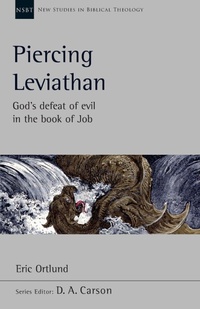
Piercing Leviathan
God's Defeat Of Evil In The Book Of Job
Published on 19. August 2021
Book
Paperback/Softback
224 pages
978-1-78974-298-5 (ISBN)
Description
' ... his hand pierced the fleeing serpent' (Job 26:13 ESV)
One of the most challenging passages in the Old Testament book of Job comes in the Lord's second speech (chapters 40-41). The characters and the reader have waited a long time for the Lord to speak - only to receive what is traditionally interpreted as a long description of a hippopotamus and a crocodile (Behemoth and Leviathan).
The stakes are very high. Is God right to run the world in such a way that allows such terrible suffering for one of his most loyal servants? Is Job right to keep trusting God in the midst of much criticism? It is difficult for modern readers to avoid a sense of frustrating anti-climax as the book concludes.
Eric Ortlund argues that Behemoth and Leviathan are better understood as symbols of cosmic chaos and evil. A supernatural interpretation fits better exegetically within the book of Job and in its original context. It also helps us to appreciate the satisfying climax to the book: in describing Behemoth and Leviathan, God is directly engaging with Job's complaint about divine justice, implying that he understands the evil at loose in his creation better than Job does, that he is in control of it, and will one day destroy it.
One of the most challenging passages in the Old Testament book of Job comes in the Lord's second speech (chapters 40-41). The characters and the reader have waited a long time for the Lord to speak - only to receive what is traditionally interpreted as a long description of a hippopotamus and a crocodile (Behemoth and Leviathan).
The stakes are very high. Is God right to run the world in such a way that allows such terrible suffering for one of his most loyal servants? Is Job right to keep trusting God in the midst of much criticism? It is difficult for modern readers to avoid a sense of frustrating anti-climax as the book concludes.
Eric Ortlund argues that Behemoth and Leviathan are better understood as symbols of cosmic chaos and evil. A supernatural interpretation fits better exegetically within the book of Job and in its original context. It also helps us to appreciate the satisfying climax to the book: in describing Behemoth and Leviathan, God is directly engaging with Job's complaint about divine justice, implying that he understands the evil at loose in his creation better than Job does, that he is in control of it, and will one day destroy it.
Reviews / Votes
Recent years have witnessed a plethora of studies on Job, but none of them is quite like this one. Most make much of God's apparent refusal to address Job's questions directly: on this reading, God wants us to trust the One who cast Orion into the heavens, who controls the treasures of the snow, who made the crocodile. God is to be trusted because he is incomparably greater than we are. But Eric Ortlund argues that this interpretation of the book mis-reads too many passages. Probing carefully such features as the double speeches of God, the differences between Job's first and second responses to God's speeches, and the meaning of Leviathan, he argues persuasively that the Book of Job is not as open-ended as many have thought, but offers a firm foundation for Job's ultimate response. * D. A. Carson, Research Professor of New Testament, Trinity Evangelical Divinity School, USA *More details
Series
Language
English
Place of publication
Nottingham
United Kingdom
Publishing group
Inter-Varsity Press
Dimensions
Height: 216 mm
Width: 140 mm
Thickness: 13 mm
Weight
288 gr
ISBN-13
978-1-78974-298-5 (9781789742985)
Copyright in bibliographic data and cover images is held by Nielsen Book Services Limited or by the publishers or by their respective licensors: all rights reserved.
Schweitzer Classification
Other editions
Additional editions
E-Book
08/2021
Apollos
€16.49
Available for download