

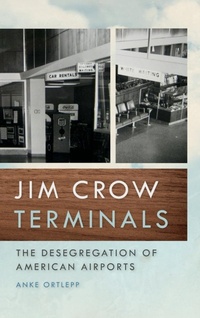
Jim Crow Terminals
The Desegregation of American Airports
Published on 1. July 2017
Book
Hardback
222 pages
978-0-8203-5093-6 (ISBN)
Description
Historical accounts of racial discrimination in transportation have focused until now on trains, buses, and streetcars and their respective depots, terminals, stops, and other public accommodations. It is essential to add airplanes and airports to this narrative, says Anke Ortlepp. Air travel stands at the center of the twentieth century's transportation revolution, and airports embodied the rapidly mobilizing, increasingly prosperous, and cosmopolitan character of the postwar United States. When segregationists inscribed local definitions of whiteness and blackness onto sites of interstate and even international transit, they not only brought the incongruities of racial separation into sharp relief but also obligated the federal government to intervene.
Ortlepp looks at African American passengers; civil rights organizations; the federal government and judiciary; and airport planners, architects, and managers as actors in shaping aviation's legal, cultural, and built environments. She relates the struggles of black travelers-to enjoy the same freedoms on the airport grounds that they enjoyed in the aircraft cabin-in the context of larger shifts in the postwar social, economic, and political order. Jim Crow terminals, Ortlepp shows us, were both spatial expressions of sweeping change and sites of confrontation over the renegotiation of racial identities. Hence, this new study situates itself in the scholarly debate over the multifaceted entanglements of "race" and "space."
Ortlepp looks at African American passengers; civil rights organizations; the federal government and judiciary; and airport planners, architects, and managers as actors in shaping aviation's legal, cultural, and built environments. She relates the struggles of black travelers-to enjoy the same freedoms on the airport grounds that they enjoyed in the aircraft cabin-in the context of larger shifts in the postwar social, economic, and political order. Jim Crow terminals, Ortlepp shows us, were both spatial expressions of sweeping change and sites of confrontation over the renegotiation of racial identities. Hence, this new study situates itself in the scholarly debate over the multifaceted entanglements of "race" and "space."
Reviews / Votes
In this major contribution to historical scholarship on racial segregation on public transportation, historian Ortlepp mines a variety of archival materials, including government records, newspapers, oral histories, and civil rights organizational records, to explore a lesser-known chapter in the struggle for desegregation. . . . Ortlepp convincingly underscores how airport terminals became sites of protest as members of the NAACP and the Congress of Racial Equality (CORE) fought to participate equally in the consumption of air travel. -- L. D. Harris * CHOICE * Ortlepp's book is an important and at times chilling reminder of how bodies that matter get filtered and screened by the everyday architecture of commercial flight. At the same time, Jim Crow Terminals is heartening to read for the ways that the physical instantiations of white supremacy in airports were systematically eliminated through legal recourse and collective persistence. -- Christopher Shaberg * African American Review * [This book] analyze[s] little-known events important to historians' understanding of the postwar civil rights movement. It helps us understand how direct action, lawsuits, and federal regulation combined to limit and eventually roll back segregationist practices. It demonstrates another way that black activists and their allies forced the South to abandon its Jim Crow ways. -- James Wolfinger * Journal of American History * Ortlepp's book is an important and at times chilling reminder of how bodies that matter get filtered and screened by the everyday architecture of commercial flight. At the same time, Jim Crow Terminals is heartening to read for the ways that the physical instantiations of white supremacy in airports were systematically eliminated through legal recourse and collective persistence. -- Christopher Schaberg * African American Review * Ortlepp sheds valuable light on the relationship between race, space and mobility in postwar America and on the particular role that airports and aviation came to play in the desegregation struggle. -- Bret Edwards * Journal of Transport History *More details
Series
Language
English
Place of publication
Georgia
United States
Target group
College/higher education
Professional and scholarly
Product notice
Paper over boards
Illustrations
7 b&w images
Dimensions
Height: 235 mm
Width: 157 mm
Thickness: 18 mm
Weight
515 gr
ISBN-13
978-0-8203-5093-6 (9780820350936)
Copyright in bibliographic data and cover images is held by Nielsen Book Services Limited or by the publishers or by their respective licensors: all rights reserved.
Schweitzer Classification
Other editions
Additional editions
E-Book
07/2017
Cokesbury
€81.49
Available for download
Person
ANKE ORTLEPP is a professor of British and American history at the University of Kassel. Her books include Germans and African Americans: Two Centuries of Exchange, coedited with Larry A. Greene.