

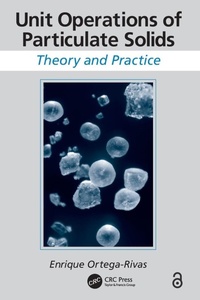
Unit Operations of Particulate Solids
Theory and Practice
1st Edition
Published on 29. March 2017
Book
Paperback/Softback
492 pages
978-1-138-07599-3 (ISBN)
Description
Suitable for practicing engineers and engineers in training, Unit Operations of Particulate Solids: Theory and Practice presents the unit operations in chemical engineering that involve the handling and processing of particulate solids.
The first part of the book analyzes primary and secondary properties of particles and particulate systems, focusing on their characterization and the effects on selection and design of silos and conveyors. Covering the main industrial operations of dry solids processing, the second part offers insight into the operation principles of the most important technologies that handle dry solids in bulk. With an emphasis on two-phase and multiphase flow, the final part describes all of the relevant systems in industrial processes that combine two different components of the state of matter as well as technologies for separating phases by purely mechanical means.
Through clear explanations of theoretical principles and practical laboratory exercises, this book provides an understanding of the behavior of powders and pulverized systems. It also helps readers develop skills for operating, optimizing, and innovating particle processing technologies and machinery in order to carry out industrial operations, such as centrifugation, filtration, and membrane separations.
The first part of the book analyzes primary and secondary properties of particles and particulate systems, focusing on their characterization and the effects on selection and design of silos and conveyors. Covering the main industrial operations of dry solids processing, the second part offers insight into the operation principles of the most important technologies that handle dry solids in bulk. With an emphasis on two-phase and multiphase flow, the final part describes all of the relevant systems in industrial processes that combine two different components of the state of matter as well as technologies for separating phases by purely mechanical means.
Through clear explanations of theoretical principles and practical laboratory exercises, this book provides an understanding of the behavior of powders and pulverized systems. It also helps readers develop skills for operating, optimizing, and innovating particle processing technologies and machinery in order to carry out industrial operations, such as centrifugation, filtration, and membrane separations.
More details
Language
English
Place of publication
London
United Kingdom
Publishing group
Taylor & Francis Ltd
Target group
College/higher education
Undergraduate and graduate students in chemical engineering, mechanical engineering, agricultural engineering, and biosystems engineering.
Illustrations
175 s/w Abbildungen, 69 s/w Tabellen
69 Tables, black and white; 175 Illustrations, black and white
Dimensions
Height: 234 mm
Width: 156 mm
Thickness: 26 mm
Weight
743 gr
ISBN-13
978-1-138-07599-3 (9781138075993)
Copyright in bibliographic data and cover images is held by Nielsen Book Services Limited or by the publishers or by their respective licensors: all rights reserved.
Schweitzer Classification
Other editions
Additional editions
E-Book
04/2016
1st Edition
CRC Press
€0.00
Available for download
E-Book
04/2016
CRC Press
€0.00
Available for download
Book
08/2011
1st Edition
CRC Press
€385.40
Shipment within 15-20 days
Person
Enrique Ortega-Rivas is a professor at the Autonomous University of Chihuahua. He is a member of the editorial boards of Food and Bioprocess Technology: An International Journal, Food Engineering Reviews, and The Open Food Science Journal. A National Researcher of Mexico, Dr. Ortega-Rivas was a Fulbright scholar and has held positions at Food Science Australia, Monash University, and Washington State University. His research interests include food engineering, particle technology, and solid-fluid separation techniques.
Content
Characterization of Particulate Systems and Relation to Storage and Conveying: Introduction. Bulk Solids: Properties and Characterization. Storage and Conveying of Bulk Solids. Bulk Solids Processing: Size Reduction. Size Enlargement. Mixing. Fluidization. Separation Techniques for Particulate Solids: Introductory Aspects. Solid Mixtures. Solid-Fluid Systems. Appendices. Index.