

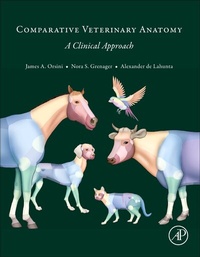
Comparative Veterinary Anatomy
A Clinical Approach
Published on 25. February 2022
Book
Paperback/Softback
1496 pages
978-0-12-812107-8 (ISBN)
Description
Comparative Veterinary Anatomy: A Clinical Approach describes the comprehensive, clinical application of anatomy for veterinarians, veterinary students, allied health professionals and undergraduate students majoring in biology and zoology. The book covers the applied anatomy of dogs, cats, horses, cows and other farm animals, with a short section on avian/exotics, with a focus on specific clinical anatomical topics. The work improves the understanding of basic veterinary anatomy by making it relevant in the context of common clinical problems. This book will serve as a single-source reference on the application of important anatomical structures in a clinical setting.
Students, practitioners and specialists will find this information easy-to-use and well-illustrated, thus presenting an accurate representation of essential anatomical structures that relates to real-life clinical situations in veterinary medicine.
Students, practitioners and specialists will find this information easy-to-use and well-illustrated, thus presenting an accurate representation of essential anatomical structures that relates to real-life clinical situations in veterinary medicine.
More details
Language
English
Place of publication
San Diego
United States
Publishing group
Elsevier Science Publishing Co Inc
Target group
Professional and scholarly
Veterinary anatomists and surgeons; zoo and wildlife clinicians; small and large animal veterinarians; biologists, students, residents, and fellows in zoo, wildlife, veterinary, exotic pet medicine and anatomy and academic environments; veterinary scientists in laboratory settings and lab animal settings; veterinary/clinical institutions and libraries; allied health professionals, comparative anatomists
Dimensions
Height: 276 mm
Width: 216 mm
Weight
450 gr
ISBN-13
978-0-12-812107-8 (9780128121078)
Copyright in bibliographic data and cover images is held by Nielsen Book Services Limited or by the publishers or by their respective licensors: all rights reserved.
Schweitzer Classification
Other editions
Additional editions
James A. Orsini | Nora S. Grenager | Alexander de Lahunta
Comparative Veterinary Anatomy
A Clinical Approach
Book
11/2022
Academic Press
€118.79
Shipment within 10-15 days
Persons
James A. Orsini, is an Associate Professor of Surgery, School of Veterinary Medicine, University of Pennsylvania. Dr. Orsini received his DVM from Cornell University and completed his internship, surgery residency, and fellowship/lectureship training at Penn's New Bolton Center campus. He is board certified in surgery by the American College of Veterinary Surgeons with a special interest and expertise in orthopedic and reconstructive surgery and laminitis, amongst other surgery areas. He has published extensively on equine pediatric surgery, antimicrobials, laminitis, gastric ulcers, pain and anti-inflammatory medications and related fields with several hundred publications. He is co-editor of Equine Emergencies: Treatment and Procedures, which is in its fourth edition and published in seven languages. Dr. Orsini's current research interests are in understanding the pathophysiology of laminitis, prevention, and improved treatments. Nora Grenager is an equine internal medicine specialist currently at University College Dublin in Ireland. Dr. Grenager received her BA from Amherst College, her VMD from the University of Pennsylvania, and then completed her internship and internal medicine residency at Steinbeck Country Equine Clinic in Salinas, California. She is board-certified in large animal internal medicine by the American College of Veterinary Internal Medicine and, until moving to Ireland, practiced primarily in California and northern Virginia.
Dr. Grenager recently published Comparative Veterinary Anatomy: A Veterinary Approach with co-editors Dr. James Orsini and the late Dr. Alexander de Lahunta. She is co-editor of the upcoming 5th edition of Equine Emergencies with Dr. James Orsini. She has published on equine endocrinopathic laminitis, ultrasonographic findings with right dorsal displacement of the large colon, links between temporohyoid osteoarthropathy and cribbing, gastric ulcers, and Corynebacterium pseudotuberculosis infection; edited a case series on equine tick-borne diseases; and has guest or proof-edited numerous other publications. She has been actively involved in the veterinary profession via positions in associations such as the American College of Veterinary Internal Medicine, The Northern California Association of Equine Practitioners, The International Laminitis Conference, and the American Veterinary Medical Association.
Alexander de Lahunta graduated from Phillips Academy Andover in 1951 and the New York State College of Veterinary Medicine in 1958. From 1958-1960 he joined the mixed animal practice of Drs. Carol and George Cilley in Concord, NH. He returned to the Department of Anatomy, College of Veterinary Medicine at Cornell University in 1960 for graduate study, where he was awarded a PhD in 1963 and appointed assistant professor at that time. Dr. de Lahunta spent 42 years on that faculty and retired in 2005. In the mid-1960s he organized and personally ran a consulting service for clinical neurology in the Teaching Hospital, as well as organized and taught a vertically oriented course in veterinary neuroanatomy and clinical neurology to first year students. For varying periods he has taught gross anatomy, embryology, applied anatomy and neuropathology. Dr. de Lahunta also received the ACVIM Robert Kirk Award. Dr. Kirk was his teacher as a student and mentor as a faculty member.
Dr. Grenager recently published Comparative Veterinary Anatomy: A Veterinary Approach with co-editors Dr. James Orsini and the late Dr. Alexander de Lahunta. She is co-editor of the upcoming 5th edition of Equine Emergencies with Dr. James Orsini. She has published on equine endocrinopathic laminitis, ultrasonographic findings with right dorsal displacement of the large colon, links between temporohyoid osteoarthropathy and cribbing, gastric ulcers, and Corynebacterium pseudotuberculosis infection; edited a case series on equine tick-borne diseases; and has guest or proof-edited numerous other publications. She has been actively involved in the veterinary profession via positions in associations such as the American College of Veterinary Internal Medicine, The Northern California Association of Equine Practitioners, The International Laminitis Conference, and the American Veterinary Medical Association.
Alexander de Lahunta graduated from Phillips Academy Andover in 1951 and the New York State College of Veterinary Medicine in 1958. From 1958-1960 he joined the mixed animal practice of Drs. Carol and George Cilley in Concord, NH. He returned to the Department of Anatomy, College of Veterinary Medicine at Cornell University in 1960 for graduate study, where he was awarded a PhD in 1963 and appointed assistant professor at that time. Dr. de Lahunta spent 42 years on that faculty and retired in 2005. In the mid-1960s he organized and personally ran a consulting service for clinical neurology in the Teaching Hospital, as well as organized and taught a vertically oriented course in veterinary neuroanatomy and clinical neurology to first year students. For varying periods he has taught gross anatomy, embryology, applied anatomy and neuropathology. Dr. de Lahunta also received the ACVIM Robert Kirk Award. Dr. Kirk was his teacher as a student and mentor as a faculty member.
Content
SECTION I: INTRODUCTION
1. Clinical Anatomy Nomenclature
SECTION II: DIAGNOSTIC IMAGING
2. Introduction to Imaging Modalities
SECTION III: CANINE AND FELINE CLINICAL CASES
3. Axial Skeleton: Head, Neck, and Vertebral Column
4. Thorax: Helen Davies
5. Abdomen
6. Pelvic Organs
7. Thoracic Limb
8. Pelvic Limb
9. Integument and Mammary Gland
SECTION IV: EQUINE CLINICAL CASES
10. Axial Skeleton: Head, Neck, and Vertebral Column
11. Thorax
12. Abdomen
13. Pelvic Organs
14. Thoracic Limb
15. Pelvic Limb
16. Integument and Mammary Gland
SECTION V: FARM ANIMAL CLINICAL CASES
17. Axial Skeleton: Head, Neck, and Vertebral Column: Andre Desrochers
18. Thorax
19. Abdomen
20. Pelvic Organ
21. Thoracic Limb
22. Pelvic Limb
23. Integument and Mammary Gland/Udder
SECTION VI: AVIAN CLINICAL CASES
24. Adaptations to Flight
25. Head and Neck
26. Thoraco-abdominal Cavity
27. Thoracic and Pelvic Limb
28. Integument/Feathers
SECTION VII: APPENDICES
SECTION VII: INDEX
1. Clinical Anatomy Nomenclature
SECTION II: DIAGNOSTIC IMAGING
2. Introduction to Imaging Modalities
SECTION III: CANINE AND FELINE CLINICAL CASES
3. Axial Skeleton: Head, Neck, and Vertebral Column
4. Thorax: Helen Davies
5. Abdomen
6. Pelvic Organs
7. Thoracic Limb
8. Pelvic Limb
9. Integument and Mammary Gland
SECTION IV: EQUINE CLINICAL CASES
10. Axial Skeleton: Head, Neck, and Vertebral Column
11. Thorax
12. Abdomen
13. Pelvic Organs
14. Thoracic Limb
15. Pelvic Limb
16. Integument and Mammary Gland
SECTION V: FARM ANIMAL CLINICAL CASES
17. Axial Skeleton: Head, Neck, and Vertebral Column: Andre Desrochers
18. Thorax
19. Abdomen
20. Pelvic Organ
21. Thoracic Limb
22. Pelvic Limb
23. Integument and Mammary Gland/Udder
SECTION VI: AVIAN CLINICAL CASES
24. Adaptations to Flight
25. Head and Neck
26. Thoraco-abdominal Cavity
27. Thoracic and Pelvic Limb
28. Integument/Feathers
SECTION VII: APPENDICES
SECTION VII: INDEX