

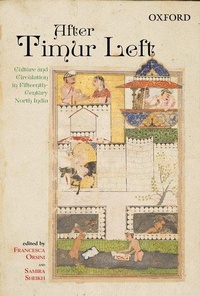
After Timur Left
Culture and Circulation in Fifteenth-Century North India
Published in December 2014
Book
Hardback
512 pages
978-0-19-945066-4 (ISBN)
Description
Timur invaded northern India in 1398 but returned to Samarkand a year later. In 1555 the Timurid emperor Humayun came back to India after being forced into exile in Persia and re-established Mughal rule in northern India. Between these two significant dates stretches an era largely consigned to oblivion-the 'long' fifteenth century.
The Mughal dynasty has long occupied a pre-eminent position in research on Indian history. It has also been credited with ushering in a radically new age of innovation in art, literature, and statecraft. But what of the period before the Mughals?
With the empire-centred study of history privileging periods of political centralization, the multi-centred fifteenth century has remained relatively unexplored and undervalued.
After Timur Left presents a path-breaking interdisciplinary set of writings on the politics, languages, religions, literatures, and arts of the fifteenth century. Together they reveal it to be a period of considerable political and social mobility, of cultural connectivity and consolidation, of innovation in literature and language choices, and of new forms of religious organization and expression.
The Mughal dynasty has long occupied a pre-eminent position in research on Indian history. It has also been credited with ushering in a radically new age of innovation in art, literature, and statecraft. But what of the period before the Mughals?
With the empire-centred study of history privileging periods of political centralization, the multi-centred fifteenth century has remained relatively unexplored and undervalued.
After Timur Left presents a path-breaking interdisciplinary set of writings on the politics, languages, religions, literatures, and arts of the fifteenth century. Together they reveal it to be a period of considerable political and social mobility, of cultural connectivity and consolidation, of innovation in literature and language choices, and of new forms of religious organization and expression.
Reviews / Votes
After Timur Left will stimulate new research on this neglected era; it should certainly be read by everyone with a serious interest in pre-colonial North India. * Cynthia Talbot, South Asia *More details
Language
English
Place of publication
New Delhi
India
Product notice
sewn/stitched
Cloth over boards
Illustrations
11 colour images, 2 b/w
Dimensions
Height: 239 mm
Width: 150 mm
Thickness: 43 mm
Weight
703 gr
ISBN-13
978-0-19-945066-4 (9780199450664)
Copyright in bibliographic data and cover images is held by Nielsen Book Services Limited or by the publishers or by their respective licensors: all rights reserved.
Schweitzer Classification
Persons
Francesca Orsini is Professor of Hindi and South Asian Literature at the School of Oriental and African Studies, University of London.
Samira Sheikh is Associate Professor of History at Vanderbilt University.
Samira Sheikh is Associate Professor of History at Vanderbilt University.
Content
Acknowledgements ; Note on Transliteration ; List of Plates and Figures ; 1. Introduction by Francesca Orsini and Samira Sheikh ; STATES, SUBJECTS, AND NETWORKS ; 2. After Timur Left: North India in the ; Fifteenth Century by Simon Digby ; 3. Bandag? and Naukar? : Studying Transitions in Political Culture and Service under the North Indian Sultanates, Thirteenth-Sixteenth ; Centuries by Sunil Kumar ; PUBLIC LANGUAGES ; 4. The Rise of Written Vernaculars: The Deccan 1450-1650 by Richard M. Eaton ; 5. Turki and Hindavi in the World of Persian: Fourteenth- and Fifteenth-Century ; Dictionaries by Dilorom Karomat ; 6. Local Lexis? Provincializing Persian in Fifteenth-Century North India by Stefano Pello ; 7. Languages of Public Piety: Bilingual Inscriptions from Sultanate Gujarat, c. 1390-1538 by Samira Sheikh ; TELLINGS OF KINGS, SUFIS, AND WARRIORS ; 8. Universal Poet, Local Kings: Sanskrit, the Rhetoric of Kingship, and Local Kingdoms in Gujarat by Aparna Kapadia ; 9.Warrior-Tales at Hinterland Courts in North India, 1370-1550 by Ramya Sreenivasan 242 ; 10. Emotion and Meaning in Mirigavati : Strategies of Spiritual Signification in Hindavi Sufi Romances by Aditya Behl ; CULTURAL SPACES AND LITERARY TRANSACTIONS ; 11. The Art of the Book in India under the Sultanates by Eloise Brac de la Perriere ; 12. Apabhramsha as a Literary Medium in Fifteenth-Century North India by Eva De Clercq ; 13. Early Hindi Epic Poetry in Gwalior: Beginnings and Continuities in the R?m?yan of Vishnudas by Imre Bangha ; 14. Traces of a Multilingual World: Hindavi in Persian Texts by Francesca Orsini ; Bibliography ; About the Editors and Contributors ; Index