

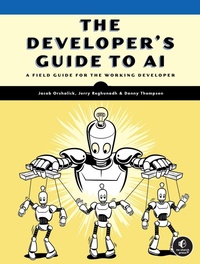
The Developer's Guide to AI
A Field Guide for the Working Developer
Published on 9. June 2026
Book
Paperback/Softback
336 pages
978-1-7185-0476-9 (ISBN)
Description
Working developers everywhere now use AI tools, but most still struggle to turn prompts and prototypes into reliable software features. The Developer's Guide to AI teaches engineers how to build real, maintainable AI capabilities using the tools they already know-JavaScript, Python, APIs, vector search, and simple agent workflows without advanced math or machine learning. Readers learn where AI belongs in an application, how to design around real-world constraints like latency and cost, and how to avoid the brittle prototypes that fail under changing requirements. With clear examples and production-focused patterns, this book helps developers ship AI features that last.
More details
Language
English
Place of publication
San Francisco
United States
Target group
Professional and scholarly
Product notice
Paperback (trade)
Dimensions
Height: 234 mm
Width: 180 mm
Thickness: 25 mm
Weight
591 gr
ISBN-13
978-1-7185-0476-9 (9781718504769)
Copyright in bibliographic data and cover images is held by Nielsen Book Services Limited or by the publishers or by their respective licensors: all rights reserved.
Schweitzer Classification
Persons
Jacob Orshalick has over 20 years in software development as an independent consultant for startups and Fortune 500 companies, leading high-impact projects and speaking regularly at conferences.
Jerry Mannel Reghunadh is a senior director with over 20 years in tech, spanning QA, product innovation, and solution architecture. He is known for mastering complex concepts and making them accessible.
Danny Thompson is a director of technology who works with Fortune 500 companies, teaches software developers worldwide, and hosts The Programming Podcast.
Jerry Mannel Reghunadh is a senior director with over 20 years in tech, spanning QA, product innovation, and solution architecture. He is known for mastering complex concepts and making them accessible.
Danny Thompson is a director of technology who works with Fortune 500 companies, teaches software developers worldwide, and hosts The Programming Podcast.
Content
Acknowledgments
Preface
Introduction
PART I: GETTING STARTED WITH AI
Chapter 1: Understanding Large Language Models
Chapter 2: Building Your First LLM-Powered Application
Chapter 3: Python Essentials for LLMs and APIs
PART II: PROMPT ENGINEERING
Chapter 4: Fundamentals of Prompt Engineering
Chapter 5: Prompt Engineering Techniques
Chapter 6: Prompt Engineering in Code
PART III: VECTOR DATABASES AND RAG
Chapter 7: Vector Databases in Practice
Chapter 8: Designing a Retrieval-Augmented Generation System
PART IV: ADAPTING MODELS TO REAL-WORLD TASKS
Chapter 9: Why and When to Customize a Model
Chapter 10: Preparing Data for Fine-tuning
Chapter 11: Fine-Tuning Models in Practice
PART V: BUILDING AGENTIC SYSTEMS
Chapter 12: From Workflows to Autonomous Agents
Chapter 13: Building an Autonomous Agent
Chapter 14: Extending Agents with Tools
Afterword
Index
Preface
Introduction
PART I: GETTING STARTED WITH AI
Chapter 1: Understanding Large Language Models
Chapter 2: Building Your First LLM-Powered Application
Chapter 3: Python Essentials for LLMs and APIs
PART II: PROMPT ENGINEERING
Chapter 4: Fundamentals of Prompt Engineering
Chapter 5: Prompt Engineering Techniques
Chapter 6: Prompt Engineering in Code
PART III: VECTOR DATABASES AND RAG
Chapter 7: Vector Databases in Practice
Chapter 8: Designing a Retrieval-Augmented Generation System
PART IV: ADAPTING MODELS TO REAL-WORLD TASKS
Chapter 9: Why and When to Customize a Model
Chapter 10: Preparing Data for Fine-tuning
Chapter 11: Fine-Tuning Models in Practice
PART V: BUILDING AGENTIC SYSTEMS
Chapter 12: From Workflows to Autonomous Agents
Chapter 13: Building an Autonomous Agent
Chapter 14: Extending Agents with Tools
Afterword
Index