

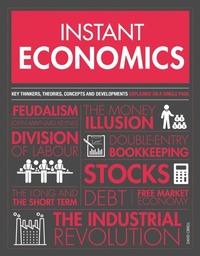
Instant Economics
Key Thinkers, Theories, Discoveries and Concepts
Will be published approx. on 18. February 2021
Book
Paperback/Softback
176 pages
978-1-78739-419-3 (ISBN)
Description
Instant Economics pulls together all the pivotal economic knowledge and thought into one concise volume. Each page contains a discrete 'cheat sheet', which tells you the most important facts in bite-sized chunks, meaning you can become an expert in an instant.
From Adam Smith to Karl Marx, taxation to debt crisis, and inequality to economic freedom, every key figure, discovery, controversy and concept is explained with succinct and lively text and graphics.
Perfect for the knowledge hungry and time poor, this collection of graphic-led lessons makes economics interesting and accessible. Everything you need to know is here.
From Adam Smith to Karl Marx, taxation to debt crisis, and inequality to economic freedom, every key figure, discovery, controversy and concept is explained with succinct and lively text and graphics.
Perfect for the knowledge hungry and time poor, this collection of graphic-led lessons makes economics interesting and accessible. Everything you need to know is here.
More details
Language
English
Place of publication
United Kingdom
Publishing group
Headline Publishing Group
Target group
College/higher education
Professional and scholarly
Product notice
Paperback (UK-trade)
Illustrations
250 illus
Dimensions
Height: 237 mm
Width: 189 mm
Thickness: 20 mm
Weight
505 gr
ISBN-13
978-1-78739-419-3 (9781787394193)
Copyright in bibliographic data and cover images is held by Nielsen Book Services Limited or by the publishers or by their respective licensors: all rights reserved.
Schweitzer Classification
Other editions
Additional editions
E-Book
08/2021
Welbeck
€3.99
Available for download
Person
David Orrell is an applied mathematician and author of several books on economics, including Introducing Economics: A Graphic Guide, and Behavioural Economics (forthcoming).
Content
Introduction * What is economics? * What does an economist do? * What is wealth? * Ancient economics * Scholastic economics * Feudalism * Islamic economics * Double-entry bookkeeping * Mercantilism * The Industrial Revolution * Adam Smith * The invisible hand * Classical economics * Karl Marx * The marginal revolution * Neoclassical economics * Alfred Marshall * Carl Menger * Marginal productivity * Inflation * Deflation * The money illusion * Rational economic man * The corporation * Preferences * Diminishing marginal utility * Demand * Supply * Elasticities * The law of supply and demand * Equilibrium * Price controls * Indifference curve * Consumer budget * Economic surplus * Deadweight losses * Opportunity cost * Perfect competition * Efficiency * Market failure * Monopoly * Monopsony * Externalities * The Great Depression * Keynes * Propensity * The multiplier * The long and the short term * Neoclassical synthesis * Milton Friedman * Chicago school * The mainstream consensus * The macroeconomy * Investment * Interest rates * Gross domestic product (GDP) * Consumption * Economic growth I - classical theory * Division of labour * Comparative advantage * Thomas Malthus * The steady-state economy * Monetary policy * Bonds * Yield curve * Credit rating * Debt * Taxes * The economics of death * Price index * Negative interest rates * Fiscal policy * Neoliberalism * International trade * Bilateral balances * Development economics * Randomized control trials * Private property * The commons * Markets * Free market economy * Communism * The fall of the Berlin Wall * Mixed economy * The IMF and World Bank * Labour * The role of government * Economic model * William Petty * Laissez-faire economics * Leon Walras * The Pareto principle * The IS-LM model * The Phillips curve * Expected utility theory * Prisoner's dilemma * The Arrow-Debreu model * The representative agent * DSGE model * Econometrics * The unpredictable economy * Integrated climate-economy models * History of money * The two sides of money * Tally sticks * Gold and silver * Paper money * Fiat money * Fractional reserve banking * Central banks * Money creation by banks * Hyperinflation * Debt and deficits * Modern Monetary Theory * Quantitative easing * Basic income * Rates of exchange * The euro * Credit cards * Cryptocurrency * Neoclassical growth model * Creative destruction * The business cycle * Human capital * New Growth Theory * Promoting economic growth * Securities * Stock * Modern portfolio theory * Random walks * Efficient market hypothesis * Options * Hedge funds * Black-Scholes * Derivatives * Value at risk * Financial services industry * The Great Financial Crisis * Post-crisis economics * Behavioural economics * Cognitive biases * Prospect theory * Behavioural finance * Complexity economics * Systems dynamics * Agent-based models * Evolutionary economics * Quantum economics * Land * Inequality * Thomas Piketty * Limits to growth * Climate change economics * Alternatives to GDP * Instability * Hyper-globalization * Power * Gender * Tax evasion * Ethics * Glossary and Further Reading.