

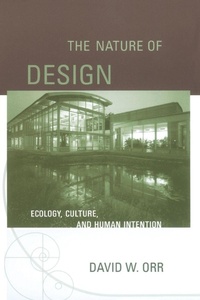
The Nature of Design
Ecology, Culture, and Human Intention
Published on 28. October 2004
Book
Paperback/Softback
248 pages
978-0-19-517368-0 (ISBN)
Description
The environmental movement has often been accused of being overly negative--trying to stop "progress." The Nature of Design, on the other hand, is about starting things, specifically an ecological design revolution that changes how we provide food, shelter, energy, materials, and livelihood, and how we deal with waste.
Ecological design is an emerging field that aims to recalibrate what humans do in the world according to how the world works as a biophysical system. Design in this sense is a large concept having to do as much with politics and ethics as with buildings and technology.
The book begins by describing the scope of design, comparing it to the Enlightenment of the 18th century. Subsequent chapters describe barriers to a design revolution inherent in our misuse of language, the clockspeed of technological society, and shortsighted politics. Orr goes on to describe the critical role educational institutions might play in fostering design intelligence and what he calls "a higher order of heroism."
Appropriately, the book ends on themes of charity, wilderness, and the rights of children. Astute yet broadly appealing, The Nature of Design combines theory, practicality, and a call to action.
Ecological design is an emerging field that aims to recalibrate what humans do in the world according to how the world works as a biophysical system. Design in this sense is a large concept having to do as much with politics and ethics as with buildings and technology.
The book begins by describing the scope of design, comparing it to the Enlightenment of the 18th century. Subsequent chapters describe barriers to a design revolution inherent in our misuse of language, the clockspeed of technological society, and shortsighted politics. Orr goes on to describe the critical role educational institutions might play in fostering design intelligence and what he calls "a higher order of heroism."
Appropriately, the book ends on themes of charity, wilderness, and the rights of children. Astute yet broadly appealing, The Nature of Design combines theory, practicality, and a call to action.
Reviews / Votes
"David Orr backs his talk with tactics and deeds that include his own actions. He convinced Oberlin College to construct a science building that 'did not impair human or ecological health somewhere else or at some later time.' That was a big order and not easily done, but he attracted and organized the multi-talented team that did it.... The chapter labeled 'Education, Careers, and Callings' is particularly fine, and presents...solid suggestions for doable changes in education that will be considered radical by many ecologically illiterate educators, but are certainly the way to go. Good stuff, easily read." --J. Baldwin, Whole Earth, Fall 2002 "The creativity of thought displayed is refreshing when compared to the hundreds of texts that criticise current practice without offering substitutes. And Orr's understanding of the role pysical surroundings play in human thinking inspires a vital alternative to the technological fundamentalism constricting so much current thought."--EcologistMore details
Language
English
Place of publication
New York
United States
Target group
Professional and scholarly
Dimensions
Height: 210 mm
Width: 140 mm
Thickness: 15 mm
Weight
345 gr
ISBN-13
978-0-19-517368-0 (9780195173680)
Copyright in bibliographic data and cover images is held by Nielsen Book Services Limited or by the publishers or by their respective licensors: all rights reserved.
Schweitzer Classification
Other editions
Additional editions
E-Book
10/2004
1st Edition
OUP eBook
€27.49
Available for download

E-Book
04/2002
1st Edition
OUP eBook
€27.49
Available for download
Person
David W. Orr is Professor and Chair of the Environmental Studies Program at Oberlin College. He is the author of Ecological Literacy and Earth in Mind, as well as more than 100 published articles. Among other awards, he has received a Lyndhurst Prize Fellowship and the National Wildlife Federation's National Achievement Award.
Content
I. THE PROBLEM OF ECOLOGICAL DESIGN ; II. PATHOLOGIES AND BARRIERS ; III. THE POLITICS OF DESIGN ; IV. DESIGN AS PEDAGOGY ; V. CHARITY, WILDNESS, AND CHILDREN